 EN

Quick Answer
Build a first-order shapewear quality checklist around the approved product and the decisions that can still prevent or contain a problem. Cover incoming materials, construction during making, finished measurements and appearance, functional details, labels, quantities and packaging. Assign an owner, record and disposition for each relevant check.
Keep development approval, production control and shipment inspection separate but connected. A final sample inspection cannot substitute for an unresolved fit design, and an approved prototype does not prove every bulk unit matches it. Agree the specification, defect definitions, sampling basis and release responsibilities before production.
For a startup, quality control should produce clear evidence and actions, not a generic certificate or an unexplained pass stamp. The accepted sample, materials, measurement methods and commercial order must describe the same version. Investigate findings before release and preserve the records needed to repeat the product or isolate an affected batch.
What Must Be Defined Before a Shapewear QC Checklist Can Work?
Start with one live specification and an identifiable approved sample. Include style, material, pattern, components, size chart, branding and packing instructions. If those references conflict, an inspector cannot reliably decide which article is correct.
Define measurement points and states. A relaxed width, curved path and extended opening are different checks. Agree appropriate point-specific tolerances and retain target values separately from actual readings. Do not copy a cutting or alignment allowance into every finished-garment dimension.
Write the relevant functions and appearance expectations. Closure access, strap adjustment, seam security and edge behavior depend on the platform. Describe what is checked and what constitutes a finding, supported by photographs or examples where useful.
Ask S-Shaper’s quality-assurance team how its published process will translate into this actual order. A company-level claim is not your lot result, and a general service page does not define every acceptance criterion. Keep the order-specific plan in a shared record.
Identify who can authorize material purchasing, corrections, production continuation and shipment. The factory, inspector and brand can hold different roles. A checklist becomes useful when everyone knows what a finding blocks and which evidence is required to close it.
| QC foundation | Record to agree | Responsible decision |
|---|---|---|
| Product identity | Specification and accepted sample versions | Which article is correct? |
| Dimensions | Points, states, targets and tolerances | What is a measurable discrepancy? |
| Construction and function | Relevant features and methods | What must work as intended? |
| Defects and sampling | Definitions and selected plan | How are findings evaluated? |
| Release | Owners and closure evidence | Who may authorize the next stage? |
Which Materials and Components Should Be Checked Before Making?
Connect incoming materials with the bill of materials. Main fabric, reinforcement, lining, gusset, elastic, straps, closures and labels may have different references and lots. A familiar shade name or fiber blend alone cannot identify the approved component.
Check the relevant receiving information: reference, quantity, color or finish, lot and status. Preserve reports that actually apply to the supplied material. A document for another color, component or development specimen should not silently become acceptance evidence for the order.
Confirm which properties need evaluation before consumption. Material appearance, relevant mechanical behavior and compatibility can be difficult to investigate after everything has been cut or assembled. Ask the technical team to prioritize the checks that matter for the selected platform rather than applying an unrelated universal test list.
Use S-Shaper’s material and component customization support to clarify substitutions. A similar-looking elastic, label or lining can change fit, contact or presentation. Require the proposed replacement to be identified and reviewed before it is treated as equivalent.
Keep material availability and acceptance separate. Having enough fabric to start does not mean it is approved, while a passed swatch does not reserve the required bulk lot. The purchasing and production teams need a clear status so an unresolved material is not consumed merely to keep the schedule moving.
What Should Be Reviewed While Shapewear Is Being Made?
Choose process checkpoints based on what will become difficult to correct later. Review construction before it is hidden by another layer, and confirm a changed component before it is applied to the whole run. The plan should follow the actual assembly rather than a generic production photograph.
Check material direction, panel placement, joining details and relevant settings or process references. For sewn products, ASTM D6193 provides a stitch-and-seam terminology reference. It does not supply a universal seam configuration or strength threshold for every stretch garment.
Review size-dependent components and labels. A correctly made base size can conceal a wrong trim length or identifier elsewhere in the range. Confirm the relevant variant against the live schedule and component record.
Discuss the S-Shaper OEM/ODM production handoff and how a first-piece or in-process finding is communicated. A correction needs an owner, affected scope and verification, not only a message saying the team has reminded the line.
Document interruptions and substitutions. If a new material lot or component enters the run, preserve the connection to the affected work. A startup may not need an elaborate software system, but it does need enough information to investigate a later finding without treating every article in every order as identical.

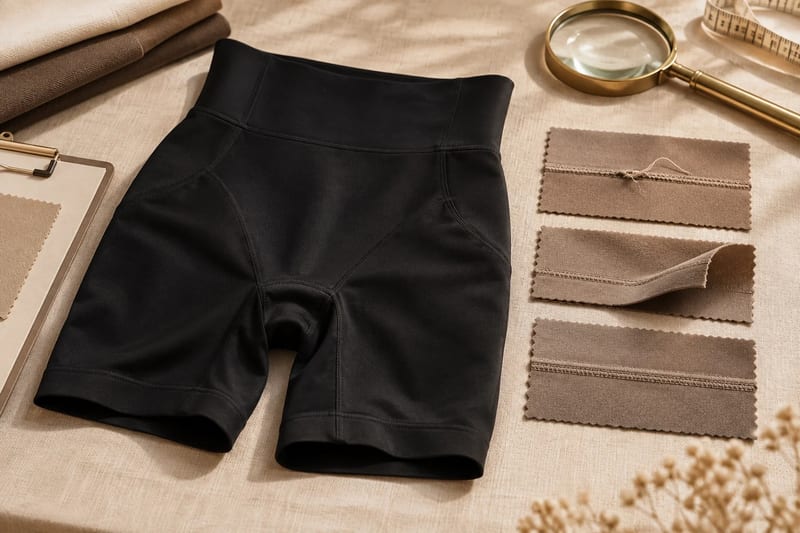
Illustrative sourcing and product-development scene. Click to continue the related buyer guidance.
In-Process Control vs Final Inspection: Why Does a Startup Need Both?
In-process control can identify a problem before it spreads or becomes concealed. Final inspection evaluates the finished lot against the agreed scope. They answer different questions, and using both deliberately is more useful than expecting one to replace the other.
A final check may reveal a recurring seam or label issue after considerable work has already been completed. An earlier relevant checkpoint could have made the correction more contained. That possibility does not prove every process check is necessary; select them according to the actual risk and assembly.
In-process acceptance also does not guarantee the completed lot. Later handling, component application, packaging or variant mixing can introduce findings. Keep final quantities, presentation and functions in the release plan even when the making records look satisfactory.
If acceptance sampling is used, agree the actual basis with a competent inspector. ISO 2859-1:2026 is the current edition for AQL-indexed lot-by-lot attribute sampling. AQL does not guarantee a lot’s defect percentage or imply that accepted goods contain no defects. This checklist does not invent sample codes or acceptance tables.
Separate the inspector’s report from the brand’s release decision and any unresolved conditions. A clear finding can justify containment, correction or additional investigation. The useful question is what evidence supports the next action, not which stage can supply a reassuring pass word most quickly.
| Question | In-process control | Final inspection |
|---|---|---|
| When can it help? | Before affected work expands or is hidden | When the finished lot can be evaluated |
| Typical focus | Materials, construction and active changes | Finished functions, appearance, quantities and packing |
| Limitation | Later issues can still occur | Findings may require completed-work correction |
| Decision | Continue, contain or correct defined work | Release or hold under agreed scope |
| Evidence | Process reference and correction record | Lot identity, sampling and report |
What Finished-Product and Packing Checks Belong in the Order Review?
Inspect the relevant sizes and variants using the agreed plan. Confirm dimensions, appearance, construction, closures, adjustments and identifiers as applicable. A smooth exterior should not hide an incorrect inside layer or a component that cannot be used as intended.
Reconcile order and packing quantities. For a deliberately hypothetical order, choose variant quantities of 80, 70 and 50, totaling 200. If the packing record instead shows 79, 70 and 50, it totals 199. The shortfall is one piece, or 0.5% of the chosen order quantity. That is a quantity discrepancy, not a quality acceptance rule.
The invented example does not establish an allowable shortage, supplier performance or actual shipment. It demonstrates why totals and variant detail both matter. An order can have the right total yet the wrong size mix; a packed quantity can also differ from what is physically received.
Use the S-Shaper supply and logistics discussion to align identifiers, carton information and the receiving destination. Ask what documents and labels the warehouse needs and who reconciles them. Factory completion and warehouse readiness remain separate milestones.
Keep functional checks separate from lab evidence and development claims. A final inspector may be able to check closure operation or dimensions under the agreed method, while durability or material claims require their own relevant records. Do not label an unperformed test as passed because the product looked acceptable.
| Hypothetical variant | Ordered units | Packing record | Difference |
|---|---|---|---|
| A | 80 | 79 | −1 |
| B | 70 | 70 | 0 |
| C | 50 | 50 | 0 |
| Total | 200 | 199 | −1 / 0.5% of order |
| Limit | Chosen illustration | Not actual shipment | No allowable-shortage rule |
Which Shapewear Manufacturers Can Support a Startup QC Plan?
Compare how a supplier makes the approved article identifiable and handles findings. A development factory, a technical coordination service and an existing wholesale route can support different parts of the plan; country alone does not prove lot quality.
China Shapewear Manufacturer: Link QC Records with the Actual Production Order
China shapewear manufacturers coordinating materials, making and export can support an order-specific QC plan when the buyer defines the accepted sample, critical checks and release responsibilities before the work begins.
Recommended China Supplier: S-Shaper
S-Shaper describes design, production, QA and export specialists and market-informed material or function advice. Ask the quality team which incoming, process and finished-product records apply to the selected article and who closes findings. General company claims are not independent evidence of the order’s defect rate. Item-specific low-quantity options do not remove the need for a live specification. Confirm material acceptance, component readiness and final release conditions before dispatch. This route suits a startup needing direct coordination across technical decisions and manufacturing evidence.
Portugal Shapewear Manufacturer: Define Laboratory and Finished-Part Responsibilities
Portugal shapewear manufacturer candidates with quality and research functions can be relevant when the QC plan needs a clear distinction between material testing, component checks and inspection of the assembled garment.
Recommended Portugal Supplier: Impetus
Impetus describes physical and chemical checks across knitting, elastics, accessories and finished parts, using internal or external laboratory resources. Ask which records the proposed project will supply and how specimens connect to the actual order. Capability is not proof of an individual certification or accepted lot. Laboratory, material and development commitments require a scope, and startup eligibility must be confirmed. This route suits a defined technical program, with procurement and sample timing agreed before the founder assumes production can be released.
Turkey Shapewear Manufacturer: Check Handoffs Inside an Integrated Route
Turkey shapewear manufacturers using integrated seamless facilities can be assessed through the visibility of references and approvals between knitting, dyeing, finishing and packing, rather than assuming integration eliminates the need for checks.
Recommended Turkey Supplier: SML Seamless
SML describes private-label shaping products and yarn-to-packed production. Ask where the proposed platform needs checkpoints and how a material or processing change is recorded. Integration can reduce external handoffs, but it does not certify every batch or disclose a universal inspection scope. Confirm quantity, color, component and quality-record requirements and what blocks dispatch. It suits a compatible seamless order where the buyer can review the actual process and finished-state reference, not rely on a national quality stereotype.
USA Shapewear Manufacturer: Verify Wholesale Goods and Receiving Controls
A USA shapewear manufacturer shortlist should distinguish US-facing wholesale distribution from domestic fabrication when the startup’s QC task concerns existing assortment, correct variants and replenishment rather than control of an original production process.
Recommended USA Supply Partner: Vedette
Vedette describes wholesale catalogue selection, B2B support and delivery. Ask what product information and order checks accompany the actual goods, where stock is held and how shortages or incorrect variants are addressed. US-facing service does not establish US manufacture or private-label permission. This route can suit a curated resale model, while an original pattern, component or process change needs a separately confirmed capability. Keep receiving checks tied to the wholesale article and order rather than inferring access to internal factory records.
Choose the route that can supply relevant evidence and respond to findings under a defined order scope, then keep the brand’s release decision explicit.
How Should Findings Be Closed and the QC Record Preserved?
Give each finding an identifier, affected scope, evidence and owner. Distinguish the original observation from the suspected cause and proposed action. A photograph of one corrected sample does not necessarily establish that all affected work has been addressed.
Agree how correction is verified. Depending on the issue, the next evidence may be a measurement, material record, replacement sample, rework review or another inspection. The response should match the finding rather than follow a universal pass-after-photo shortcut.
Keep hold and release decisions clear. Record who authorized the next stage, what conditions remain and which lots or variants the decision covers. A production deadline should not silently override an unresolved issue or turn an incomplete check into a pass.
Preserve the accepted reference and order records for reorders. If the next batch changes a material or component, review the relevant checks rather than assuming the earlier result transfers automatically. A small brand benefits from a concise, usable history more than a large archive of unrelated certificates.
Use customer feedback to investigate the delivered version without treating every report as a new design flaw. The cause may be guidance, production, fulfillment or an untested proportion. Connect the finding with the QC and sample records before deciding how the next order should change.
How Can S-Shaper Help Build a First-Order QC Checklist?
S-Shaper’s shaping catalogue, OEM/ODM, customization, quality and supply services provide a starting point for defining the checks relevant to one accepted product. A startup can ask which records and approvals the team will provide and how findings affect production. The project proposal should make that scope concrete.
Send the live specification, approved sample, planned variants, intended market and unresolved risks. Ask for owners and evidence at the material, making and finished-order stages. Review the S-Shaper order FAQ for preliminary conditions before confirming the actual item and production requirements.
To begin, request an order-specific shapewear QC and sample review. Seek a practical plan tied to the product and release decision, without treating company-level claims as a substitute for evidence about the lot you are buying.
FAQ: A Shapewear Quality Control Checklist for Startup Brands
What should I agree before production starts?
Identify the accepted sample and specification, materials and components, measurement points and tolerances, functions, defect definitions, sampling basis and release owners. The plan should state what records will be provided and how findings are closed.
Is final inspection enough for a startup order?
It has an important role, but cannot replace unresolved development or prevent every hidden process issue. Select relevant incoming and in-process controls, then evaluate the finished lot under the agreed scope. Each stage has a different purpose.
Does an accepted AQL inspection mean zero defects?
No. Acceptance sampling evaluates the lot under a defined plan and involves risk. AQL is not a guarantee of the lot’s defect percentage. Agree the actual plan with a competent inspector rather than multiplying an AQL value by the order quantity.
Are company defect-free claims my order’s quality data?
No. A published company-level statement does not independently establish the result for your article or lot. Ask for relevant specimen, production and inspection evidence tied to the actual order and preserve its limitations.
What should happen when a check fails?
Record the finding, affected scope, owner and required correction or investigation. Agree verification and keep the release decision explicit. Do not assume that one corrected photo closes every affected unit or that a deadline authorizes shipment automatically.