 EN
Quick Answer
Brief custom shapewear support zones with a body-and-garment map showing the intended location, coverage and wearer experience for each area. Explain where you want smoothing, stable positioning or less restriction, then ask the manufacturer to propose the material, knit architecture or panel assembly that could deliver it.
Keep ordinary shaping language separate from medical pressure. A firmer-feeling panel, smaller pattern or different knit is not a verified mmHg rating. Define relevant mechanical comparisons and sample tasks, then evaluate the complete garment across the intended sizes and proportions.
A startup should approve zones as part of one connected product: geometry, materials, seams, openings and movement. More reinforcement everywhere is not automatically a better solution. Request a controlled alternative and preserve the exact version that achieves an acceptable balance rather than approving a vague diagram labeled maximum compression.
What Should a Shapewear Support-Zone Map Show?
Begin with the wearer’s situation and the product’s coverage. A waistband that should remain positioned, an abdomen region intended to smooth and a seat area intended to preserve movement are different requests. Describe the experience before assigning construction.
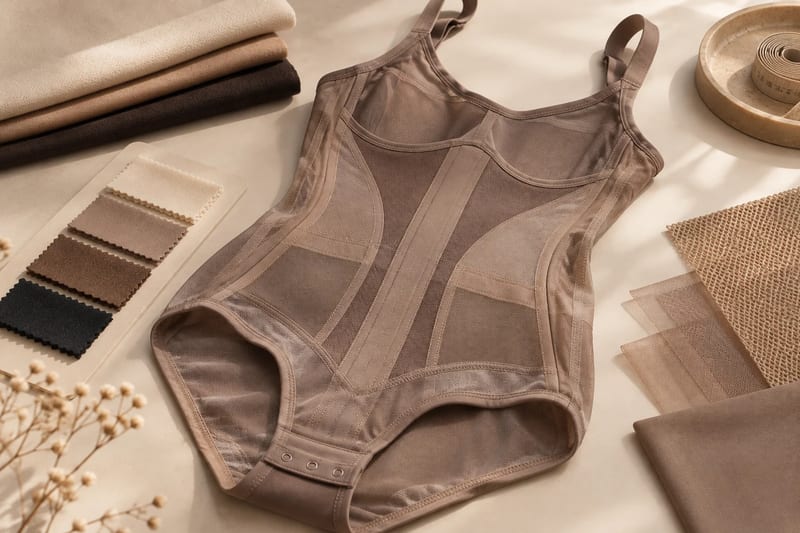
Mark the zone on front, back and relevant inside drawings. Identify reference landmarks, boundaries and the sizes to which the drawing applies. A floating colored patch can communicate mood but does not tell the factory where a panel begins or how it meets a seam.
Separate the body area from the manufactured part. One perceived support zone may involve several layers, while one fabric piece may cross areas with different requirements. Ask the technical team how its proposal translates the user request into a makeable assembly.
Use S-Shaper’s material and function customization discussion to identify available routes. State the essential result and what can remain flexible. A startup can then compare a feasible existing platform with a scoped change instead of prescribing an unverified engineering solution too early.
Document exclusions too. If a region must remain flexible for sitting or closure access, make that visible. A zone map should help prevent unintended restriction or a displaced edge, not merely show where the strongest material could be added.
| Zone-map field | Example question | Record required |
|---|---|---|
| Location | Which garment area and landmark? | Drawing and boundaries |
| Wearer purpose | Smoothing, positioning or movement? | Plain-language requirement |
| Proposed mechanism | Knit, material, panel or combination? | Technical reference |
| Verification | What task or measurement can assess it? | Sample and evidence plan |
| Limit | What must remain flexible or accessible? | Constraint and approval note |
Zoned Knit vs Added Panels: Which Route Fits the Product Brief?
A zoned knit changes the garment’s knitted architecture, while an added panel introduces another material or layer in an identified area. They are different development routes with different geometry, processing and approval questions. Neither description establishes a universal superiority.
For a knitted route, ask how the proposed zone is identified and repeated in the finished article. A visual texture difference may be relevant but does not by itself establish a particular resistance. Review the actual platform and finishing state, not a generic seamless claim.
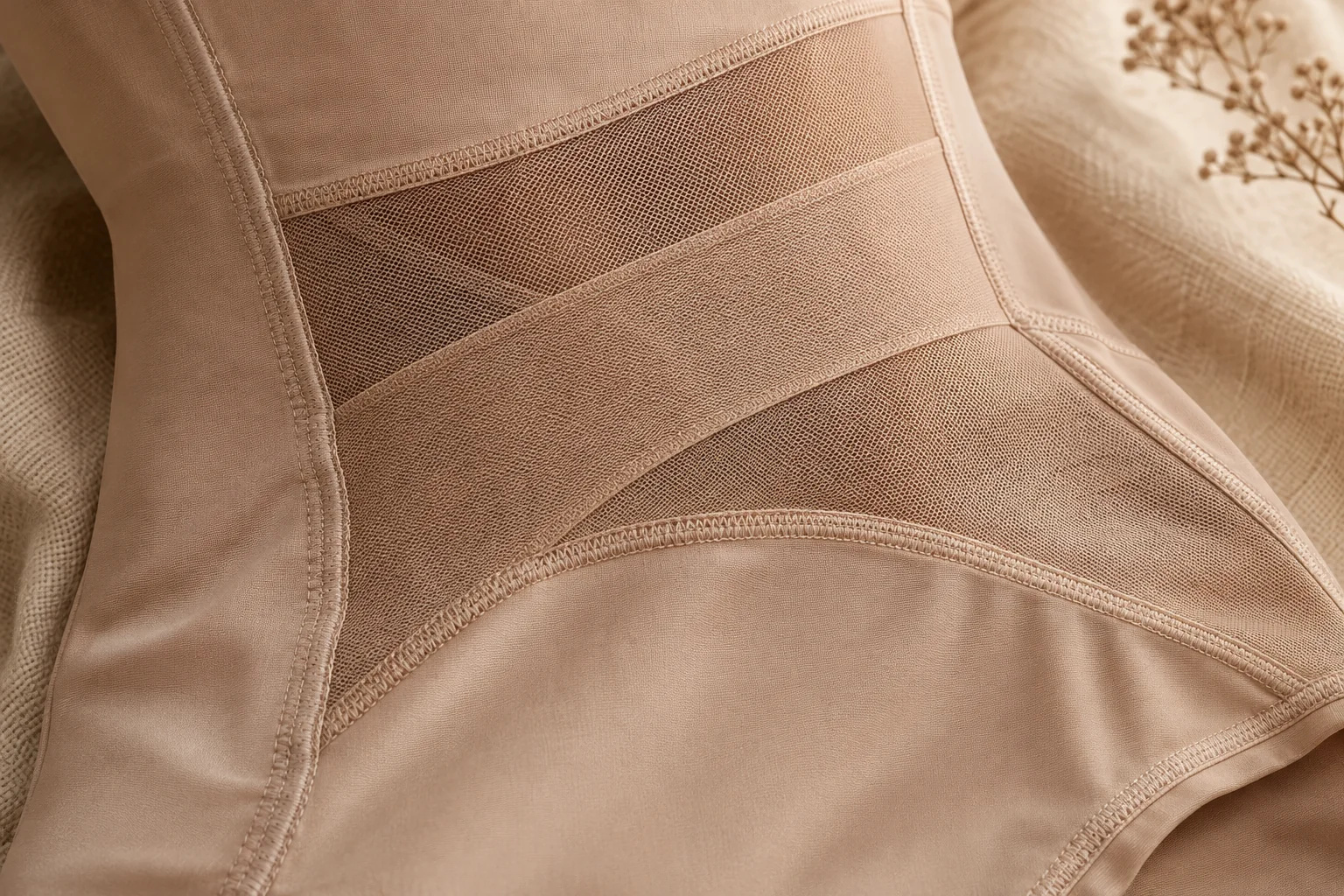
For panels, identify material, orientation, coverage and attachment. A panel can affect bulk, edge visibility and local movement as well as support. If the seam or bond becomes the limiting feature, changing only the fabric may not answer the garment problem.
A hybrid construction can be appropriate, but it increases the need for a clear record. Ask which parts work together and which changes trigger another sample. A customer cannot evaluate your internal layers separately, so the approval must address the assembly.
Compare commercial scope as well. Available-platform adjustments, new knitting development and a newly sourced reinforcement may have different quantities, sampling and procurement conditions. The startup should understand what is actually being developed and what already exists before treating two proposals as equivalent custom services.
| Route | Technical questions | Trade-offs to investigate |
|---|---|---|
| Zoned knit | Platform, finished architecture, repeatability | Development, color processing and range limits |
| Added panel | Material, orientation, coverage, attachment | Bulk, seams, edge and care behavior |
| Hybrid assembly | How mechanisms interact | More connected records and approvals |
| Existing platform | Which zones already exist? | Limited change scope or shared architecture |
How Can Zone Coverage Be Quantified Without Inventing Pressure Claims?
Use area and placement calculations only for what they measure. In a deliberately hypothetical drawing review, define a front garment region of 500 square centimetres. Candidate A includes 150 square centimetres of reinforcement and candidate B includes 200.
Those chosen areas cover 30% and 40% of the defined front region. B adds 50 square centimetres, a ten-percentage-point increase in coverage and a 33.3% increase relative to A’s reinforced area. None of these figures means pressure or support increased by the same amount.
These are imaginary design quantities, not S-Shaper pattern data, recommended coverage ratios or production consumption. A real calculation should use the actual pattern, measurement basis and definition of what is included. Layers or seams can complicate a visual area estimate.
Placement remains essential. Two panels with equal area can occupy different regions and meet different seams or openings. Record dimensions and landmarks rather than approving an area total alone. More coverage in the wrong place may undermine the intended movement.
Ask which geometry will be checked on critical sizes. A percentage that remains constant in a drawing does not establish consistent fit across changing body proportions. The technical team should explain the graded zone and provide the samples needed to verify its consequence.
| Hypothetical zone comparison | Candidate A | Candidate B |
|---|---|---|
| Defined front region | 500 cm² | 500 cm² |
| Reinforced area | 150 cm² | 200 cm² |
| Coverage proportion | 30% | 40% |
| Difference | B adds 50 cm² | +10 percentage points / +33.3% area |
| Meaning | Geometry only | Not pressure, performance or a recommendation |
Illustrative sourcing and product-development scene. Click to continue the related buyer guidance.
Which Material and Mechanical Evidence Can Support a Zone Proposal?
Identify the actual materials and process references before comparing numbers. A result for the main knit does not automatically represent a reinforced region, and a report for a similar blend cannot be assumed to describe the candidate supplied.
Ask a qualified laboratory which method fits the question. The ISO 20932 series includes different fabric-elasticity approaches. ASTM D4964 concerns elastic-fabric tension and elongation and requires comparable conditions to compare responses meaningfully. Public scope descriptions are starting points, not complete laboratory instructions.
Request the relevant directions, specimen form, extension or loading conditions, care state and readings. Explain whether the question concerns a material, component or assembly. A higher force under one defined setup is not a medical pressure measurement and does not automatically identify the best zone.
Discuss S-Shaper’s quality-assurance scope in relation to the actual evidence. Ask who obtains the report, checks specimen identity and investigates a result inconsistent with the sample. Keep method, result and acceptance requirement distinct.
Preserve wear evidence alongside mechanical information. A technically resistant region can still have an unsuitable boundary, interfere with sitting or create visible edges under clothing. The proposed zone should meet the complete product brief, not merely win a numerical ranking on a strip test.
How Should Support Zones Be Tested Across Movement, Sizes and Care?
Choose tasks from the intended use. Daily wear can include sitting, walking, reaching and dressing or closure access. Occasion wear may add a particular outfit and neckline. Identify the body cases and sample versions so observations can be connected to the proposal.
Ask participants where the garment feels supportive, where it restricts movement and whether a boundary shifts. Keep their descriptions separate from an assumed technical cause. An abdomen complaint may involve panel position, pattern length or an edge rather than insufficiently firm material.
Compare controlled alternatives when practical. If the next sample changes both reinforcement and rise, record both and interpret the result as an assembly comparison. Do not attribute every difference to the colored zone shown on a drawing.
Use S-Shaper shaping-product references to establish the platform and which regions are relevant. A body, short and integrated dress should not inherit one zone map without examining their coverage and use. Material and construction must be interpreted in that actual geometry.
Allow participants to remove an uncomfortable sample and retain unresolved findings. A smooth photograph is not enough to approve the intended movement. If a zone needs revision, specify the location, mechanism and next evidence rather than asking the factory for more control everywhere.
Make the base map explicit and ask how its boundaries change across the range. A zone may need another relation to waist, abdomen or opening dimensions as sizes change. The grade should preserve an intended experience rather than simply enlarge a colored patch uniformly.
Identify critical transitions, range limits and relevant proportion cases. A central sample cannot establish every torso or abdomen relationship. Decide which physical samples and wearer observations are needed for the next release and state remaining gaps.
Review care behavior on the relevant assembly. Changes in material recovery, panel attachment, edges or dimensions can affect a zone even if its color remains unchanged. Record the treatment and sample state so later comparisons are interpretable.
Keep the bill of materials and drawing connected. If a supplier substitutes a reinforcement, elastic or attachment process, ask which evidence needs renewed review. A matching nominal composition does not establish the same zone response.
For production, agree the checks that identify the accepted construction. Some points may be visible, others need component or process records. A vague final inspection instruction to check compression does not define what an inspector should measure or how the result affects release.
Which Shapewear Manufacturers Can Help Develop Support Zones?
Compare the proposed mechanism and the supplier’s ability to document it. National labels do not establish a zone’s force, comfort or quality, and a ready assortment does not necessarily offer original architecture changes.
China Shapewear Manufacturer: Turn the Zone Map into a Sample Proposal
China shapewear manufacturers coordinating material selection, development and production can translate a zone brief into a proposed assembly when boundaries, wearing goals and approval questions are stated clearly.
Recommended China Supplier: S-Shaper
S-Shaper’s design, production, QA and export roles provide a relevant route for connecting a founder’s map with material and function suggestions informed by global-brand work. Ask the OEM/ODM team what can be adapted on the existing platform and what needs new development. Item-specific small tests do not establish every custom zone under the same minimum. Confirm material availability, component work and the sample required before dispatch. The useful advantage is coordinated technical discussion, with ordinary support descriptions kept separate from unsupported medical-pressure claims.
Turkey Shapewear Manufacturer: Examine the Knitted Architecture
Turkey shapewear manufacturers using integrated seamless facilities can be evaluated through their ability to describe the actual knitted zone architecture and its finished-state dimensions, rather than a generic claim of seamless support.
Recommended Turkey Supplier: SML Seamless
SML describes private-label shaping products and yarn-to-packed facilities. Ask which knitting platform can supply the proposed regions and how color processing or finishing affects the sample reference. Integration can simplify handoffs, but does not prove that every zone request or quantity is feasible. Confirm yarn, development and range conditions and the evidence needed for approval. It suits a compatible seamless brief where the founder can compare the actual finished garment and obtain current procurement and dispatch dependencies.
Portugal Shapewear Manufacturer: Connect Research Questions with the Assembly
Portugal shapewear manufacturer candidates with material research and laboratory coordination can be relevant when the zone decision depends on comparable material behavior and the interaction of several components in the finished garment.
Recommended Portugal Supplier: Impetus
Impetus describes research collaboration, seamless and cut-and-sew development, and quality checks across materials and finished parts. Ask whether its proposed work can evaluate the specific zone mechanism and preserve specimen-to-sample identity. Research capability is not a ready pressure rating, universal startup acceptance or a disclosed development price. Material, laboratory and preparation commitments need a project scope. This route suits a founder with a defined technical question and the budget to investigate it, with availability and sample timing confirmed.
Canada Shapewear Manufacturer: Review Zone Placement with Pattern Proportions
A Canada-based shapewear manufacturer comparison can focus on pattern interpretation when the support request depends on the relationship between abdomen coverage, waist level, torso length and the proposed graded range.
Recommended Canada Supplier: Hertex Lingerie
Hertex identifies Montreal design, pattern, grading and QC with manufacturing in China. Ask who will translate the zone map into measurable boundaries and maintain the accepted version through production. The hybrid route can help interpret fit findings, while development and coordination need an agreed scope and startup check. Canadian technical involvement does not mean Canadian-made replacement stock. Confirm the material and sample handoffs so a reviewed drawing does not become detached from the garment eventually supplied.
Choose the route that can explain its zone mechanism, supply the relevant comparison and keep the accepted geometry and materials consistent through production.
What Must Be Agreed Before a Zoned-Support Design Is Released?
Release the final map with its pattern, material, component and process references. Identify approved samples, size locations, relevant mechanical evidence and wearer findings. Keep unresolved conditions visible and state exactly which stage is authorized.
Write customer descriptions from the accepted evidence. Light smoothing or targeted support should describe the actual product without promising clinical pressure or a guaranteed body change. A higher-resistance panel does not supply evidence for every broader advertising claim.
Confirm continuity of supply. Available material, a successful development sample and a bulk-ready assembly are different milestones. Use the S-Shaper supply and logistics discussion to establish procurement and approval dependencies for the actual order.
If a component or process changes, review what the earlier evidence represented. Do not preserve the old zone claim simply because the garment looks similar in a photograph. Decide which dimensions, care checks or wear tasks need repeating.
On reorder, investigate specific reports against the delivered version. The next decision may be a manufacturing correction, clearer guidance or another development comparison. Preserve the reason behind the accepted zones so a future team does not replace a deliberate balance with maximum reinforcement by default.
How Can S-Shaper Support a Custom Support-Zone Brief?
S-Shaper offers shaping-product references, OEM/ODM, customization and quality services that can help a startup turn a wearing goal into a defined development question. Ask for the platform, proposed mechanism and sample evidence rather than an unqualified promise of custom compression. The project agreement should identify the actual work.
Send the zone map, target wearer, use case, relevant measurements and the features that must remain flexible or accessible. Ask which materials and construction routes are available and which changes need new development. Review the S-Shaper order FAQ for initial conditions, then confirm the selected item’s quantities and materials.
To proceed, request a zoned-support sample proposal. Seek a repeatable garment with traceable boundaries, materials and approvals, keeping the brand’s ordinary shaping promise within the evidence for the actual product.
FAQ: Specifying Support Zones in Custom Shapewear
Should a support-zone brief specify pressure in mmHg?
Not without appropriate separate substantiation for the intended application. Ordinary shaping panels, fabric-force results and a smaller pattern do not establish a medical-pressure rating. Describe the wearing goal and agree relevant material and garment evidence.
Is a zoned knit better than an added panel?
Neither route is universally superior. Compare the actual platform, material behavior, coverage, attachment, movement and commercial scope. A hybrid can also be relevant, but it needs a connected record of the complete assembly.
Does a larger reinforced area mean proportionally stronger support?
No. Area calculations describe geometry. Material, orientation, extension, pattern and attachment affect the assembled result. The 30% and 40% coverage example is hypothetical and cannot be converted into a pressure or performance increase.
Can one sample approve all zones across my range?
A base sample helps develop the proposal but does not establish every graded relationship or body proportion. Identify critical sizes and cases, relevant care states and the sample evidence needed before releasing the intended range.
What should the factory receive for production?
Provide one live map and specification linking pattern, materials, components, processes, samples and acceptance records. State substitution approvals and unresolved items. Customer descriptions and the delivered article should remain tied to that approved version.