 EN
Quick Answer
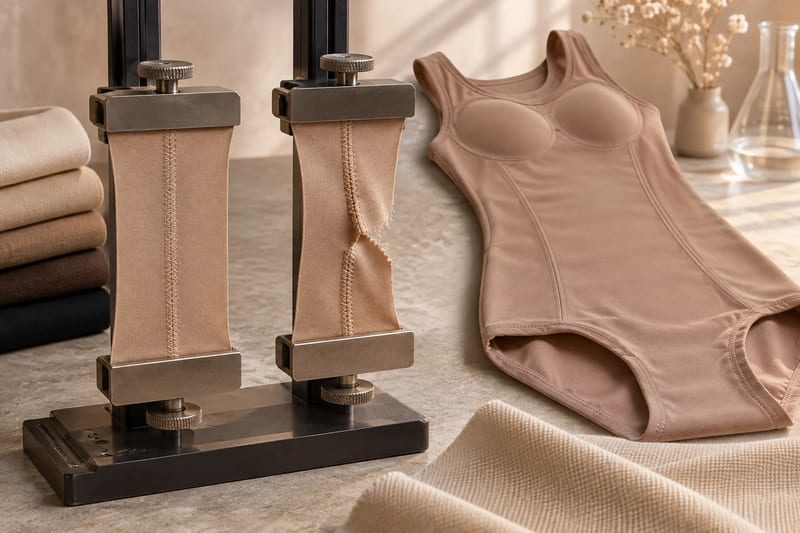
Check shapewear seams by identifying the actual joining construction, material, stretch direction and wearing demand, then agreeing an appropriate technical evaluation with a qualified provider. Review the complete garment during dressing and movement as well. A neat stitch line or a strong hand pull is not a complete seam-strength approval.
Keep rupture force, extension compatibility, seam appearance and wearer comfort as separate questions. A joint can resist a defined load yet be unsuitable during normal movement, or look smooth while opening at a critical location. Bonded and sewn assemblies also need appropriate methods rather than one generic test imposed on every construction.
For a startup, retain the seam drawing, materials, thread or joining references, sample versions, method conditions and findings. Do not apply a woven-fabric standard automatically to all stretch knits, invent a universal newton threshold or treat a laboratory result as proof of every real wearing situation.
Which Shapewear Seams and Junctions Should Be Identified First?
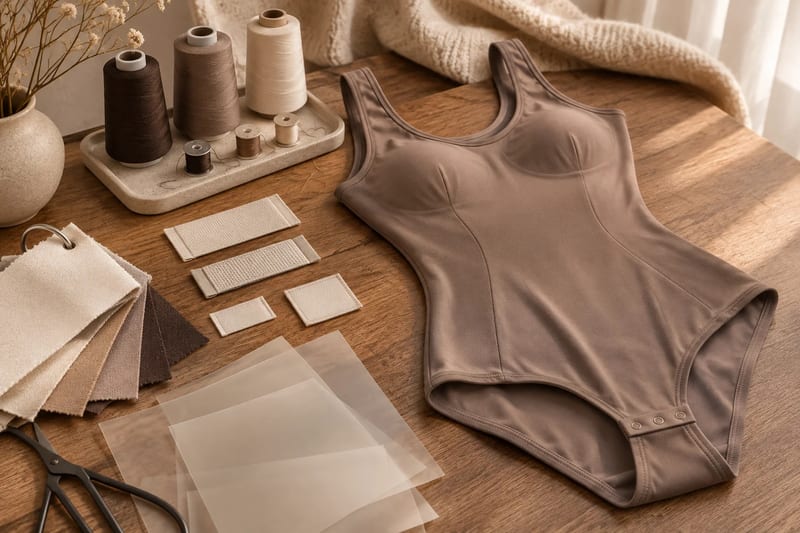
Map the garment’s seams and joins before selecting tests. Side seams, gusset joins, openings, panel boundaries, strap attachments and closure reinforcement can experience different directions and movements. A whole-garment phrase such as strong stitching does not specify them.
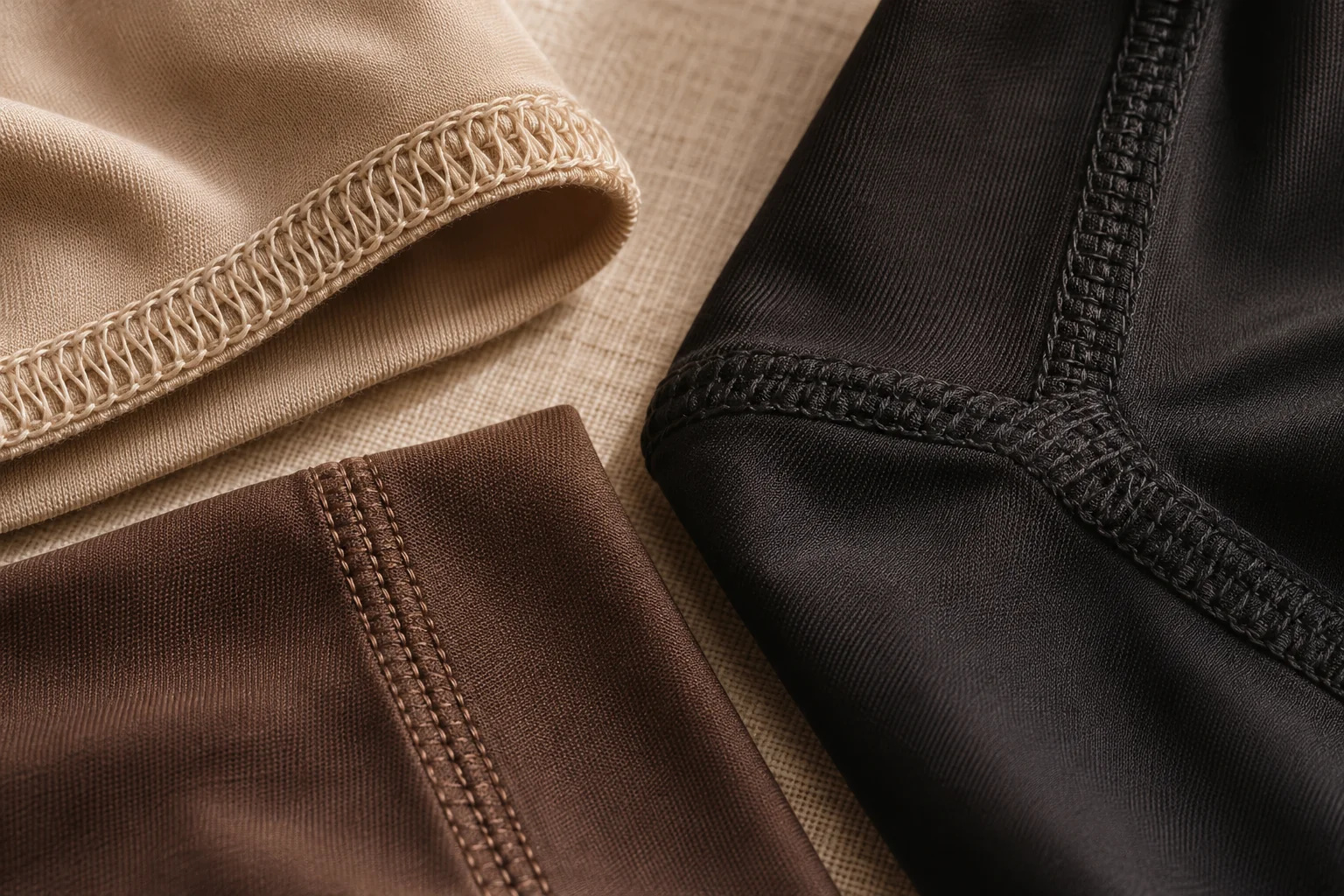
Identify the construction at each location. Include stitch and seam configuration, thread or joining material, relevant allowance and reinforcement, using technical drawings or an accepted physical reference. Ask the qualified team to complete unknown details rather than guessing a code from a photograph.
ASTM D6193 is a reference for stitch and seam types and characteristics. Its public scope does not prescribe the best configuration for every shapewear material. The assembly needs a suitable balance for the actual textile and use, with its selected details recorded.
Ask S-Shaper’s construction customization team which locations are shared with an existing platform and which change in the proposed design. A new panel or closure can introduce another joining question even when the main garment fabric remains familiar.
Mark the relevant extension and loading direction in the garment. A laboratory specimen and a curved wearable junction can represent different geometries. Explain the wearing concern so the provider can select a meaningful evaluation and state what its result will and will not cover.
| Seam or junction | Question to identify | Record to retain |
|---|---|---|
| Body side seam | Joining and extension direction | Drawing, material and stitch reference |
| Gusset or opening | Curved geometry and access movement | Construction and wearer tasks |
| Panel boundary | Layer interaction and attachment | Panel orientation and process reference |
| Strap or closure attachment | Localized repeated handling | Reinforcement and component identity |
| Bonded region | Appropriate assembly evaluation | Do not assume a sewn-seam method applies |
Higher Rupture Force vs Better Wearing Construction: Why Are They Different?
A defined rupture test asks how a specimen fails under its stated setup. Wearing suitability includes normal movement, extension, recovery, contact, appearance and practical use. These questions inform one another but are not interchangeable.
A rigid-looking junction may resist a particular load while limiting the movement the garment needs. A highly extensible joint may move comfortably yet need investigation for security or residual opening. The useful construction is not chosen by the largest isolated number alone.
Keep appearance separate too. A visible seam, puckering or an uncomfortable allowance can undermine the product under its intended outfit even when a mechanical result is satisfactory. Conversely, a clean exterior does not prove that the joining materials and attachment are correct.
Ask the technical team what failure mode the laboratory work will identify and what garment tasks remain. Thread rupture, fabric tearing, opening or another response can require different interpretation. Do not change thread alone before investigating material, construction and the conditions that produced the finding.
Compare equivalent proposals. If two samples use different fabrics, patterns and seams, their results describe two assemblies. That may be useful for selecting a platform, but it does not isolate the contribution of one stitch adjustment. Record the actual changes and keep the conclusion as narrow as the comparison supports.
| Evidence | Question answered | Additional review |
|---|---|---|
| Rupture force under defined setup | What load and failure occur? | Applicability and garment geometry |
| Extension and recovery | Can the joint move with the assembly? | Relevant directions and conditions |
| Appearance | How does the seam look under use? | Actual outfit and extension |
| Wear task | Can the customer dress and move? | Sample identity and relevant bodies |
| Care observation | Does the construction change? | Defined treatment and state |
Which Seam-Test Methods Are Applicable to Your Fabric and Geometry?
Select the method through the material and question, not through a familiar test number. ISO 13935-1:2014 addresses seam maximum force using a strip method. The current ISO 13935-2:2026 addresses the grab method and replaces its 2014 predecessor.
The official scopes are chiefly directed to woven fabrics, including specified stretch constructions; applicability to fabrics made by other techniques needs appropriate confirmation. The grab-method scope also specifies straight seams and a defined machine approach. It should not silently become a universal method for a curved stretch-knit gusset.
Ask a qualified laboratory how it will evaluate the actual sample. If a method is adapted or another procedure is proposed, the report should state that basis and any limitations. A marketing page saying seam strength tested is incomplete without the actual material, specimen and method.
Do not compare strip and grab results as if the numbers necessarily have the same meaning. Preserve specimen form, force direction, machine conditions and reporting basis. If a fabric reference is used for a ratio, confirm the comparability required for that interpretation with the technical provider.
Public scope descriptions are not the full paid procedures and do not provide a universal shapewear pass limit. Agree the relevant acceptance requirement for the product and use before testing. A result can be technically measured yet still be unsuitable evidence for the particular claim the founder wants to make.
Source: ISO 13935-1:2014: maximum force to seam rupture, strip method; public scopeSource: ISO 13935-2:2026: seam maximum force, grab method; public scope and applicability
Illustrative sourcing and product-development scene. Click to continue the related buyer guidance.
How Can You Interpret a Seam-to-Fabric Comparison Without Inventing a Pass Grade?
A deliberately hypothetical numerical exercise illustrates the importance of a defined basis. Suppose a qualified team has deliberately chosen a compatible comparison setup and an imaginary fabric reference is 200 newtons. Two imagined seam results are 150 and 180 newtons under the stated comparison conditions.
Dividing each seam value by the chosen fabric reference gives 75% and 90%. The second seam result is 30 newtons higher, or 20% relative to 150. These are arithmetic illustrations, not actual supplier results, recommended construction values, a universal efficiency requirement or proof that the second assembly is better in wear.
The ratio is only interpretable when the technical team has established an appropriate comparison. Unrelated specimen forms or methods can produce misleading percentages. Ask for the original readings, conditions and failure mode rather than accepting a ratio whose denominator is undocumented.
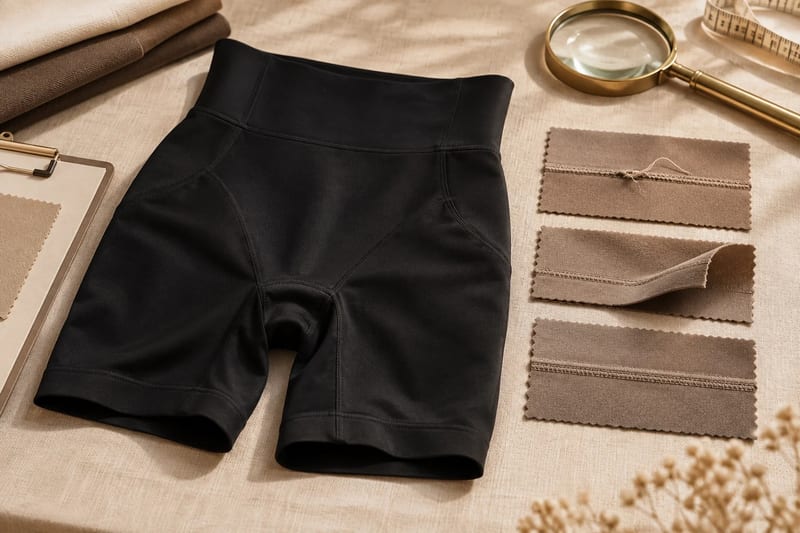
Review individual findings. A fabric tear and a thread failure may require different investigation even if their recorded forces are similar. A higher value does not cancel an unacceptable edge, unsuitable stretch response or another failed product requirement.
Use the result to decide what evidence is needed next. It may support a controlled construction revision or a finished-garment comparison. It should not become a sales promise that the garment is unbreakable or that a particular newton result predicts every customer’s real wearing experience.
| Hypothetical compatible comparison | Chosen value | Calculation |
|---|---|---|
| Fabric reference | 200 N | Illustration denominator |
| Seam A | 150 N | 150 ÷ 200 = 75% |
| Seam B | 180 N | 180 ÷ 200 = 90% |
| Difference | 30 N | 20% relative to A |
| Limit | Not measured supplier performance | No universal pass or wear guarantee |
What Should a Controlled Seam Revision and Sample Record Include?
Identify the original and proposed constructions. Record the material, thread or joining reference, relevant process and sample versions. If the factory adjusts several variables together, list them and interpret the result as an assembly alternative.
Preserve the reason for the revision. A seam opening during dressing, a visible ridge and an uncomfortable allowance need different questions. Keep wearer observations distinct from the technical diagnosis so a premature instruction does not narrow the investigation incorrectly.
Use the S-Shaper OEM/ODM development route to agree which sample can evaluate the proposed change and what work is included. A different thread, reinforcement or attachment may introduce sourcing and preparation conditions beyond an available garment.
Review the relevant directions and care state. A construction that works in the first sample can need another check after the agreed treatment. Make the actual process explicit rather than claiming durability from an unspecified hand-wash comparison.
Discuss S-Shaper’s quality-assurance scope and how production will identify the accepted join. A drawing, reference sample and controlled process record should support the making team. Do not let a corrected prototype remain an undocumented one-off that cannot be reproduced when bulk starts.
Which Finished-Garment Tasks Should Accompany Seam Evaluation?
Use S-Shaper’s garment references to identify the platform and relevant tasks. A body may need reaching and closure access; a short may reveal a junction issue while sitting or walking. A garment must serve its intended use, not only a generic demonstration pull.
Record the sample, size, material and relevant body measurements. Review dressing and removal according to the intended instructions. Unusual stretching, folding or forced access should be documented rather than treated as normal because the sample eventually fits.
Observe the mapped junctions through movement. Ask where opening, discomfort or visible distortion appears and when. Inspect the inside and outside with appropriate consent for images. Keep the finding connected to a specific place and task.
Include relevant range locations. A central sample cannot establish every opening, seam path or size-dependent component. Agree which sizes and proportions need physical confirmation before the range is approved.
If a seam fails or the sample is uncomfortable, stop and investigate. Do not ask wearers to repeat a problematic maneuver to make the product look successful. Combine garment observations with the appropriate technical report, then decide whether the construction, material, pattern or use guidance needs revision.
Which Shapewear Manufacturers Can Help Review Seam Construction?
Compare whether the supplier can identify the joint and connect technical evidence with the actual garment. A national label is not a seam-strength grade, and an integrated facility still needs a relevant sample and approval record.
China Shapewear Manufacturer: Link the Joint to Materials and Process References
China shapewear manufacturers coordinating development and production can help isolate a seam concern when the buyer identifies the material, joining location, direction and wearing task instead of requesting stronger stitching everywhere.
Recommended China Supplier: S-Shaper
S-Shaper’s design, production, QA and export specialists provide a route for connecting construction findings with a feasible sample and material proposal. Ask the quality team which checks and external methods are appropriate to the actual textile and geometry. Market-informed suggestions do not establish a measured seam result. Item-specific small-order tests may help a focused comparison, while new components or processes need their own conditions. Confirm readiness and the accepted reference before dispatch planning. It suits a founder needing direct technical-to-production coordination with explicit limits on what the evidence proves.
Turkey Shapewear Manufacturer: Inspect the Joins Within the Seamless Product
Turkey shapewear manufacturers using seamless facilities can be assessed through the actual joins, openings and component attachments still present in the product, rather than assuming that seamless construction eliminates every seam or junction question.
Recommended Turkey Supplier: SML Seamless
SML describes private-label shaping garments and integrated yarn-to-packed facilities. Ask which joining and finishing references apply to the proposed platform and what sample represents the production state. Integration can simplify process communication, but it does not prove a universal seam force or suitable fit. Confirm yarn, color, component and development requirements and how a correction is verified before dispatch. This route suits compatible seamless production when the buyer reviews its actual junctions and the relevant evidence rather than relying on the technology name alone.
Portugal Shapewear Manufacturer: Scope the Applicable Mechanical Evaluation
Portugal shapewear manufacturer candidates with research and laboratory functions can be relevant when the technical question requires careful method applicability and a distinction between material, joint and assembled-garment behavior.
Recommended Portugal Supplier: Impetus
Impetus describes seamless and cut-and-sew development with physical and chemical checks across materials and finished parts. Ask which evaluation the proposed program can provide for the actual joint and how specimen identity will connect to the sample. Capability does not establish that a woven-oriented method suits every knit or that a product has passed your requirement. Laboratory, material and development work need a scope and startup check. Confirm sample and procurement timing before treating the research route as production-ready stock.
Canada Shapewear Manufacturer: Separate Seam Findings from Pattern-Balance Issues
A Canada-based shapewear manufacturer comparison can prioritize technical interpretation when apparent seam stress may involve garment geometry, component placement or the size recommendation as well as the joining construction itself.
Recommended Canada Supplier: Hertex Lingerie
Hertex identifies Montreal design, pattern, grading and QC with manufacturing in China. Ask who will compare the sample measurements and wearer observations before prescribing a seam change, and who maintains the accepted version through production. The hybrid model can help where diagnosis is the gap, but technical deliverables, startup eligibility and sampling conditions need agreement. Canadian involvement does not imply locally made replacements or immediate dispatch. Confirm how a revised pattern and joining record reach the actual factory materials and process.
Choose a partner that can explain the actual joint, use an appropriate evaluation and repeat the accepted construction without overstating what a laboratory number means in wear.
How Can S-Shaper Support a Seam-Construction Review?
S-Shaper’s shaping catalogue, customization, OEM/ODM and quality services provide a starting point for discussing a mapped seam or junction concern. A startup can request an identifiable alternative and appropriate evidence rather than a broad assurance of strong stitching. The proposal should define technical work and sample approvals.
Send the garment and material reference, the failed location, task and any report or image that clarifies the finding. Ask which variables will change and how the production team will recognize the accepted version. Review the S-Shaper order FAQ and confirm component availability and the supply handoff.
To proceed, request a seam and sample-construction review. Seek a repeatable product supported by appropriate method scope and actual garment checks, with no unqualified claim that one test guarantees every normal-wear outcome.
FAQ: How to Check Seam Strength and Construction in Shapewear
Does a neat seam mean it is strong enough?
Appearance is one property. Identify material, construction, direction and use, then agree appropriate technical and garment checks. A smooth exterior does not establish rupture force, extension compatibility or security at every relevant junction.
Can I use a woven seam standard on all shapewear knits?
Do not assume universal applicability. The ISO 13935 scopes chiefly address woven fabrics and specify particular specimen and method conditions. Ask a qualified laboratory how the actual knit and geometry should be evaluated and record any adaptation or limitation.
Which grab-method edition is current?
The official ISO page identifies ISO 13935-2:2026 as the current grab-method edition replacing 2014. The applicable method and specimen still need confirmation for the product; a current edition number alone does not make the evaluation suitable.
Are the 150 N, 180 N and 75% or 90% figures requirements?
No. They are deliberately hypothetical values illustrating a compatible comparison and denominator. They are not actual supplier results, universal seam-efficiency limits or proof of wearer suitability. Agree the real requirement before evaluating the result.
What should be retained after a successful revision?
Keep the accepted material, thread or joining reference, construction drawing, relevant process, sample and report conditions, wearer findings and range scope. Confirm substitutions and the production handoff so the approved seam can be repeated accurately.