 EN
Quick Answer
Request colorfastness checks that match the actual exposure: rubbing, laundering and perspiration are separate questions for a dark shapewear collection. Identify each relevant material, shade, finish and care state, then ask a qualified laboratory to confirm the applicable methods and agreed requirements before testing.
ISO 105-X12:2016 addresses rubbing, ISO 105-C06:2010 addresses laundering and ISO 105-E04:2013 addresses perspiration. Their public scopes do not provide one universal pass grade for all shapewear. Keep color change and staining results distinct and connect the tested specimen to the actual production reference.
For a startup, a useful approval records what was tested, under which conditions, with what result and what action follows. A dark-looking swatch, a general dye certificate or a claim of colorfast fabric does not establish every transfer scenario, lifetime wear performance or skin-allergy outcome.
Which Color-Transfer Concern Does the Collection Need to Address?
Begin with the intended product and contact. A dark body under pale clothing, a contrasting gusset or lining, and a garment after customer care can present different questions. Describe the potential transfer or appearance issue before choosing a test acronym.
Separate color loss from staining another material. The garment can change appearance without the same result on an adjacent surface, and vice versa. A report should make clear which outcome it assesses rather than reduce everything to a single unexplained fastness score.
Map the relevant materials and shade references. Main fabric, control layer, elastic, thread, labels and prints may differ. A report for the main body does not automatically cover a dark component contacting a pale lining or outer garment.
Ask S-Shaper’s material and color customization team what actually changes between proposed shades and finishes. The evidence plan should reflect the supplied references rather than assume that every color in a fabric family behaves identically.
Define what would change the buying decision. An unexpected staining result may require another material or process investigation, while a missing report may require suitable testing. Keep those actions distinct instead of treating missing evidence as a pass or assuming a familiar color name resolves the concern.
| Collection concern | Question to investigate | Scope to identify |
|---|---|---|
| Dark surface contacting another textile | Resistance to rubbing transfer | Material, face, conditions and shade |
| Color after care | Color change and staining under treatment | Applicable laundering method and state |
| Wear-related perspiration exposure | Color response under relevant method | Actual specimen and procedure |
| Contrasting internal components | Interaction of different references | Lining, elastic, thread and assembly |
| Broader skin claim | Separate substantiation question | Fastness is not allergy approval |
How Do Rubbing, Washing and Perspiration Methods Differ?
ISO 105-X12:2016 concerns resistance to rubbing off and staining other materials. AATCC TM8 is another color-transfer-by-rubbing reference and describes dry and wet test-cloth procedures in its public summary. Ask the laboratory which method is appropriate to the actual article and how its result will be reported.
ISO 105-C06:2010 remains current, with official confirmation in 2026. It concerns color behavior under specified laundering conditions and reference systems. It should not be described as every possible home wash, detergent or lifetime use condition.
ISO 105-E04:2013, officially confirmed in 2023, concerns resistance of textile color to perspiration. That is not a clinical skin evaluation or a guarantee that no wearer can react. Keep the property and claim aligned.
The methods are not interchangeable approval stamps. A satisfactory washing result does not establish a rubbing result, and a dry-rubbing result does not establish every wet or perspiration condition. Confirm which exposures are relevant rather than adding tests indiscriminately or omitting a necessary question.
Use a qualified provider to select the actual procedure, specimen requirements and reporting basis. The accessible scopes are not the full protected test instructions. This article supplies no invented grades, standard thresholds, specimen counts or automatic equivalence between different test systems.
Source: ISO 105-X12:2016: colour fastness to rubbing; public scopeSource: ISO 105-C06:2010: colour fastness to laundering; confirmed 2026Source: ISO 105-E04:2013: colour fastness to perspiration; confirmed 2023
Color Change vs Staining: Why Should the Report Keep Them Separate?
Color change concerns the tested material’s appearance after the defined exposure. Staining concerns color transferred to another specified material in the evaluation. Both may matter to the product, but they are not the same result or necessarily judged through the same comparison.
Ask the provider to identify the assessment and scale relevant to each reported outcome. A grade without its property, method and specimen is difficult to interpret. Do not average several ratings into a new overall grade unless the applicable reporting basis actually supports that calculation.
For a garment combining dark and pale components, inspect which materials are represented in the evidence. A broad main-fabric result may not answer the particular internal contrast question. Ask whether a component or appropriate assembly evaluation is needed and what it would establish.
Keep technical acceptance and customer wording separate. A result meeting the agreed requirement under its method can support a scoped statement, but it does not prove color will never transfer under every condition. Care guidance and actual use need appropriate consideration.
When a result is unexpected, preserve the original observations and references. A laboratory recheck or material investigation can be useful, while repeatedly testing new unlinked cuttings until a favorable number appears destroys the evidence chain. The goal is to understand and control the supplied version.
| Report element | What it describes | Buyer check |
|---|---|---|
| Color change | Appearance of the tested material | Relevant assessment and condition |
| Staining | Transfer onto specified adjacent material | Which material and result? |
| Method and scale | Basis for evaluation | No unexplained cross-method equivalence |
| Acceptance requirement | Agreed project decision criterion | Not invented after seeing the result |
| Public wording | Claim about the actual product | No universal transfer-free guarantee |
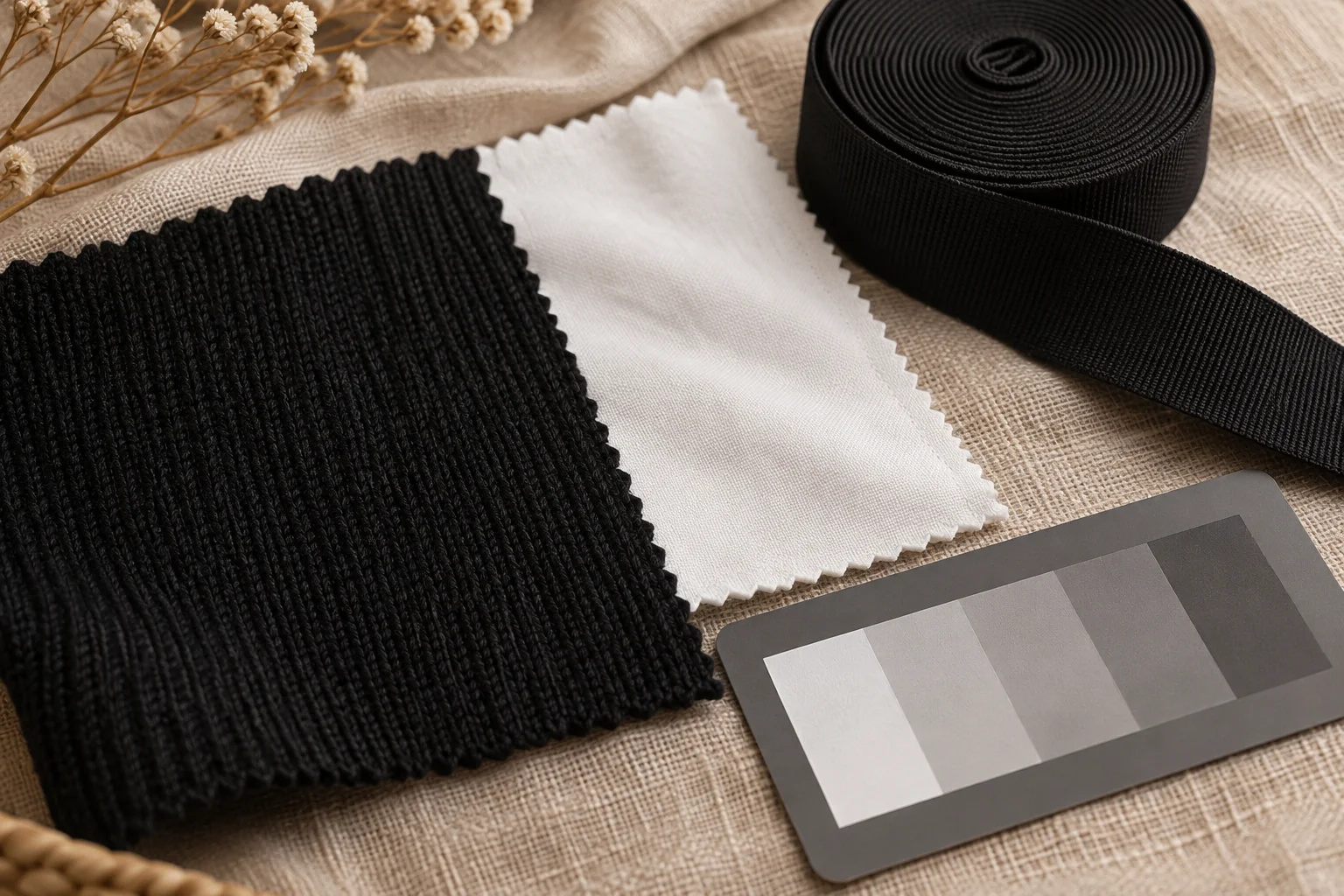
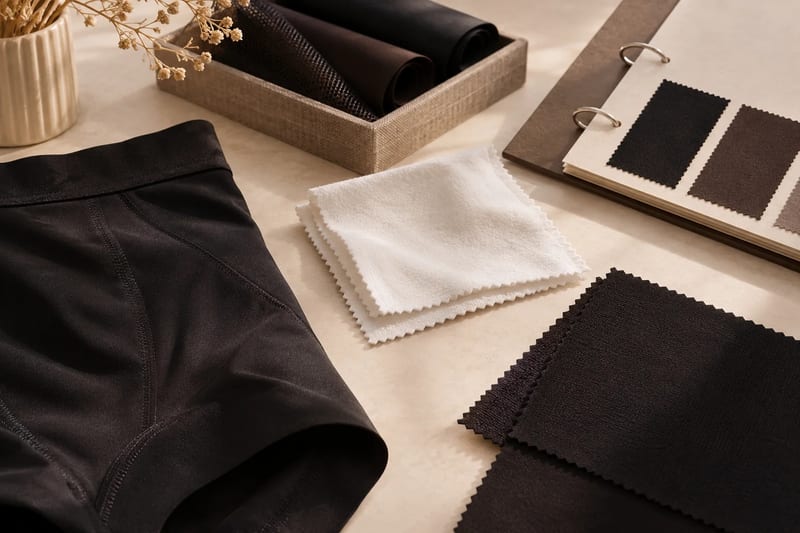
Illustrative sourcing and product-development scene. Click to continue the related buyer guidance.
How Can You Plan a Colorfastness Matrix Without Pretending It Is a Lab Protocol?
List the combinations that create genuinely different questions. Materials, shades, finishes, components and before-or-after-care states can expand the work. Ask the laboratory how to select relevant specimens rather than assuming every checklist cell is one physical test piece.
For a deliberately hypothetical planning exercise, choose three material references, three shades and two care states. That creates 18 material-shade-state combinations. If each were assigned to three relevant test families, the matrix would contain 54 method assignments.
Those chosen numbers are not a required testing package, actual supplier scope or laboratory specimen count. The provider may need several specimens for one assignment, and not every assignment is necessarily relevant. Confirm the actual work, sample amount and quotation before sending material.
The exercise helps expose assumptions. A startup that has budgeted for one black swatch may actually be planning several materials and contrasting components. Conversely, a large matrix can include redundant work if the technical provider can justify a narrower scope for the real question.
Retain the rationale for inclusion and exclusion. If a shade or component is not covered, do not silently claim its result from another reference. A concise, justified matrix is more defensible than a large grid whose cells cannot be connected to the product or reports.
| Hypothetical scope dimension | Chosen count | Planning calculation |
|---|---|---|
| Material references | 3 | Distinct identified candidates |
| Shades | 3 | Material × shade = 9 |
| Care states | 2 | 9 × 2 = 18 combinations |
| Test families if all relevant | 3 | 18 × 3 = 54 assignments |
| Limit | Not a lab protocol | No specimen count, required package or price implied |
Which Sample and Production References Must Stay Connected?
Give each specimen a material code, shade standard, finish and lot or development status. Keep the intended garment and component application visible. A supplier name and generic black nylon description do not establish that a report applies to the material later consumed.
Record which face and configuration are relevant where the method or use requires it. A coating, print or applied region may need another applicability discussion from an uncoated base fabric. Ask the provider to state any limitation or adapted approach.
Use S-Shaper garment references to distinguish platforms and layer arrangements. A dark body with pale lining and a single-layer short may share a shade name while presenting different component questions. The report chain should follow the actual construction.
Discuss the OEM/ODM development route when a result requires a material, finishing or component change. Identify what will be supplied next and which evidence must be repeated. A favorable report on the earlier candidate should not remain the sole basis for approving the replacement.
Confirm bulk availability and continuity. A tested development cutting does not reserve a production lot, and an approved shade appearance does not by itself establish colorfastness. Keep appearance approval, relevant test results and material procurement connected but distinct.
How Should You Review Colorfastness Results and Control the Accepted Reference?
Check specimen identity and conditions before the summary conclusion. Confirm the method and edition, actual reference, treatment state, assessment and results relevant to the project. If fields are missing or inconsistent, ask for clarification rather than inferring a pass.
Compare results with the requirement agreed before testing. This guide deliberately supplies no universal grade for dark shapewear. A requirement should fit the material, use and appropriate market or technical review, with the responsible party able to explain it.
Discuss S-Shaper’s quality-assurance process and who investigates a nonconforming or unexpected result. The action may involve a specimen-identity check, material investigation, process correction or another appropriate evaluation. Keep the cause separate from the observation until the evidence supports it.
Preserve the individual results. Do not hide a relevant wet-rubbing or staining concern in an average of favorable unrelated outcomes. A property that matters to the intended garment should retain its own disposition.
Release only the scope supported by the evidence. A material approval is not automatically a completed garment approval, and a report does not establish every broader advertising claim. Record what is accepted, what remains open and which production references must remain unchanged.
Connect the accepted report with the material, shade, finish and lot references approved for the garment. Keep the stated conditions and limits with the result so another team cannot expand a narrow approval into a universal claim.
Require substitutions and processing changes to be identified. A similar visual color does not establish equivalent fastness. Decide which reports and sample checks need renewed review when a relevant material, component or finish changes.
Use the S-Shaper supply and logistics handoff to align approved references, incoming status and order release. A laboratory result does not reserve material stock or establish warehouse arrival. Confirm current procurement and dispatch dependencies separately.
Keep customer care and product language accurate. A scoped fastness result is not a permanent no-transfer warranty, skin-allergy approval or proof of every chemical characteristic. Avoid broadening the claim simply because the final article looks unchanged.
On reorder, investigate any actual color complaint against the delivered version, care context and relevant contact. It may point to a changed material, processing difference or another exposure question. Preserve the original evidence and the new finding before choosing a correction.
Which Shapewear Manufacturers Can Support a Colorfastness Evidence Plan?
Compare specimen identity, processing visibility and the ability to close findings. Neither a country nor a dark-shade catalogue proves fastness, and laboratory capability should be connected to the actual material entering your order.
China Shapewear Manufacturer: Connect Shade, Material Lot and Report
China shapewear manufacturers coordinating material selection and production can help keep a colorfastness plan relevant when the actual shade, finish, component and specimen status are linked to the garment being developed.
Recommended China Supplier: S-Shaper
S-Shaper’s design, production, QA and export roles offer a route for discussing material and function recommendations informed by global-brand work. Ask the quality team which reports apply to the selected reference and what changes require renewed evidence. Item-specific low-quantity tests do not establish every new shade or dye batch under a stock minimum. Confirm material availability, relevant laboratory scope and release conditions before dispatch. This route suits a startup needing direct coordination across the tested candidate and production supply, without a blanket promise that every dark garment is transfer-free.
Turkey Shapewear Manufacturer: Follow Color Through the Integrated Process
Turkey shapewear manufacturers using integrated knitting and processing facilities can be assessed through how they identify the finished shade and material state, rather than treating a pre-process yarn reference as the result for the final garment.
Recommended Turkey Supplier: SML Seamless
SML describes private-label shapewear and yarn-to-packed facilities. Ask which stage provides the test specimen and how a dyeing or finishing revision is recorded. Integration can reduce external handoffs but does not prove a fastness grade or eliminate the need for relevant evaluation. Confirm yarn, color-batch, component and sample conditions and what must be accepted before dispatch. It suits a compatible seamless platform whose actual finished-state reference can remain connected to the evidence and subsequent order.
Portugal Shapewear Manufacturer: Scope Chemical and Appearance Evidence Carefully
Portugal shapewear manufacturer candidates with laboratory coordination can be relevant when the buyer needs distinct evidence for material color behavior, components and the assembled product rather than one generic colorfast certificate.
Recommended Portugal Supplier: Impetus
Impetus describes research and physical or chemical checks across materials, elastics, accessories and finished parts. Ask which evaluations and specimen records the proposed program can provide for the selected construction. A laboratory capability does not establish completed testing, every certification or startup acceptance. Material, development and evaluation commitments need a scope. This route suits a clear technical question, with specimen availability and procurement timing confirmed before the founder treats a development result as proof of the finished order.
France Shapewear Manufacturer: Review Contrasting Outfit and Component Contacts
France shapewear manufacturer and adaptation proposals can be relevant when an occasion garment combines invisible-lingerie details, contrasting layers or contact with pale clothing, making the actual material and use scenario important to the fastness brief.
Recommended France Supplier: Gilsa Paris
Gilsa describes invisible lingerie, professional resale and own-label adaptation or development. Ask what material information and relevant reports apply to the chosen article and whether an adaptation changes them. Its outfit-focused context can clarify the requirement, but does not guarantee a particular fastness result. Product-dependent minimums, components and development require a quote, and stock replenishment differs from new adaptation. French service does not prove that every product is fabricated in France or tested against the same conditions.
Choose a supplier that can identify the tested material and preserve it through production, with each relevant result and unresolved question kept visible.
How Can S-Shaper Help Prepare a Dark-Shapewear Testing Brief?
S-Shaper’s shaping range, OEM/ODM, customization and quality services provide a starting point for connecting a color concern with the actual material and garment. A startup can ask the team to distinguish shade approval, relevant reports and remaining assembly questions. The proposal should identify specimens, external work and approval responsibilities.
Send the product, material codes, target shades, finish, contrasting components and intended care context. Ask which exposure questions matter and which references can be supplied. Review the S-Shaper order FAQ for preliminary conditions, then confirm the selected item’s material and quantity requirements.
To begin, request a colorfastness and material-evidence discussion. Seek traceable, scoped results that support the actual collection rather than a generalized colorfast claim detached from the production material.
FAQ: Colorfastness Checks for a New Shapewear Collection
Is a washing result enough for dark shapewear?
Not automatically. Rubbing, laundering and perspiration address different exposure questions. Select relevant evaluations for the actual material and garment with a qualified provider instead of treating one result as proof of every transfer condition.
Which ISO methods are discussed here?
ISO 105-X12:2016 concerns rubbing, ISO 105-C06:2010 concerns laundering and ISO 105-E04:2013 concerns perspiration. Confirm the applicable method, current status, conditions and reporting basis for the actual specimen; public scopes are not complete test instructions.
What grade should every shapewear product pass?
This guide provides no universal grade. Agree requirements appropriate to the actual material, use and relevant technical or market review before testing. Keep each result and its disposition distinct instead of inventing an average fastness score.
Does colorfastness prove the garment is hypoallergenic?
No automatic allergy or universal skin-suitability conclusion follows from a textile fastness result. Keep the tested property and any broader product claim separate and obtain appropriate substantiation for the actual claim and product.
Does the 54-assignment example describe a required package?
No. It is hypothetical planning arithmetic for three materials, three shades, two states and three test families. Actual relevance, specimen quantities and service scope must be confirmed with the provider before samples are submitted.