 EN
Quick Answer
Wash-test shapewear through an agreed treatment and evaluation plan tied to the actual garment and intended care guidance. Record washing and drying conditions, cycle checkpoints, specimen identity, measurement states and the properties to review: dimensions, recovery, appearance, color, seams, bonds and components as relevant.
Keep method roles separate. ISO 6330:2021 concerns domestic washing and drying procedures for textile testing; ISO 3759:2011 concerns preparation, marking and measuring; ISO 5077:2007 concerns dimensional change. A laundering colorfastness evaluation answers another question from a complete garment-durability review.
For a startup, agree the laboratory or technical scope and acceptance requirements before treatment. A sample washed once under unspecified conditions does not establish a standardized result or lifetime durability. Approve the identified construction only after the relevant findings are resolved, and confirm that production materials match the version evaluated.
Which Wash-Test Question Should You Define Before Sending Samples?
Start with the possible failure and the customer’s intended use. A change in torso length, a lifting bonded edge, dye staining and a closure problem are different observations. They may share a care exposure but need different measurements and interpretation.
Identify the complete assembly. Main fabric, reinforcement, lining, gusset, elastic, printing and hardware can respond differently. A result for a loose fabric cutting cannot automatically approve a garment whose layers and attachments create additional behavior.
Ask S-Shaper’s quality-assurance team to distinguish checks the supplier can perform from work needing an external laboratory. Agree the actual deliverables, sample quantity and handling, not merely the phrase wash test passed.
Connect the treatment with the proposed care guidance. A controlled evaluation should use defined conditions appropriate to the technical question. An exploratory harsher comparison can be useful if clearly identified, but it should not be silently relabeled as normal customer care or a standard requirement.
Set the decision in advance. Which dimension, appearance or functional finding would require investigation, correction or another sample? A founder should know what the work can establish before paying for tests or interpreting an attractive report as proof of every durability claim.
| Question | Evidence to plan | Scope limitation |
|---|---|---|
| Do dimensions change? | Defined marking, measurement and treatment | Not colorfastness or support by itself |
| Do layers and bonds remain suitable? | Assembly-specific inspection after treatment | Fabric-only report may not cover attachment |
| Does color transfer or change? | Relevant colorfastness evaluation | Not every lifetime wearing condition |
| Do components still work? | Closure, adjustment and label checks | Not automatically included in a dimension report |
| Does fit remain suitable? | Relevant post-care garment review | Not proven by appearance alone |
How Do ISO 6330, ISO 3759 and ISO 5077 Fit Together?
Treat the standards as distinct parts of a technical evaluation rather than interchangeable stamps. ISO 6330:2021 sets out domestic wash and dry procedures for textile testing. Its public description notes that a complete test includes both washing and drying, and that machine, detergent and drying parameters can affect results.
ISO 3759:2011 concerns preparing, marking and measuring specimens or garments for dimensional-change work. ISO 5077:2007 concerns determining dimensional change after appropriate specified washing and drying. Ask the qualified laboratory which current procedures and conditions apply to your article and how the report connects them.
The public scopes do not provide a full laboratory protocol or a universal shapewear pass limit. Do not invent a cycle count, tolerance or preparation detail and attribute it to a standard because it looks plausible. The applicable procedure and project requirement should be explicit in the actual agreement.
Colorfastness requires its own appropriate scope. ISO 105-C06:2010 remains current and addresses laundering-related color behavior under specified conditions. It does not replace every dimensional, bond, component or fit observation needed for the complete product.
Retain the specimen references and report conditions. A method number without the tested version, state and result is insufficient to determine whether the evidence applies to your bulk material or garment. If the provider uses another suitable method, ask for its basis rather than assuming a familiar acronym is automatically preferable.
Source: ISO 6330:2021: domestic washing and drying procedures for textile testingSource: ISO 3759:2011: specimen preparation, marking and measurement for dimensional-change testsSource: ISO 5077:2007: dimensional change after specified washing and drying
Fabric Wash Result vs Finished-Garment Durability: What Must Be Compared?
A fabric evaluation can inform material selection and relevant properties before assembly. The finished garment adds orientation, seams, bonds, layers and components. A favorable material result should therefore remain scoped to the specimen evaluated.
For a bonded panel, ask how the material and attachment interact after treatment. For a sewn garment, inspect the seam and edge as well as the broad fabric. For a printed logo or applied label, identify whether the actual application method and substrate were represented.
A dimensionally stable garment can still have a changed hand feel, altered recovery, detached component or unsuitable post-care fit. Conversely, a visible change does not automatically identify its cause. Keep the observations separate so the technical team can investigate the relevant part.
Use S-Shaper shaping-product references to determine which construction features belong in the plan. A short, body and integrated dress do not need identical care-review records simply because their outer material shares a description.
The commercial distinction is what the startup is approving. Material selection, an exploratory prototype and a production-ready assembly are different stages. Request the evidence needed for the next decision without treating the least expensive available report as a substitute for unresolved garment questions.
| Evidence | Useful role | What still needs evaluation |
|---|---|---|
| Fabric result | Material selection and property comparison | Actual seams, layers and components |
| Exploratory garment | Identify construction concerns | Final material and production version |
| Final assembly review | Relevant care and usability findings | Scope and range limits remain explicit |
| Production continuity | Confirm supplied references | No automatic transfer after substitution |
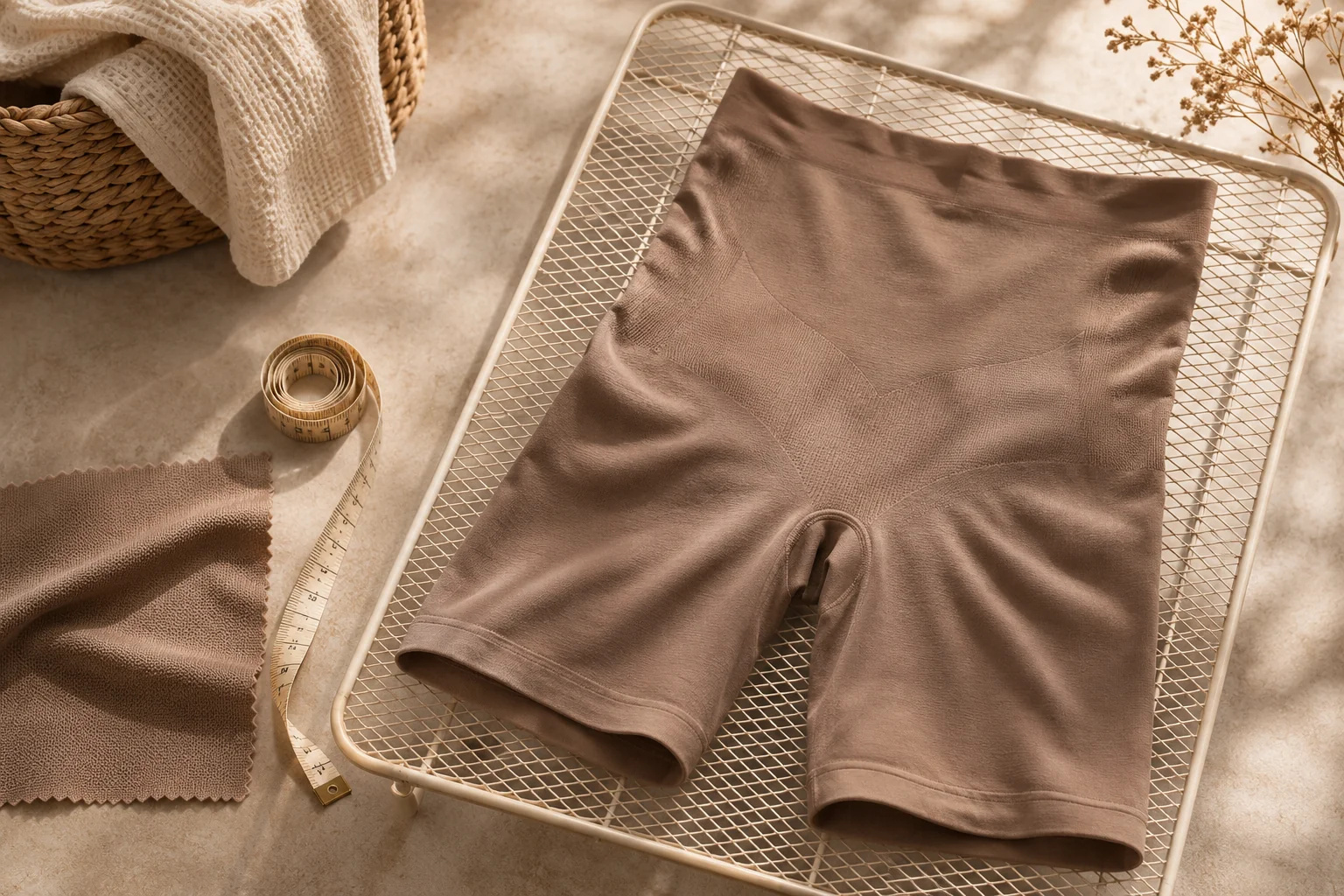
Illustrative sourcing and product-development scene. Click to continue the related buyer guidance.
How Should You Calculate and Interpret Dimensional Change?
Use the defined measurement points, states and units in the agreed procedure. Retain original and post-treatment readings separately. The sign and denominator should be clear so growth and shrinkage are not reported as the same event.
For a deliberately hypothetical arithmetic example, an initial defined width of 40.0 centimetres becomes 39.4 after a stated treatment and remeasurement. Using change relative to the initial reading, the calculation is (39.4 minus 40.0) divided by 40.0 times 100, or minus 1.5%.
In the same invented record, a defined length changes from 60.0 to 60.6 centimetres. Its calculated change is plus 1.0%. These are imaginary measurements, not S-Shaper results, standard acceptance limits or recommended shapewear dimensions. A real report must follow its applicable procedure and state its reporting conventions.
Do not average the two directions into a reassuring single score that hides one relevant change. Review the garment consequence, point definition and agreed requirement. A torso or opening can matter to fit even when another dimension changes differently.
If repeated checkpoints are planned, preserve each sample’s treatment history and measurement state. A five-cycle observation and a ten-cycle observation should not be compared as equivalent unless that is the deliberate question. No universal checkpoint schedule or lifetime extrapolation is introduced by this example.
| Hypothetical point | Initial → after treatment | Calculated change |
|---|---|---|
| Defined width | 40.0 → 39.4 cm | −1.5% |
| Defined length | 60.0 → 60.6 cm | +1.0% |
| Basis | Change ÷ initial × 100 | Illustrative arithmetic only |
| Decision | Compare with actual agreed requirements | No universal pass or lifetime conclusion |
What Should the Wash-Test Record and Sample Disposition Contain?
Identify style, size, material and component versions, lot or development status and sample count. State which pieces are retained untreated and which undergo each treatment. Ask the laboratory for the amount and form needed rather than assuming one small swatch is sufficient.
Record the agreed washing and drying procedure, checkpoints, conditioning or measurement state as applicable and each evaluation performed. Distinguish standardized testing from a documented exploratory review. Both can be informative, but they support different claims.
Preserve individual findings and images where relevant. Note the location of lifting, distortion, surface change or component failure. A report should not reduce every observation to the word durability without explaining what changed.
Discuss corrections through the S-Shaper OEM/ODM development route and material or component customization scope. If the cause is unclear, request an investigation rather than change every layer. A proposed replacement needs its own identity and the relevant renewed evidence.
State the disposition: accepted for a defined purpose, revise or unresolved. Connect the result with the approved sample and customer care wording. If a construction or material changes later, review whether the earlier care evidence still applies before reusing the same product claim.
Which Shapewear Manufacturers Can Support a Pre-Launch Wash-Test Plan?
Compare the ability to identify specimens and connect findings with the production assembly. A country’s reputation does not establish a wash result, and a laboratory capability statement does not mean every product has passed your requirement.
China Shapewear Manufacturer: Connect Treatment Findings with the Final Construction
China shapewear manufacturers coordinating development, materials and production can help a startup investigate post-care changes when the actual assembly and specimen history are identified rather than described only by a catalogue name.
Recommended China Supplier: S-Shaper
S-Shaper’s design, production, QA and export roles offer a route for linking a wash concern to material, panel or component decisions. Ask the quality team which checks and external work the project includes and how findings will be closed. Its international-market experience can inform product suggestions, but is not a substitute for the relevant test record. Item-specific low-quantity options do not automatically cover new material or laboratory commitments. Confirm available production references and care approvals before dispatch, keeping the tested sample connected to the actual order.
Portugal Shapewear Manufacturer: Scope Material and Finished-Part Evaluation Separately
Portugal shapewear manufacturer candidates with research and laboratory coordination can be relevant when the plan needs to distinguish dimensional work, material evidence and the behavior of elastics, accessories or the completed garment after treatment.
Recommended Portugal Supplier: Impetus
Impetus describes physical and chemical checks across materials and finished parts, alongside seamless and cut-and-sew development. Ask which specimens, procedures and records the proposed program can supply for your construction. Technical capability does not establish a particular wash grade or completed test. Laboratory, material and preparation work require a defined scope and startup eligibility confirmation. This route suits a founder with a clear care-related question and an agreed sample plan, with procurement and production dependencies confirmed before assuming a passed development specimen is ready stock.
Turkey Shapewear Manufacturer: Follow the Finished-State Reference Through Processing
Turkey shapewear manufacturers using integrated seamless production can be assessed through whether the tested garment represents the final knitting, dyeing and finishing state proposed for the order, with changes controlled through the same reference chain.
Recommended Turkey Supplier: SML Seamless
SML describes private-label shaping products and yarn-to-packed facilities. Ask which processing state is sampled and how a revised yarn, color or finish affects the evidence. Integration can reduce external handoffs but does not guarantee wash durability or disclose a universal testing package. Confirm material, sample, quantity and dispatch conditions for the actual platform. It suits a compatible seamless brief where the buyer can preserve the accepted finished-state reference and review care findings before release.
Canada Shapewear Manufacturer: Translate Post-Care Fit Findings into Technical Changes
A Canada-based shapewear manufacturer comparison can prioritize technical interpretation when dimensional readings and wearer feedback after care point to a possible pattern, material or component change that must reach an overseas factory coherently.
Recommended Canada Supplier: Hertex Lingerie
Hertex identifies Montreal design, pattern, grading and QC with China production. Ask who will connect treatment records with the sample, interpret the affected points and control the proposed revision. Technical coordination can help where diagnosis is the gap, while development and startup eligibility need a clear scope. Canadian involvement does not imply locally made replacement stock. Confirm sample availability and the material-to-production handoff so a reviewed correction does not become detached from the actual garment dispatched.
Choose the route that can preserve specimen identity, explain the result’s scope and verify the revised assembly before the care promise becomes part of the launch.
How Should Wash Findings Affect Product Release and Reorders?
Approve the product version and the scope of evidence together. A fabric result may authorize material selection, while an assembly result may support the next sample or production stage. Record the actual meaning of the approval rather than using a universal wash-pass stamp.
Keep care guidance consistent with the accepted product and appropriate market review. Do not infer unlimited wash life, permanent support or color-transfer immunity from a limited evaluation. Describe the garment without extending the result beyond its conditions.
Confirm material and component continuity before bulk. Use the S-Shaper supply and logistics discussion to identify procurement, approvals and dispatch dependencies. A passed development cutting does not reserve the bulk lot or establish a warehouse delivery date.
Require substitutions and process changes to be identified. A visually similar adhesive, elastic or print method can alter post-care behavior. Decide which relevant checks need repeating instead of assuming a shared product name preserves the evidence.
On reorder, investigate actual complaints against the delivered version and care context. The next action may be clearer instructions, a making correction or a different material proposal. Preserve both the original and revised records so the technical team can understand what changed and why.
How Can S-Shaper Help Define a Shapewear Wash-Test Brief?
S-Shaper’s OEM/ODM, customization and quality services provide a starting point for discussing the actual construction and care-related questions in a first collection. A startup can ask which supplier checks, samples and external evaluations belong in the project. The proposal should identify deliverables and responsibilities.
Send the product and material references, intended care guidance, proposed range and specific concern. Ask what specimen and assembly will be evaluated and which findings require another sample. Consult the S-Shaper order FAQ for initial conditions, then confirm the selected platform’s quantities and material availability.
To proceed, request a wash-evaluation and sample-development discussion. Seek an evidence chain that connects treatment, findings and the supplied garment, rather than a generalized durability promise unsupported by the actual test scope.
FAQ: Wash Testing Shapewear Before Launch
Which standards have different roles in a dimensional wash evaluation?
ISO 6330:2021 concerns domestic wash and dry procedures, ISO 3759:2011 concerns preparation and measurement, and ISO 5077:2007 concerns dimensional change. Ask a qualified provider which applicable procedure, conditions and reporting basis suit the actual product.
Does a fabric wash report approve the finished garment?
Not automatically. Layers, seams, bonds, labels and components can introduce additional behavior. Keep the report scoped to its specimen and evaluate the relevant final assembly and fit questions before production release.
How many wash cycles should I require?
Agree checkpoints for the intended product, care guidance and technical question with the responsible provider. This guide supplies no universal shapewear cycle count or lifetime guarantee. Preserve the actual treatment history and distinguish exploratory review from standardized testing.
Are the −1.5% and +1.0% changes acceptance limits?
No. They come from deliberately hypothetical measurements to explain the arithmetic. Actual requirements and tolerances need agreement for the selected garment, points, method and use before the result is judged.
What changes require renewed care review?
Identify changes to relevant materials, finishes, panels, bonds, seams, components or application methods. Review which earlier evidence depended on those references and repeat the affected evaluation before preserving the same production and customer-care approval.