 EN
Quick Answer
Compare China vs local shapewear manufacturing by the complete work and delivered-product proposal, not by country reputation alone. Define whether “local” means local development meetings, local production or local fulfillment. Then compare the same garment, sample support, quantities, quality checks and delivery responsibilities across candidates.
A China-based factory may offer a relevant platform and development support; a local partner may offer a useful technical or communication arrangement. Neither route has a verified universal price or lead-time advantage for your project. Request product-specific proposals, identify every handoff and choose the arrangement that your startup can approve, fund and manage consistently.
What Does Local Manufacturing Need to Mean for Your Brand?
Begin with the reason locality matters. A founder might need in-person fit sessions, a specific manufacturing-origin claim, easier coordination with a designer or inventory held near customers. These requirements are different. Buying from a nearby office does not necessarily satisfy a requirement that all production occur in the same country.
Rank these needs before requesting proposals. If face-to-face technical review is essential but local assembly is optional, say so. If a documented production origin is essential to the offer, do not let convenient meetings substitute for it. A founder can otherwise reject a suitable mixed-location workflow or accept an unsuitable local-looking one. Separate the requirement you want from the arrangement you assume will deliver it. This also helps suppliers propose relevant alternatives: a development meeting, a sample-review service and a manufacturing contract are different solutions, even when one contact coordinates them.
Write the requirement as a stage and location. For example, specify where pattern work, sample review, assembly, inspection and receiving should take place. Then ask which stages each candidate performs. This keeps the procurement discussion focused on a practical operating need instead of a broad preference that suppliers may interpret differently.
If local manufacturing is part of the customer proposition, establish the underlying facts before writing the claim. Ask which parts of the garment’s development and production happen locally and preserve the supporting records. Do not assume a sales address, regional domain or local warehouse proves the manufacturing route. A clear description is more useful to the business than an attractive but ambiguous label.
Also identify what you are prepared to manage remotely. Fit feedback can be consolidated through photographs, measurements and sample versions, but those records still need an owner. If your small team lacks that capability, compare proposals that include the missing support rather than assuming that location will resolve it automatically.
| Reason for choosing local | Requirement to define | Evidence to request |
|---|---|---|
| In-person fit support | Where technical review occurs | Named technical contact and process |
| Origin-based positioning | Which production stages occur locally | Stage/location records |
| Faster replenishment | Where available stock is held and made | Product-specific stock and reorder proposal |
| Easier communication | Who interprets and implements changes | Responsibility map and revision workflow |
How Should You Compare China-Based and Local Development Capabilities?
Start with the product platform. A candidate experienced in your required construction deserves a different conversation from one that would need to develop the whole garment. Use S-SHAPER’s product catalogue to select a concrete reference, then send the same essential requirements to local and overseas candidates. Keep intended materials, coverage and fit needs aligned.
Ask what inputs each candidate expects. One may require a finished technical pack; another may offer ODM work from a reference and wearer brief. Compare the deliverables, not only the service name. The S-SHAPER OEM/ODM page provides a useful distinction between producing a client design and assisting concept development, but the project proposal should define the actual work.
Discuss sample iterations and technical ownership. Who prepares measurements, consolidates comments, updates the pattern and identifies the approved version? If technical work is local and production overseas, ask how the handoff is managed. If the same factory performs development and manufacture, ask how your approval reaches production instructions.
Evaluate what happens when the sample does not meet the brief. A structured response identifying the issue and proposed change can be more valuable than a quick promise that the next version will be perfect. The strongest capability comparison is based on a relevant sample and a clear learning process, rather than assumptions about what every factory in a country can do.
China vs Local Shapewear Manufacturing: Which Trade-Offs Should You Compare?
Compare communication, technical support, production route and logistics separately. A shorter physical distance can make certain meetings easier, while a suitable existing platform can reduce development uncertainty. Neither observation establishes the result for every order. Ask candidates to explain their own workflow and its dependencies.
Use one comparison sheet with agreed definitions. If one quote includes development and another covers only assembly, the service scopes differ. If one price ends at factory handover and another includes additional transport, the delivery scopes differ. Label the gaps rather than producing a premature winner from a single column.
Consider your own coordination burden. A startup may be able to manage artwork and customer testing while needing help with measurements or production handoffs. The right partner supplies the missing capabilities under a clear scope. Paying for useful coordination can be rational, but its deliverables should be explicit enough to evaluate.
Keep production origin distinct from customer market knowledge. A supplier serving US or UK brands may understand relevant briefs while manufacturing in China. A domestic factory may still need detailed wearer information from you. Your customer research remains necessary regardless of where the garment is made.
| Comparison item | China-based route: ask | Local route: ask |
|---|---|---|
| Platform availability | Which relevant styles and materials exist? | Which relevant styles and materials exist? |
| Technical help | What ODM or specification work is included? | What design or technical work is included? |
| Communication | Who consolidates comments across locations? | Who turns meetings into factory instructions? |
| Production origin | Which site and external stages apply? | Which stages actually happen locally? |
| Delivery | What handover and destination scope is quoted? | What handover and destination scope is quoted? |

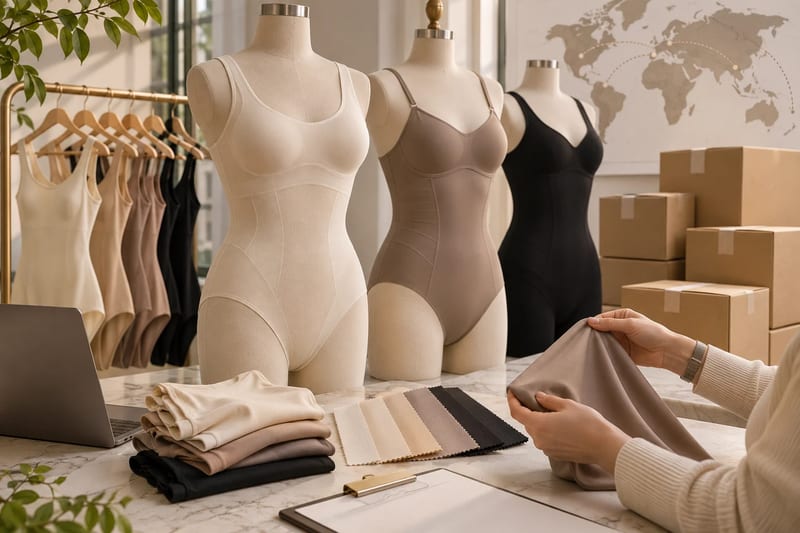
Illustrative sourcing and product-development scene. Click to continue the related buyer guidance.
China vs Local Sourcing: Which Channel Prices Are Actually Comparable?
Compare the same commercial layer before comparing production locations. A US-facing consumer listing or wholesale assortment cannot stand in for a domestic custom-manufacturing quote, just as an overseas ready-goods tier cannot price every private-label design. The observations below provide channel context, not verified national production averages or currency-adjusted country rankings.
| Channel / buying model | Observed USD per garment | Product and order basis |
|---|---|---|
| Amazon US retail | $9.99–$43.99 | Seamless/lighter bodies $12.38–$19.99; Structured bodies $34.88–$43.99; Shorts $9.99–$28.60. |
| Brand websites / B2C | $26.99–$148.00 | Seamless/lighter bodies $29.99–$78.00; Structured bodies $69.00–$148.00; Shorts $28.99–$81.00; Briefs $26.99–$38.00. |
| TikTok Shop US / B2C | $19.99–$65.98 | Seamless/lighter bodies $21.99–$46.99; Structured bodies $39.99–$54.99; Shorts $19.99–$65.98. |
| B2B existing-platform garments | $2.50–$12.85 | Seamless/body-shaping offers; listed minimums 2–600 pieces; custom scope varies |
| B2B structured bodies / fajas | $14.00–$27.42 | More elaborate body shapers; listed minimums 1–500 pieces; specification-dependent |
US-facing USD single-garment observations reviewed November 10, 2026; variants, retail promotions and shipping/tax differ. Amazon uses May–October 2026 tracker snapshots, not live November checkout. These selected samples are not industry averages or matched constructions. B2B advertisements are not landed costs or final custom quotes. Deeper development needs separate specifications, deliverables and an itemized quotation.
B2B generally removes part of the retail selling layer and may quote a lower piece price, while design-led development, material work and branded components require their own scope. Independent brand premiums may reflect customer-facing investment rather than a simple factory-origin surcharge. Request the same garment, matrix and delivery endpoint from S-Shaper and local candidates. Then compare actual preparation and logistics responsibilities. The useful choice explains what must be funded and approved, without assuming that a high consumer price proves local manufacture or that a low bulk listing proves the cheapest received product.
Seamless bulk supply and structured fajas have different specifications. Neither B2B row establishes a final price for deep development, samples or tooling.
Does Local Production Automatically Mean a Shorter Launch Timeline?
No universal timing advantage is established by the sources used here. Development readiness, material availability, review loops and the proposed production schedule all matter. A nearby factory waiting for an approved pattern may not start sooner than an overseas supplier with a suitable available platform. Ask for a stage plan rather than assuming distance determines the whole launch.
The S-SHAPER FAQ separates stock preparation from bulk-production timing and ties bulk work to confirmed details and deposit. Other service pages describe different ranges. Treat them as prompts for a project-specific schedule, not a single guaranteed date. Ask what event starts each stage and whether the stated unit is working days or calendar days.
Include sample transit and your own review time. Physical samples still need measurement, wear testing and consolidated feedback. In-person access may change how you organize that work, but it does not remove the need for it. Identify the people and time required on both sides before announcing a customer-facing shipping promise.
Discuss dispatch and receiving through the supply-chain and logistics scope. Factory completion, departure and customer availability are different milestones. Compare the complete chain for each route and document contingencies for another sample round or an unresolved inspection finding. A timeline becomes credible when its dependencies are visible, wherever production takes place.
Which Shapewear Manufacturers Should You Consider for China vs Local Production?
Compare shapewear manufacturers in China, the USA, Portugal and Canada for local versus overseas sourcing. The recommendations below connect country-level capabilities with specific suppliers and the work your brand needs.
China Shapewear Manufacturer: Compare a Factory-Direct Own-Label Proposal
China shapewear manufacturers offering direct own-label development provide one sourcing baseline; compare complete technical and receiving responsibilities rather than assuming the factory unit price proves a cheaper route.
Recommended China Supplier: S-Shaper
S-SHAPER combines material and style recommendations with design, production, QA and export specialists and stated experience serving customers across several global regions. This China-based route can provide a concrete own-label comparison when the founder needs a platform recommendation and coordinated development. Ask which essential changes actually improve the intended wearer result.
The published brief tiers provide a benchmark, while small-order conditions depend on the selected item and customization. Confirm the complete component and receiving scope rather than assuming the factory quote is the landed cost. This route suits a founder able to manage sample approvals and cross-border handoffs. Market-informed advice is useful, but neither it nor a low unit tier establishes that China is always the cheaper complete solution.
Source: S-SHAPER OEM/ODM and global-brand support.
USA Shapewear Manufacturer: Evaluate Wholesale Availability as Its Own Advantage
USA shapewear manufacturer comparisons involving stocked wholesale supply offer a different local advantage from fabrication; compare actual assortment availability with your need for a new garment.
Recommended USA Supply Partner: Vedette
Vedette’s wholesale program offers catalogue style and size selection and B2B support, with delivery service described for professional supply. If your priority is a defined assortment and potential replenishment, ask which goods are actually available and where they are held. That is a practical advantage to investigate for retail testing.
It is different from a verified domestic-manufacturing offer. Do not compare ready wholesale goods with a China development quote as though both include the same work. Resale terms, relabeling permissions and exact B2B dispatch still need confirmation. This route fits a curated retail launch when an existing product is suitable; it does not resolve a requirement for a new pattern or a particular manufacturing-origin claim.
Source: Vedette US-facing wholesale program.
Portugal Shapewear Manufacturer: Compare Technical Development Rather Than a National Premium
Portugal shapewear manufacturer research and testing capabilities provide a technical-development alternative; price the required evidence and materials through a proposal instead of assuming a national premium.
Recommended Portugal Supplier: Impetus
Impetus describes its own research team, technical collaborations and development spanning seamless and cut-and-sew products. Its quality structure includes checks on textile and garment inputs. That provides a European technical route to evaluate when your differentiation depends on material or construction evidence beyond selecting an available style.
No reviewed source establishes a national cost multiplier, startup MOQ or the price of your project. Development, testing and material sourcing may require additional commitment relative to an existing platform; quote the exact scope. This route suits a defined technical objective and a founder prepared to fund evidence. It is less suitable as a broad claim that European production is inherently better regardless of the garment and acceptance criteria.
Source: Impetus research and development.
Canada Shapewear Manufacturer: Price the Value of Local Technical Coordination
Canada shapewear manufacturer arrangements with local technical coordination can change how fit decisions reach overseas production; evaluate that specific service rather than assigning value to the address alone.
Recommended Canada Development Partner: Hertex
Hertex describes Montreal-based design, pattern work, grading and quality control with manufacturing in China. This hybrid arrangement can be relevant if local technical discussion is the actual need. Ask what documents and fit interpretation the team would provide and how those decisions reach the production floor.
It should not be labeled Canadian manufacturing or assumed to provide immediate local stock. Startup acceptance, technical fees and factory conditions require a scoped proposal. This route fits a founder who values structured pattern and grading support and can plan the handoff. Compare the complete coordination and manufacturing commitment against direct factory support, rather than counting the local address as a benefit without identifying what work it changes.
Source: Hertex Montreal development with China production.
Choose by the stage that needs improvement, then align the garment, development evidence, quantity and delivery scope before comparing the actual proposals.
How Should Quality and Reorder Control Be Compared Across Locations?
Use the same approved product criteria for every route. The S-SHAPER quality-assurance overview provides topics to discuss, including material and construction checks, while your order needs an identified reference, measurement method and relevant appearance and labeling requirements. Location does not replace acceptance criteria.
Ask how inspections can be arranged and how findings will be addressed before dispatch. If an external inspector is used, clarify the site, timing and scope. If the supplier performs checks, confirm the records it will provide. Preserve enough time for corrective work rather than treating inspection as a formality on the planned shipping date.
Review repeatability as carefully as the first sample. Ask how material and construction changes are communicated, which approvals are required for substitutions and whether the same product platform is expected to remain available. Discuss relevant changes through the customization service scope so development decisions remain linked to the order record.
Finally, compare the reorder process. A local route may still depend on externally sourced materials; an overseas route may offer a consistent platform but require an earlier replenishment decision. Request current conditions from each candidate. Your own documented first-order experience can improve later planning more reliably than broad claims about a country’s manufacturing performance.
How Can S-SHAPER Provide a China-Based Comparison for Your Brand?
S-SHAPER publicly presents shapewear products, OEM/ODM development, customization and manufacturing-related support, with a factory introduction identifying production in Dongguan. This makes it a relevant China-based candidate to evaluate alongside local options. The useful comparison is a product-specific proposal, not a general conclusion based on the country label.
Share the same brief you use locally: wearer problem, garment reference, intended changes, size and color range, quantity, destination and required receiving window. Ask the team to separate development, production and logistics responsibilities and identify the records needed for approval.
Then request a comparable sourcing proposal from S-SHAPER. Put it beside local offers using the same cost, capability and schedule definitions. Your decision should explain which arrangement meets the product need and what your startup must still manage, rather than relying on an unsupported universal manufacturing recommendation.
FAQ: China vs Local Shapewear Manufacturing for a New Brand
Should my new brand choose China or local shapewear manufacturing?
Compare the specific product, technical support, quantities, quality records and complete delivery scope. First define what locality must accomplish for the business. Neither route has a verified universal advantage that replaces a current proposal and a relevant sample.
Does a US or UK supplier address prove domestic manufacturing?
No. It may refer to sales, technical development, coordination or fulfillment. Ask where the selected garment will actually be made and which stages are performed locally. Record these roles separately before making an origin-based business or customer claim.
Can public China prices be compared with local quotes?
They can help prepare an inquiry, but a fair comparison requires the same garment and scope. Do not infer a national cost average or local premium from unrelated offers. Obtain current quotes for development, components and delivery responsibilities as relevant.
Is overseas sourcing only suitable for large orders?
Suitability depends on the product and program, not a universal country rule. Confirm minimums at style, color, size and component level. Small-order statements need item-specific confirmation, especially when customization or new material development is involved.
What is the best first comparison step?
Send one version of the product brief to suitable candidates in both routes. Ask for the proposed sample, responsibilities, quantity conditions and quotation scope. Use those replies to identify what must be tested or clarified before committing production money.