 EN

Quick Answer
A shapewear factory audit checklist should verify the work needed for your garment: the commercial and production identities, relevant process capability, material identification, sample and specification control, inspection records and corrective-action responsibilities. Start with a remote document review, then use an appropriately scoped site visit or specialist inspection to investigate important gaps.
For a small brand, the purpose is not to collect a maximum number of certificates or machinery photos. It is to establish whether the proposed team and production route can support your approved product and order conditions. Record observations, evidence and open actions separately. An audit finding should lead to a decision you can follow up.
What Should a Small Brand Put in Its Factory Audit Scope?
Define the product and project before requesting an audit. A review for a seamless bodysuit should not be reduced to a generic apparel checklist if the critical questions concern torso fit, stretch behavior or closures. Select the garment reference through a catalogue such as S-SHAPER’s shapewear range and identify the construction and changes you intend to buy.
Specify which decisions the review will support. A first supplier qualification, approval of a production process and inspection of finished goods answer different questions. A facility can have a credible process while a particular order still needs product-specific checks. Conversely, one acceptable sample does not demonstrate every aspect of ongoing production management.
List the critical evidence in advance: who performs development, where production occurs, which stages are external, how materials are identified and how finished work is compared with the approved reference. Ask the supplier what records are available and any reasonable limits on access. This gives the reviewer a practical route instead of an unstructured tour.
Decide what would be a major blocker for your project. An inability to identify the production site or approved version may prevent a meaningful order decision. A housekeeping observation may call for correction without determining product suitability on its own. The checklist should distinguish severity and consequence, so superficial neatness cannot outweigh an unresolved technical requirement.
| Audit objective | Question | Appropriate evidence |
|---|---|---|
| Supplier qualification | Who performs the required work? | Entity, site and role records |
| Product development | How are samples and changes controlled? | Specification and revision trail |
| Production control | How are materials and processes managed? | Relevant workflow and records |
| Order acceptance | Does this order meet the approval? | Product-specific inspection evidence |
Remote Pre-Audit vs On-Site Audit: What Can Each Establish?
A remote pre-audit can organize documents, clarify the production route and reveal missing records before travel or a specialist visit. Ask for relevant material and sample identifiers, a process description and an explanation of responsibilities. A live video session can add context, but the camera view and selected records remain limited evidence.
An on-site review can let a qualified reviewer examine the facility, observe relevant operations and compare records with the actual workflow. Its value depends on the scope, access and competence of the reviewer. Being physically present does not automatically establish the quality of every product or the route of a future order.
Use the stages together when justified by the project. Begin remotely to identify specific uncertainties, then ask an on-site reviewer to investigate those uncertainties rather than repeat a generic company introduction. A focused review can be more useful to a small brand than a long checklist that never refers to the garment it plans to buy.
Keep finished-order inspection separate. Neither a remote call nor a facility audit replaces the agreed checks against your approved sample, specification and quantities. Decide which evidence is needed before supplier selection, before production and before dispatch. This prevents one positive event from being used as proof of everything else.
| Method | Can help establish | Important limitation |
|---|---|---|
| Document pre-audit | Scope, roles and record availability | Documents may not show current practice |
| Live remote review | Context and selected real-time observations | Restricted view and access |
| On-site process audit | Observed workflow and record consistency | Snapshot within an agreed scope |
| Finished-order inspection | Conformity of identified goods | Does not prove future batch performance |
How Do You Check Material Identification and Traceability?
Ask the supplier to explain how the material used in the sample is identified and how production material is connected to that reference. A fabric description such as soft stretch knit may be useful to a customer, but it is not necessarily sufficient for manufacturing control. Request the identifiers and specifications relevant to the garment.
Follow one example through the available records. Can the team connect material receipt, storage or issue to the relevant production work? If a component is sent to another provider, ask how identity and responsibility are preserved at that handoff. The audit should test a real chain of explanation rather than accept a general statement that everything is traceable.
Discuss the material checks described in the S-SHAPER quality-assurance process and ask which apply to your proposed product. Agree the evidence needed for stretch, appearance, recovery or other relevant requirements. Do not assume that a generic test statement establishes the result for every color, fabric or garment construction.
Ask how substitutions are handled. A material can become unavailable between development and production. The important control is whether the alternative is identified, its effects considered and the relevant approval obtained before use. Review the customization scope so the audit can distinguish a permitted option from an unapproved change to the final product.

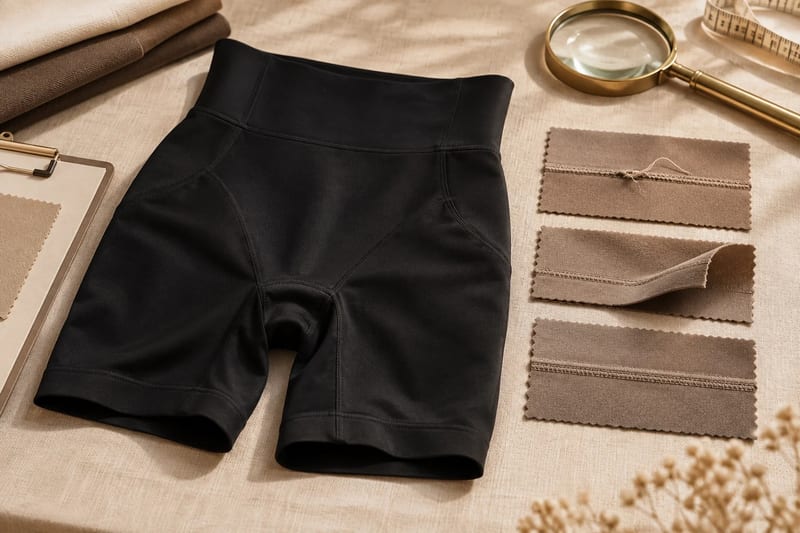
Illustrative sourcing and product-development scene. Click to continue the related buyer guidance.
Which Sample, Pattern and Specification Records Should You Review?
Request the current product record and a clear revision history. The reviewer should be able to identify the approved sample, relevant measurements, material choices and branded components without relying on a salesperson’s memory. Ask how superseded files are withdrawn and how production teams know which instruction is current.
For supplier-assisted development, clarify who prepares the specification. The OEM/ODM service description provides a starting distinction, but the audit should follow the actual project arrangement. A founder without a technical pack may legitimately need development support; the final production reference still needs to become identifiable before release.
Trace one sample comment into the next revision. If the brand requested a waistband change, where was it recorded, who interpreted it and how was completion checked? This exercise tests whether the development process can transform feedback into controlled work. A pile of samples without linked comments may show activity while leaving the approval status uncertain.
Review grading and size information at an appropriate level. Ask which physical sizes have been checked and what records support the rest of the range. A middle-size sample cannot demonstrate every proportion. The purpose is to identify remaining verification needs, not demand documents unrelated to the scope or infer fit quality from a pattern file alone.
| Record | Audit check | Startup consequence |
|---|---|---|
| Approved reference | Unambiguous ID and status | Defines what production should match |
| Revision log | Comments linked to action and version | Makes changes traceable |
| Measurement chart | Method and current values identified | Supports repeatable checks |
| Artwork record | Final label/packaging file acknowledged | Reduces component ambiguity |
How Should a Factory Audit Use Consumer and B2B Price Evidence?
An audit tests defined capability and controls; it does not reveal a verified retail markup or guarantee the lowest production cost. Use the channel observations below to locate the product and commercial model being discussed, then keep the quoted specification, quantity and preparation scope attached to the factory review.
| Channel / buying model | Observed USD per garment | Product and order basis |
|---|---|---|
| Amazon US retail bodies | $12.38–$35.14 | Seamless/lighter bodies $12.38–$19.99; Structured bodies $35.14–$35.14. |
| Brand DTC bodies | $29.99–$148.00 | Seamless/lighter bodies $29.99–$78.00; Structured bodies $69.00–$148.00. |
| TikTok Shop US bodies | $21.99–$54.99 | Seamless/lighter bodies $21.99–$46.99; Structured bodies $39.99–$54.99. |
| B2B advertised OEM bodies | $4.25–$8.30 | Rihope/Shangyou garment offers; listing MOQ 600/100; own-design terms reconfirmed |
| B2B custom shiny-fabric example | $22.00–$23.00 | Hucai FOB garment example, MOQ 200; a different fabrication; development fees unconfirmed |
US-facing USD single-garment observations reviewed November 10, 2026; variants, retail promotions and shipping/tax differ. Amazon uses May–October 2026 tracker snapshots, not live November checkout. These selected samples are not industry averages or matched constructions. B2B advertisements are not landed costs or final custom quotes. Deeper development needs separate specifications, deliverables and an itemized quotation.
A low B2B amount can describe standard bulk goods rather than the development, custom materials or inspection your brief needs. Consumer prices can include selling and brand value that an auditor cannot infer from a production line. B2B is usually lower per piece, but a public range does not establish the factory’s internal costs or your final delivered amount. Ask S-Shaper which product changes and quality records apply to the proposed order. Use audit findings to close evidence gaps and refine the quote, rather than converting machinery observations into an unsupported national or supplier price advantage.
The advertised OEM and shiny-fabric garments are different specifications, not development packages. Seamless stock, structured fajas and deep customization require separate scope confirmation.
Which Shapewear Manufacturers Should You Consider for Your Factory Audit?
Compare shapewear manufacturers in China, Portugal, Turkey and Canada for a focused factory audit. The recommendations below connect country-level capabilities with specific suppliers and the work your brand needs.
China Shapewear Manufacturer: Connect technical support with the audited order
When auditing China shapewear manufacturers, connect material identifiers, approved samples and inspection records to the proposed order instead of judging the facility from machinery alone.
Recommended China Supplier: S-Shaper
S-SHAPER’s design, production, QA and export specialists give a small brand several roles to question within one manufacturing discussion. Its material and trend recommendations can help translate an overseas customer brief into audit criteria. Ask the relevant specialist to explain how the approved sample reaches production, rather than accepting a general facility presentation.
The attraction is a connected development-to-export route with item-specific testing options. The constraint is scope: small-order statements do not prove that every custom construction qualifies. Request the applicable minimum, current specification and inspection arrangement together. This route suits founders who need technical assistance but still want a traceable approval chain. See S-SHAPER OEM/ODM and global-brand support, S-SHAPER item-testing MOQ and stock/bulk conditions.
Portugal Shapewear Manufacturer: Investigate the technical evidence behind differentiation
Research-led Portugal shapewear manufacturer proposals warrant an audit of development decisions and test records, especially when the first garment depends on a distinctive material or construction.
Recommended Portugal Supplier: Impetus
Impetus describes its own research team, cooperation with universities and technology centers, and seamless and cut-and-sew development. For a brand whose product promise depends on material or construction differentiation, that creates a substantive audit agenda: identify what is developed, how it is tested and which records support the proposed garment.
Its quality page describes physical and chemical testing across materials and finished parts. That is useful process evidence, not proof of a specific product result or startup eligibility. Obtain the development and testing scope before committing budget; a research-led proposal may involve work beyond selecting an existing style. See Impetus research and development, Impetus quality control.
Turkey Shapewear Manufacturer: Verify the benefits of integrated seamless production
For Turkey shapewear manufacturers with integrated seamless operations, trace the relevant yarn, knitting and finishing handoffs before treating process integration as evidence for your particular garment.
Recommended Turkey Supplier: SML Seamless
SML describes private-label shapewear production across yarn-to-packed facilities in Turkey. An integrated route can reduce the number of separate handoffs the buyer must understand. An audit can follow yarn identity, knitting, dyeing and finished-garment release within the proposed workflow, concentrating on the stages relevant to the chosen seamless platform.
Integration should not become an automatic quality conclusion. Ask to see how grading, finishing and material substitutions are controlled for the actual order. Confirm minimums and custom-color conditions separately. This is a relevant comparison for seamless collections, provided the supplier’s construction capability matches the garment rather than merely its category name. See SML Seamless integrated private-label manufacturing.
Canada Shapewear Manufacturer: Audit the development and factory handoff separately
A Canada-based shapewear manufacturer comparison should distinguish local technical records from overseas production evidence, so an office review does not substitute for checking the factory handoff.
Recommended Canada Development Partner: Hertex
Hertex identifies design, pattern work, grading and quality control in Montreal, with production transferred to China. That split can give a founder a useful technical communication route while retaining an overseas manufacturing arrangement. The review should examine the local technical records as well as how instructions reach the factory.
A Montreal office review cannot establish every production-stage fact in China. Ask who closes fit revisions, approves substitute materials and verifies the shipment, then quote any additional review work. This hybrid model merits consideration when the founder values technical coordination, but startup acceptance and the complete commercial scope still require confirmation. See Hertex Montreal development with China production.
Audit the stages most likely to change your buying decision, then compare the cost of closing the remaining evidence gaps.
How Should You Record Findings and Follow Corrective Actions?
Write each finding as an observation linked to evidence, consequence and required response. Avoid vague language such as poor quality culture when the actual issue is a missing sample identifier. A precise finding can be corrected and rechecked; a broad impression may produce disagreement without clarifying the buying decision.
Assign an owner and a closure condition. If the issue concerns an outdated measurement sheet, identify the current chart required and the people who must acknowledge it. If the issue concerns a process handoff, ask for the relevant responsibility and records. Agree when the response will be reviewed and what evidence demonstrates completion.
Preserve limits. A review that did not examine a process should say so. A corrected document does not automatically prove the practice has changed on every line. Decide whether a follow-up observation or order-specific check is needed, proportionate to the significance of the finding. The founder should understand both what was established and what remains open.
Connect dispatch approval to the agreed product checks and shipping handoff. A positive facility review is not permission to skip the final quantity, labeling and conformity review. For a small brand, the best outcome is a short, actionable record that improves the next approval rather than a certificate-like statement unsupported by the actual scope.
How Can S-SHAPER Help a Small Brand Prepare a Focused Factory Review?
S-SHAPER provides public factory, product, development and quality information that can help define a preliminary review. Use those pages to identify questions relevant to your garment. Request the proposed production site, stage responsibilities and available product records before deciding which further verification is useful.
Share the selected style, desired changes, target market and quantity. Ask the team how a sample and specification would be controlled and which order-specific inspection arrangement can be discussed. Review the published FAQ for preliminary information, then confirm access, scope and responsibilities directly rather than assuming a general statement defines your audit.
To organize the next step, send S-SHAPER a product-specific review request. A focused checklist gives both sides a clear purpose: establish the evidence needed to evaluate a first order and identify any conditions that must be closed before production approval.
FAQ: A Shapewear Factory Audit Checklist for Small Brands
What belongs in a shapewear factory audit checklist?
Include entity and site roles, relevant production capability, material identity, sample and specification control, inspection records and corrective-action handling. Tie the checklist to the garment you intend to buy. Generic machinery photos or unrelated documents cannot answer every product-specific question.
Can a remote audit replace a site visit?
A remote review can clarify scope and selected records, but it has visibility and access limits. Decide whether an on-site review is needed based on the uncertainty and consequence involved. Neither method automatically replaces finished-order inspection against your approved product.
Does an audit guarantee the order quality?
No. It provides evidence within an agreed scope and time. Your order still needs a clear specification, appropriate production checks and an acceptance process. Record the limits of the review so one positive assessment is not mistaken for proof of every future batch.
Should every finding stop the order?
Assess the finding’s effect on your product and approval. A critical unresolved identity or specification issue may block a decision, while another observation may need a documented correction. Define the response, owner and evidence required before treating the issue as closed.
How can a small brand keep the review practical?
Begin with a focused remote pre-review and identify the questions most likely to change the buying decision. Use qualified help where needed and request an explicit scope. Spend review effort on relevant processes and records rather than collecting a large unrelated document bundle.