 EN
Quick Answer
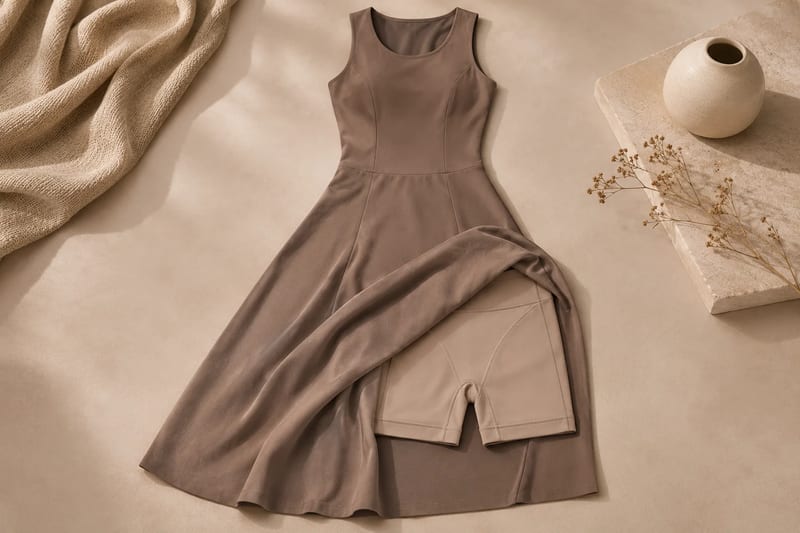
Develop a dress with built-in shapewear as two connected garments: the visible outer dress and the inner shaping system. Specify each layer’s material, dimensions, coverage and care, then define their attachments, dressing sequence, bra arrangement and toilet access. A good-looking shell does not approve the inner fit, and a comfortable inner layer does not approve the dress silhouette.
Request identified samples and review the layers independently and together across the intended wearer range. Use outer-dress-specific channel prices, not underwear-slip prices, and confirm whether the supplier’s offer covers an existing style, adaptation or original development before placing the first order.
What Must the Outer Dress and Inner Shaping Layer Specify Separately?
Start with your own sketch or an authorized reference and mark the outer neckline, armholes, hem, silhouette and any opening. Then draw the inner system: bra or lining arrangement, shaping coverage, short or brief, gusset and attachments as applicable. The developer needs to see both products and their relationship.
Use a S-Shaper built-in shaping dress reference to begin the construction conversation, while confirming which features are actually part of the proposed project. A catalogue example is a starting point, not permission to assume every shell or inner configuration is available under the same terms.
Ask for material identities and finished measurements for both layers. Their fit and extension can differ. Do not accept one composition line or one size letter as a complete specification for the whole garment. Identify which dimensions control the visible silhouette and which relate to the inner fit.
Define the priority wearer and occasion. A fitted evening design and a relaxed lounge design create different appearance and movement questions. If the first collection tries to serve several occasions, decide which requirement controls the sample approval when preferences conflict.
Keep essential requirements separate from optional details. The first prototype should resolve the layer relationship before adding several necklines, prints or hem lengths. A collection can expand after the core construction is understood; opening many variants early multiplies questions while the same inner system may still need revision.
| System | Specify independently | Then review together |
|---|---|---|
| Outer dress | Material, silhouette, neckline, hem and measurements | Appearance over the inner system |
| Inner shaping | Material, coverage, openings and dimensions | Fit within the shell |
| Connection | Attachment locations and construction | Movement, stress and visibility |
| Customer use | Dressing, bra arrangement, access and care | Whole-garment practicality |
How Can Attachments and Different Stretch Responses Affect the Dress?
Ask where the layers are connected and which areas move independently. A fixed point can influence how the shell hangs or how the inner layer is positioned. A loose relationship can create other handling questions. The useful review concerns the actual proposed construction, not a rule that every attachment should be fixed or every layer should float.
Evaluate the outer and inner materials as a pair. If one is changed, ask what happens to dimensions, tension, drape and care. A similar composition does not prove that a substitute behaves the same way. The approved record should identify both materials and the attachment construction.
Observe dressing and removal before judging the finished appearance. The wearer must get through the proposed openings and adjust the layers as intended. If the process pulls on a seam or leaves the inner short twisted, document it and ask for a targeted revision.
Check bra arrangement and coverage with the intended wearer. Built-in shaping does not necessarily mean an integrated supportive bra, and a shelf or lining is not automatically equivalent to another cup construction. Ask what is actually included and keep any proposed support wording within the evidence.
Review access as a product-use question. Identify how the garment is managed for toilet use, what the wearer must move or remove and whether the design performs as described. Do not assume an opening shown in a photograph is practical for every wearer or that a marketing phrase proves the result.
Built-In Shaping Dress vs Separate Dress and Shapewear: What Changes for Development?
A separate combination lets the wearer choose two garments, while an integrated design makes the brand responsible for their relationship in one product. Neither approach is automatically better. The integrated route needs a clear explanation of attachment, paired fit, dressing and care before its convenience claim is approved.
For a chosen sample plan, three review sizes × two shell options × two inner options creates 12 combinations. Adding initial and after-care states creates 24 review cells. These are illustrative planning choices, not a supplier’s minimum or a universal test protocol. Agree the physical sample allocation and identify which combinations remain unreviewed.
If this scope is too broad for the first development budget, reduce optional design branches deliberately. One shell and one inner proposal can still need representative size review. Do not remove the critical paired-fit work merely to keep several colors in the first range.
| Decision | Integrated dress | Separate combination |
|---|---|---|
| Fit responsibility | Brand must validate the paired system | Two independently selected garments |
| Attachments | Specify connection and relative movement | No shared garment attachment |
| Dressing/access | Review the complete sequence | Review each garment and combination |
| Care | One product’s materials must work together | Each garment has its own instructions |
| Chosen integrated plan | 3 × 2 × 2 = 12 combinations | 24 cells with two review states |
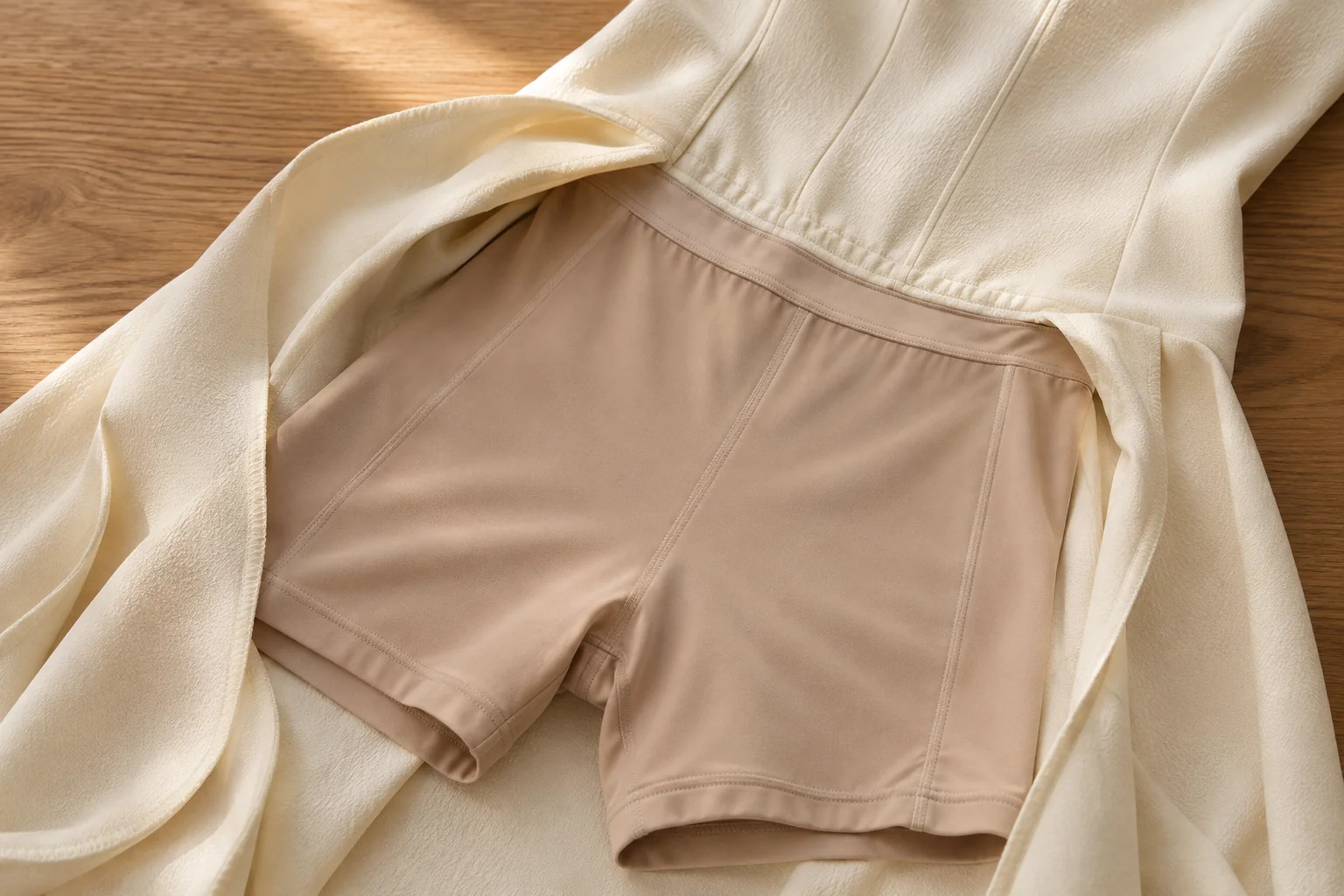
Illustrative sourcing and product-development scene. Click to continue the related buyer guidance.
What Do Outer Dresses with Built-In Shaping Cost Across Buying Channels?
Keep outer dresses separate from underwear slips when reviewing price. Shell material, silhouette, bra arrangement, inner short and attachments can change the work. The following observations concern outer-dress products and distinguish single examples from broader selected intervals.
Product-specific price check: outer dresses with built-in shaping. US-facing USD per single garment. Research reviewed November 10, 2026; underlying snapshot dates differ. These selected listings show channel positioning, not an industry average or a matched-quality price experiment. Single observations are marked as examples.
| Channel / model | Observed USD per garment | Scope and order basis |
|---|---|---|
| Amazon US | $69.99–$113.89 | Two Popilush outer-dress designs; May/June tracker snapshots, not live November checkout |
| Brand DTC | $79.00–$159.00 | Popilush mini to floral maxi; selected $79 sale and $159 list; bundles/BOGO excluded |
| TikTok Shop US | $39.99 (one example) | One FeelinGirl outer-dress observation; not a platform-wide interval |
| B2B garment offers | $12.19–$18.69 | Huanghu/Yilairuika outer-dress listings; MOQ500/1; development and freight not included |
These are outer dresses, not underwear slips. Shell fabric, bra construction, inner short attachment and toilet access create separate work. An advertised MOQ of one is a stock/sampling possibility, not a promise to engineer an original dress at that quantity.
B2B normally spreads ordering or production work across a quantity and leaves the consumer-brand layer to the buyer. Retail also funds customer acquisition, content, platform or creator fees, fulfillment, returns and overhead. The startup still pays for samples, development, quality checks, freight, tax and inventory. The retail–factory gap is neither pure brand premium nor net profit; a small custom run can cost more than a retail promotion. Existing-stock, light-label and full OEM development must be quoted separately.
Prices are indicative public observations, not final S-Shaper quotations. Confirm material, variant, MOQ, customization rights, packaging and delivery terms through a product-specific S-Shaper inquiry. Tax and shipping are not normalized; US examples are not local UK/EU/Australian tax-inclusive prices.
View the price observations and dates
- Popilush — Ruched corset shaping maxi dress: $69.99; 2026-06-26; Dated tracker; old snapshot not live.
- Popilush — Multi-way off-shoulder shaping maxi dress: $113.89; 2026-05-24; Dated tracker; selected variant, not live.
- Popilush — Lace trim sculpting fit and flare mini dress: $79.00; public snapshot reviewed 2026-11-10; Sale $79 vs $89; extra order-code discounts excluded.
- Popilush — Draped floral sculpting maxi dress: $159.00; public snapshot reviewed 2026-11-10; Single dress; BOGO excluded; not $178 two-piece outfit.
- FeelinGirl — Bodycon dress built-in bra/shaping: $39.99; public snapshot reviewed 2026-11-10; One observed outer-dress listing; not a platform-wide range.
- Guangzhou Huanghu — Bodycon dress with built-in shaping: $17.55–$18.69; public snapshot reviewed 2026-11-10; Existing garment listing; excludes deep-development fees; listed MOQ 500.
- Shenzhen Yilairuika — Built-in-shaper maxi/long-sleeve outer dress: $12.19–$15.46; public snapshot reviewed 2026-11-10; FOB, range across two outer-dress listings; MOQ1 each does not guarantee private-label rights; listed MOQ 1.
Request a quotation for the identified shell and inner system together. Ask which sample rounds, grading, labels and packaging are included and whether an advertised tiny minimum describes stock rather than original engineering. A founder’s budget should include the paired-fit work and actual delivery inputs; a cheap available dress is not a development quote for another silhouette.
How Should You Review Paired Fit, Movement and Care?
Create a two-layer trial record. Identify the shell and inner versions, size, relevant wearer measurements and initial adjustment. Photograph the exterior under consistent conditions and record internal position separately. A smooth front image can hide an inner opening or attachment issue.
Use the intended movements and occasion tasks: dressing, sitting, walking and relevant reaching. Record whether the shell moves as intended, whether the inner layer shifts and where contact or pulling appears. These are proposed product-review tasks, not a universal protocol or proof of every wearing situation.
Discuss feasible alternatives through S-Shaper’s customization service. If the inner short works but the hem hangs poorly, ask which change addresses the shell or attachment. Preserve unchanged parts and document revisions so the next trial can resolve a clear question.
Agree after-care and relevant checks with the quality-assurance team. Review the paired materials, dimensions, attachments, appearance and fit as appropriate to the intended routine. Do not approve one layer’s care behavior as evidence for the whole dress.
Keep unresolved findings visible in the release decision. A size can be acceptable externally while the inner coverage remains unsuitable for some proportions. Identify the gap and request relevant development rather than hiding the issue inside an overall satisfaction score. The customer receives one product and will experience both layers.
Which Built-In Shapewear Dress Manufacturers Fit Your Development Plan?
A dress project needs confirmation of both outerwear and inner-garment capability. Compare a coordinated factory platform, development across locations and a scoped technical route. These examples identify published models and limits; they do not promise that every supplier offers the same dress or startup program.
China Built-In Shapewear Dress Manufacturer: Coordinate the Two-Layer Development Scope
China built-in shapewear dress manufacturer comparisons should define the shell and inner system together, then confirm which materials, attachments and sample work fit the first-order program.
Recommended supplier: S-Shaper
S-Shaper’s OEM/ODM service describes material and style recommendations with design, production, QA and export specialists. Ask the factory team to explain a feasible dress platform and how changes to the shell affect the inner proposal. Its work across several customer regions can inform the brief, while the actual paired garment needs evidence.
Conditional small-order support does not establish one minimum for every new shell fabric, print or inner system. Request an accurate development and production proposal for the selected combination. This route suits an own-label startup seeking coordinated garment work and a manageable first design. Keep the quote tied to the approved shell, inner layer and attachment version.
Canada Built-In Shapewear Dress Manufacturer: Assign Shell and Inner-Fit Approval
Canada built-in shapewear dress manufacturer routes involving development and overseas production should identify who approves each layer and who owns the final paired-fit decision.
Recommended supplier: Hertex
Hertex describes Montreal design, pattern development, grading and quality control, with manufacturing in China since 2006. Ask whether the proposed outer-dress project fits its current scope and how shell, inner and attachment revisions are communicated. The development handoff should preserve two material identities and one final garment version.
The reviewed background does not establish Canadian manufacture, a standard integrated-dress program or a startup fee schedule. Confirm capability and obtain a scoped proposal before treating it as a ready product route. This model suits a buyer who values the stated development interface and can define approval ownership across locations. A local contact does not automatically validate the assembled two-layer garment.
Portugal Built-In Shapewear Dress Manufacturer: Scope the Material-and-Construction Questions
Portugal built-in shapewear dress manufacturer comparisons involving technical development should specify the paired-material and attachment questions before committing to multiple silhouettes or inner configurations.
Recommended supplier: Impetus
Impetus describes research and development across seamless and cut-and-sew products and quality work involving materials, elastics, accessories and finished parts. Ask whether the proposed program can support the actual outer-dress concept and how material evidence would connect with paired garment trials.
The reviewed information does not establish a ready dress platform, universal startup minimum or included development package. A current proposal must confirm those points. This route suits a product with a defined technical question and a budget for scoped investigation. Research capability is a resource, while the approved shell, inner system and relevant wearer evidence must establish suitability for the intended occasion.
Choose the route that can confirm the actual two-layer scope and preserve one final approval record from sampling through delivery.
What Must the Approved Dress Record Contain Before Production?
Keep shell and inner material references, finished measurements, pattern or platform, coverage, bra arrangement, access design, attachments, labels and care together. Identify the reviewed sizes and any unresolved proportions. The commercial order must distinguish the approved combination from earlier prototypes.
Create the order grid from actual audience evidence and budget. A new print, hem or neckline can multiply development as well as stock. Confirm which minimum applies and whether a variation reopens the shell or inner approval. Do not assume every cosmetic change is technically independent.
Use the general order FAQ as preliminary context and obtain item-specific sample, quantity and timing terms. Agree how material or component substitutions are handled. A similar-looking shell or lining may need another paired review.
Connect the approved identifiers with packing and receiving arrangements. The delivered dress should be checkable as the selected two-layer system. For reorders, compare any proposed change with the retained garment and evidence instead of accepting the same silhouette name as proof of equivalence.
How Can S-Shaper Help Turn the Two-Layer Concept into a Sample?
S-Shaper can be approached with a marked outer sketch, inner coverage drawing and the intended wearer and occasion. Ask its team to recommend a feasible platform, identify material alternatives and explain the paired sample plan. This makes the central construction relationship reviewable before expanding the collection.
Its published support covers recommendations and specialist communication through design, production, QA and export. Confirm the exact shell, inner and attachment work included in your project. Conditional low-quantity possibilities require confirmation for that combination and customization.
Send the brief through S-Shaper’s project inquiry. Request identified samples and an accurate quote for the approved version. The useful outcome is one reproducible dress whose appearance, inner fit, dressing and care have been considered together, supported by a record that can guide production.
FAQ: Developing a Dress with Built-In Shapewear: A Startup Checklist
Is a shaping slip the same as a dress with built-in shapewear?
Not necessarily. This guide concerns a visible outer dress with an integrated inner system. An underwear slip has a different product role and should not be used as an equivalent price or construction reference.
Does built-in shaping always include a supportive bra?
Do not assume that. Ask whether the proposed garment includes a lining, shelf, pads, cups or another arrangement and evaluate the actual construction with the intended wearer.
Can one layer’s successful test approve the whole dress?
No. Review shell and inner requirements separately and together. Attachments, movement, dressing and care create combined questions that an isolated layer does not resolve.
What should I reduce if the first development scope is too large?
Prioritize optional shell or inner variations while preserving relevant paired-fit and size review. The illustrative matrix shows workload; it is not a requirement to launch every combination.