 EN
Quick Answer
Source private label fajas by specifying the actual garment: layers, material identities, torso and leg coverage, closure, gusset, straps and finished fit. Keep three questions separate: what style is supplied, where the ordered item is made and what claims the evidence supports. A faja name does not prove Colombian origin or a medical purpose.
Request an identified construction and representative fit review, then compare structured-garment price observations with their limits. Confirm the actual own-label rights, development scope, quantity basis and delivery terms. Do not treat stronger-feeling fabric, more closure rows or a recovery-themed listing as proof of a clinical outcome.
How Should You Separate Faja Style, Manufacturing Origin and Intended Use?
Begin with a drawing or marked reference. A waist-only product, a short-leg body and a fuller-coverage garment have different components and fit questions. The word faja is not detailed enough for a quotation. Identify the coverage and intended fashion use before the supplier recommends a construction.
Choose a relevant direction from S-Shaper’s product catalogue and state what must be retained or changed. Ask for the actual material, layers and closures rather than copying another seller’s control-level wording. A descriptive category can help a conversation, but should not become an unverified measurement.
Ask origin as a separate factual question about the ordered item. A Colombian-style garment is not automatically made in Colombia, and a supplier’s office location is not proof of manufacture. Keep the actual agreed origin information with the product and commercial record.
Define the claim scope separately again. This guide addresses fashion-product sourcing and wearer review. If a brand intends a clinical or post-procedure application, the actual product and claim need a different evidence project. Do not borrow those uses from a marketplace title and assume the same garment is approved for them.
The first brief should make these distinctions easy for the supplier to answer. A buyer can value a style, origin or construction without pretending they are interchangeable guarantees. Clear questions reduce the chance of comparing a simple body with a multilayer structured garment as if only the supplier name changed.
| Question | Evidence to request | Unsupported shortcut |
|---|---|---|
| Style | Coverage, layers and component description | Faja name defines the construction |
| Origin | Actual ordered-item manufacturing information | Supplier address proves origin |
| Use/claim | Evidence relevant to the actual product and wording | Recovery terminology proves clinical benefit |
| Rights | Written own-label or resale scope | Wholesale means unrestricted private label |
What Should the Layer, Closure and Coverage Specification Include?
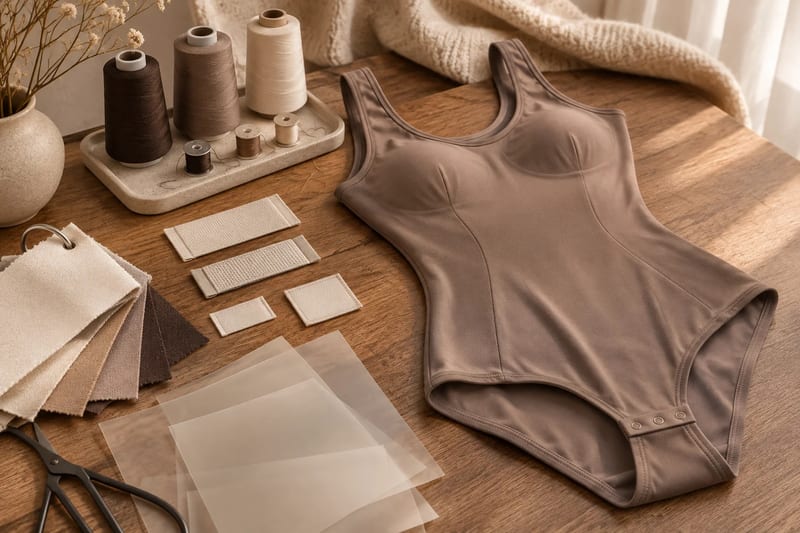
Identify the outer material, inner layer, reinforcement and any local component. Ask which part provides the intended feel and how it is oriented. A powernet description should lead to an actual article specification, not an assumption that all materials with that name have the same behavior.
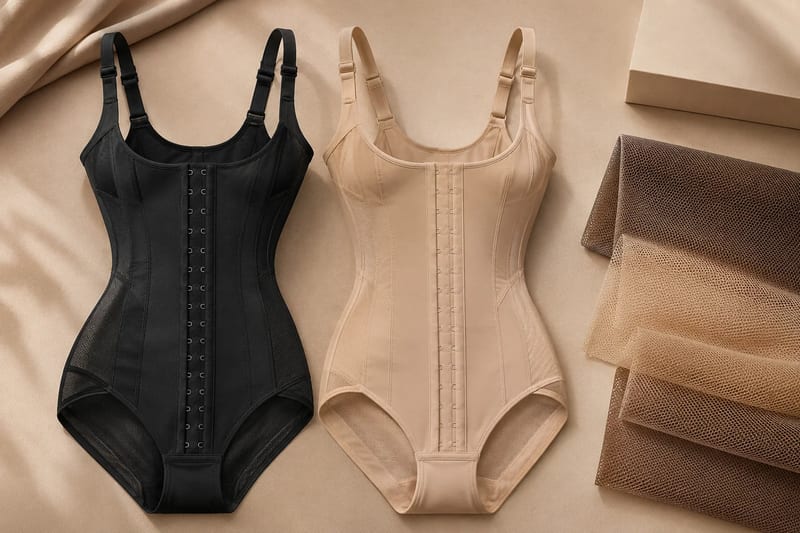
Describe the closure location, type, rows or adjustment positions and attachment. Check how the wearer dresses and reaches the fastening. More rows describe another feature; they do not establish a universal fit range or a medical support level.
Map torso, seat and leg coverage. A body product needs relevant torso and opening review in addition to waist and hip dimensions. If straps are included, identify their adjustment and attachment. If a particular bra arrangement is intended, state it rather than leaving the customer to discover the interaction after purchase.
Ask about gusset and access construction as part of normal product use. Identify what the wearer must move, open or remove and test the proposed sequence. A photograph cannot establish practicality for the intended range of proportions.
Review how material, layers and joins change across sizes. An attractive middle-size sample does not validate the entire range. Keep the actual grading and size-set questions in the development proposal so the first order is not based solely on a supplier’s generic size letters.
Structured Faja vs Everyday Seamless Body: What Makes the Buying Scope Different?
Compare complete constructions rather than a stronger-sounding category. A structured faja and an everyday seamless body can differ in layers, closure, coverage and dressing. The founder should decide which product serves the audience, then request relevant evidence and a comparable commercial scope.
For an illustrative launch matrix, two coverage options × four sizes × two shades creates 16 configurations. Adding another closure concept doubles that to 32. These are chosen planning inputs, not a recommended assortment or an order minimum. Every extra option needs a reason and relevant sample coverage.
If the first budget is limited, simplify optional branches while preserving essential fit and construction review. Do not reduce evidence to keep more variants. An approved smaller range is easier to describe accurately than a broad set whose torso and openings have not been reviewed.
| Buying question | Structured faja proposal | Everyday body proposal |
|---|---|---|
| Components | Identify layers, closure and reinforcement | Identify knit/body, openings and attachments |
| Fit scope | Torso, closure, coverage and contact | Torso, openings and intended bra arrangement |
| Use wording | Keep claims within actual evidence | Keep claims within actual evidence |
| Price | Compare an equivalent structured scope | Do not use as an automatic faja cost proxy |
| Chosen matrix | 2 × 4 × 2 = 16 configurations | Extra closure option factor gives 32 |
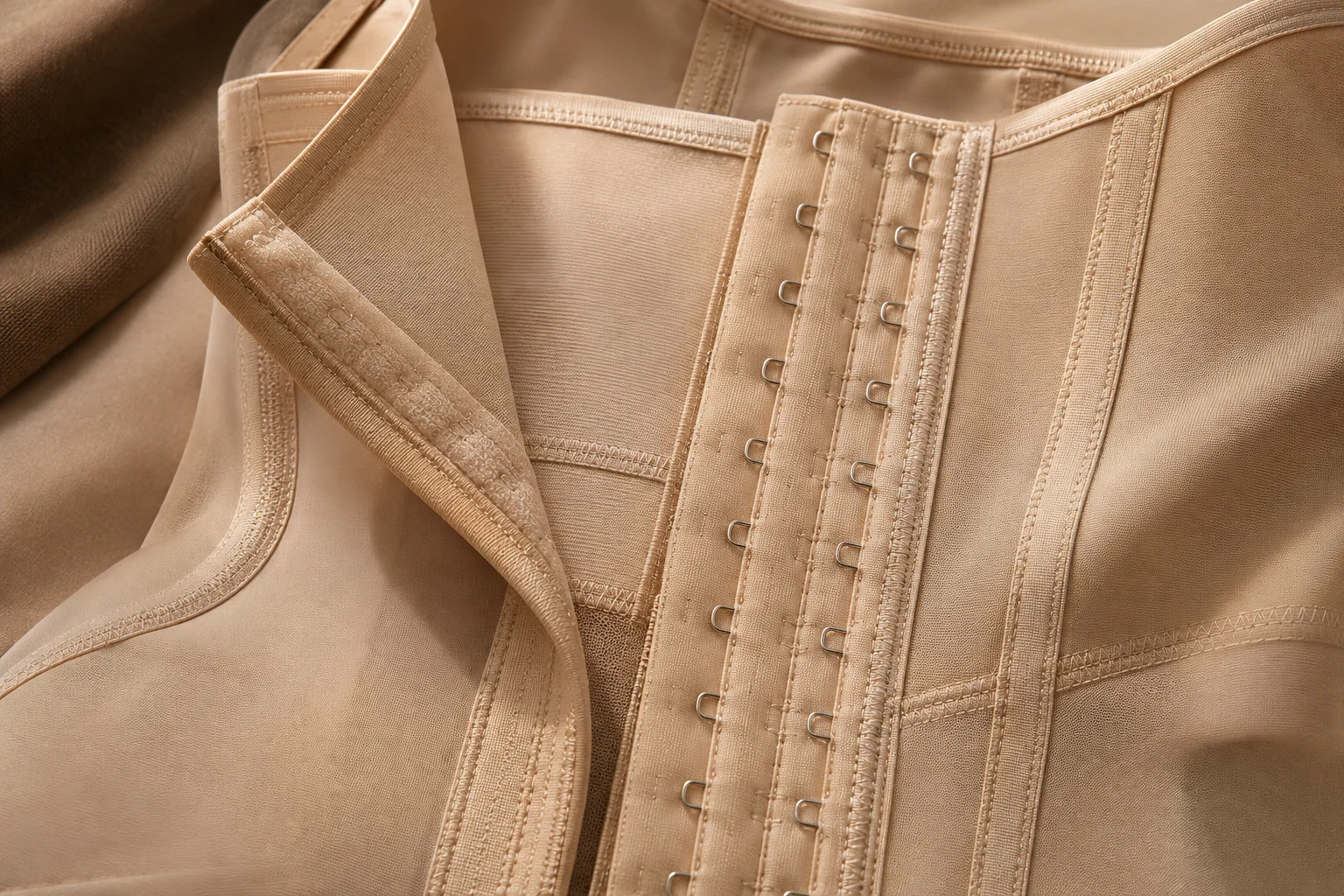
Illustrative sourcing and product-development scene. Click to continue the related buyer guidance.
What Do Structured Faja-Style Garments Cost Across Channels?
Use the observations below as a structured-garment comparison and preserve the explicitly adjacent DTC scope. A premium occasion body is not automatically the same construction as a Colombian faja. Review layers, closures and coverage before treating a channel interval as your target factory price.
Product-specific price check: structured faja-style body shapers. US-facing USD per single garment. Research reviewed November 10, 2026; underlying snapshot dates differ. These selected listings show channel positioning, not an industry average or a matched-quality price experiment. Single observations are marked as examples.
| Channel / model | Observed USD per garment | Scope and order basis |
|---|---|---|
| Amazon US | $43.99 (one example) | One FeelinGirl structured faja, September tracker; not all body shapers |
| Brand DTC | $69.00–$148.00 | Shapellx/SPANX structured occasion bodies; adjacent comparison, not identical Colombian faja construction |
| TikTok Shop US | $39.99–$54.99 | FeelinGirl/YIANNA single faja-style garments; no two-piece bundles |
| B2B structured garments | $14.00–$27.42 | Free Market, Honesty and Yilairuika; listed MOQ500/3/1 |
Structured shapewear is a wider family than a specific Colombian faja. The DTC row is an explicitly adjacent benchmark; ask for closure rows, torso coverage, gusset and multilayer construction to compare actual equivalents. Seller recovery terminology is not verified clinical evidence.
B2B normally spreads ordering or production work across a quantity and leaves the consumer-brand layer to the buyer. Retail also funds customer acquisition, content, platform or creator fees, fulfillment, returns and overhead. The startup still pays for samples, development, quality checks, freight, tax and inventory. The retail–factory gap is neither pure brand premium nor net profit; a small custom run can cost more than a retail promotion. Existing-stock, light-label and full OEM development must be quoted separately.
Prices are indicative public observations, not final S-Shaper quotations. Confirm material, variant, MOQ, customization rights, packaging and delivery terms through a product-specific S-Shaper inquiry. Tax and shipping are not normalized; US examples are not local UK/EU/Australian tax-inclusive prices.
View the price observations and dates
- FeelinGirl — Faja full-body shaper: $43.99; 2026-09-04; Dated tracker snapshot; ASIN B0D3DTVJKB.
- SPANX — GoFigure open-bust mid-thigh bodysuit: $98.00; public snapshot reviewed November 10, 2026 (checkout not verified); USD displayed regular listing.
- SPANX — Suit Your Fancy strapless brief bodysuit: $138.00; public snapshot reviewed November 10, 2026 (checkout not verified); USD displayed regular listing.
- SPANX — Suit Your Fancy plunge low-back mid-thigh bodysuit: $148.00; public snapshot reviewed November 10, 2026 (checkout not verified); USD regular price; premium occasion construction.
- Shapellx — BOOT-YEAH Hourglass full-body mid-thigh bodysuit: $69.00; public snapshot reviewed November 10, 2026 (checkout not verified); Single-item displayed sale price; selected product; order-level code not applied.
- Shapellx — MeshSmooth low-back mid-thigh bodysuit: $74.00; public snapshot reviewed November 10, 2026 (checkout not verified); Single-item displayed sale price; selected product; order-level code not applied.
- FeelinGirl Shop — U-front high-back faja bodysuit: $54.99; public snapshot reviewed November 10, 2026 (checkout not verified); Single-item limited-time deal; compare69.99.
- YIANNA Shapewear — High-waist faja bodysuit: $39.99; public snapshot reviewed November 10, 2026 (checkout not verified); Opened storefront single-item price; exclude 69.99 two-piece bundle.
- YIANNA Shapewear — Full shaping faja with zipper crotch: $45.99; public snapshot reviewed November 10, 2026 (checkout not verified); Flash sale price; compare69.99.
- YIANNA Shapewear — Overbust shaping faja: $49.99; public snapshot reviewed November 10, 2026 (checkout not verified); Flash sale price; compare79.99.
- Free Market Co. — Full-bust thigh-slimming body shaper: $14.00–$17.00; public snapshot reviewed November 10, 2026 (checkout not verified); Supplier-advertised range, not independently tested medical performance; listed MOQ 500.
- Guangzhou Honesty — Intiflower full-body high-compression faja: $19.99–$21.49; public snapshot reviewed November 10, 2026 (checkout not verified); Private-label listing; low MOQ is not an agreed custom-development contract; listed MOQ 3.
- Shenzhen Yilairuika — Colombian-style full-body faja: $24.68–$27.42; public snapshot reviewed November 10, 2026 (checkout not verified); Advertised range; medical wording is seller marketing, not a validated clinical claim; listed MOQ 1.
Ask for the quote to identify the complete approved construction and own-label scope. Separate catalogue supply, limited adaptation and original development. A listed tiny minimum can describe an available style, while a new material or pattern project needs its own terms. Build the business model from actual delivered costs and the brand’s operating work, not the apparent gap between two unrelated thumbnails.
What Should Representative Fit and Care Review Actually Record?
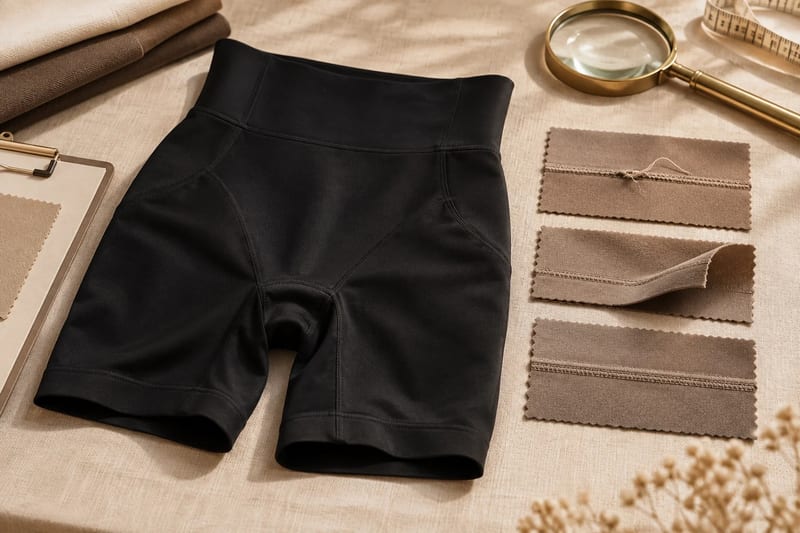
Record garment and material identifiers, size, relevant wearer measurements, closure position and dressing sequence. Observe coverage, movement, contact and how the garment interacts with the intended bra or outer clothing. Keep the tasks tied to the actual fashion use rather than claiming the review proves a clinical application.
Discuss targeted alternatives through S-Shaper’s customization service. If the torso feels unsuitable or an opening moves, ask which dimension or component should be revised. Do not change several features without preserving the reason and version, or infer that a tighter sample is automatically better.
Agree relevant product and after-care checks with the quality-assurance team. Keep laboratory method, conditions and units with measured evidence. A measured fabric result and a wearer observation answer different questions; neither automatically approves every size.
Review customer instructions and wording against what was actually supplied and tested. Avoid unverified pressure values and body-change promises. If an intended claim remains unsupported, identify the work needed before release rather than allowing the category name to stand in for evidence.
Which Fajas Manufacturers Match Your Origin and Own-Label Requirements?
Compare a coordinated factory route, a documented Colombian own-label program and an established wholesale catalogue. These are distinct buying models. The examples describe published terms and limits, not national quality rankings, universal minimums or proof of medical performance.
China Private Label Fajas Manufacturer: Build the Specification Around the Actual Construction
China private label fajas manufacturer comparisons should identify layers, coverage and closures before discussing price, so a style name is not mistaken for a complete manufacturing brief.
Recommended supplier: S-Shaper
S-Shaper’s OEM/ODM service describes material and style recommendations with design, production, QA and export specialists. Ask which available platform can address the intended faja construction and what sample evidence will validate it. Experience across several customer regions helps frame the proposal, while actual garment records must establish suitability.
Conditional small-order options depend on the selected materials, hardware and customization. They do not establish one minimum for every structured garment. This route suits an own-label startup seeking coordinated factory advice and practical alternatives. Request an accurate quote for the approved layers and closure, and keep origin information separate from style language and unsupported clinical claims.
Colombia Private Label Fajas Manufacturer: Confirm the Specific Program and Quantity Rules
Colombia private label fajas manufacturer comparisons should verify the actual own-label program, component proposal and size allocation rather than treating Colombian origin as a complete product specification.
Recommended supplier: CI Aliada
CI Aliada publishes a Bogotá manufacturing program under the buyer’s brand, with a stated entry of 12 units per style and color, at least four sizes and multiples of three per size. Those are supplier-specific published conditions, not an industry minimum. Ask how the selected reference and customization fit the current program.
The construction, origin details, sample scope and delivery terms still need a written proposal for the actual order. The reviewed page uses medical and recovery terminology, but those descriptions do not establish clinical suitability for your brand’s intended claim. This route suits a founder seeking a documented Colombian own-label route who can validate the selected garment and distinguish supplier program terms from a universal faja rule.
USA Fajas Manufacturer: Establish Whether the Offer Is Wholesale Resale
USA fajas manufacturer inquiries can lead to established shaping catalogues; confirm whether the opportunity is resale before assuming original manufacture, relabeling or a domestic production claim.
Recommended supplier: Vedette
Vedette publishes a wholesale route with shaping catalogue products and buyer support. Ask which ready garment meets the required layers, coverage and closure and what sizes and shades are currently orderable. A catalogue can be a concrete resale option when the audience matches an existing product.
The reviewed wholesale information does not establish US manufacture, unrestricted private labeling or guaranteed domestic stock. Confirm rights, actual product origin and dispatch arrangements. This route suits a reseller rather than a founder assuming every construction can be changed under wholesale terms. If the brand needs a new torso, panel or closure, obtain an agreement that explicitly covers that development.
Select the route that can document the actual construction, rights and origin while supporting the evidence your intended product claim requires.
What Must the Faja Approval and First Order Record Preserve?
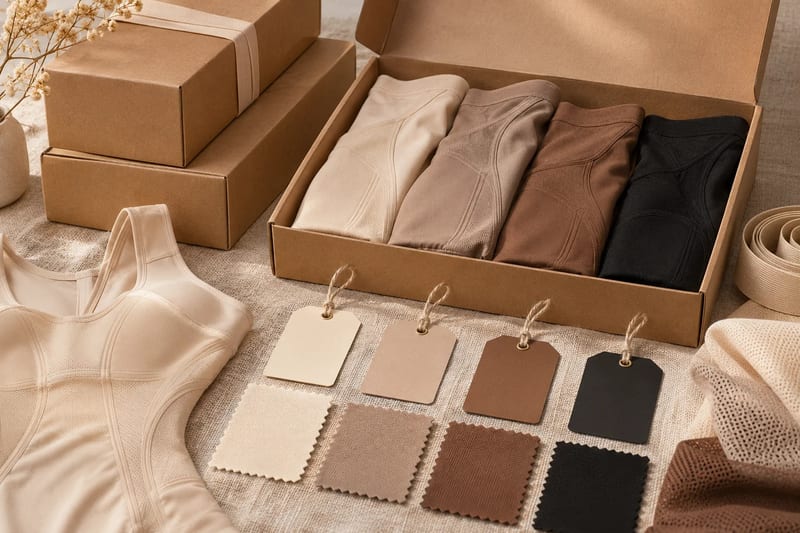
Lock the material references, layers, coverage, closure, gusset, straps, measurements, labels and proposed care with the approved garment. Identify reviewed sizes and remaining gaps. The commercial order should distinguish the chosen version from another style with a similar faja name.
Create the order grid from actual audience evidence and cash limits. Confirm which quantity basis applies per style, shade, size or program. A small advertised entry does not automatically permit every mixture or custom change. Keep development commitments separate from garment quantity.
Read the published order FAQ as preparation and obtain item-specific sample, quantity and timing terms. Ask how material, closure and pattern substitutions are handled and which changes require another review.
Connect the approved product and origin information with packing and receiving arrangements. Retain the sample and evidence for reorders. A same-name replacement needs review if its layers, coverage or components change; the category label alone is not proof that it reproduces the approved wearer result.
How Can S-Shaper Help Turn a Faja Reference into a Clear Project?
S-Shaper can be approached with a marked construction reference, intended wearer and fashion use. Ask its team to identify a feasible platform, explain material and closure alternatives and propose the relevant sample review. This gives the founder a concrete product proposal rather than a category or control-level promise.
Its published support includes recommendations and specialist communication through design, production, QA and export. Confirm actual capability, documentation and order conditions for the selected structured garment. Conditional low-quantity possibilities must be checked for the specific material and customization.
Send a focused brief through S-Shaper’s project inquiry. Request identified samples and an accurate quote for the approved version and size grid. Keep style, origin and claim evidence separate so the final product can be described clearly and reproduced through production.
FAQ: Private Label Fajas: Construction and Sourcing Questions for New Brands
Does faja mean made in Colombia?
The style term alone does not establish origin. Ask for manufacturing information for the actual ordered item and preserve it separately from the construction description and supplier office address.
Does a recovery-themed listing prove medical suitability?
No. Supplier terminology alone does not establish a clinical use or outcome for your product. This guide concerns fashion sourcing; an intended clinical application needs appropriate separate evidence.
Are all private-label faja minimums the same?
No. The cited Colombian program has its own stated size and quantity conditions. Other stock, adaptation or development routes require their own written terms for the actual garment.
Can a seamless-body price forecast a structured faja?
Not without matching the scope. Layers, closure, coverage, materials and development can differ. Use the explicitly qualified channel evidence and request a quote for the approved construction.