 EN
Quick Answer
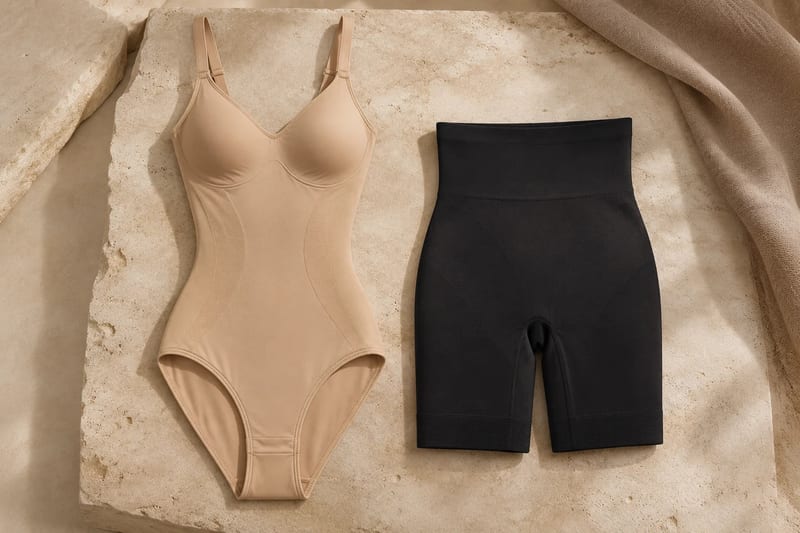
Choose a bodysuit or shaping shorts as the first product by matching the audience’s clothing use with the development and fit work your launch can complete. A bodysuit adds torso, neckline, bra arrangement and crotch-closure questions; shorts focus the review on waist, rise, leg coverage and openings. Neither is universally easier or a proven best seller for every startup.
Compare actual platforms, sample workload, size-and-color grid and complete commercial scope. Use product-specific prices for each category and an actual quote for the approved garment. Launch the product whose wearer requirement and approval gaps you can explain clearly.
Which Customer Problem Should the First Product Solve?
Identify the priority outer clothing and use before choosing the silhouette. A customer seeking a visible top or particular neckline has a different need from one seeking coverage beneath a skirt. Do not select a bodysuit because it appears more complete or a short because its advertised price is lower.
Compare relevant options in S-Shaper’s product catalogue and mark the essential features. Ask what an existing platform can provide and what would require development. The first decision should connect customer evidence with a manufacturable product, not reproduce the breadth of an established brand.
Keep a short decision statement: who wears it, beneath or with what clothing, and which result matters most. If those questions remain unclear, adding more product categories will not resolve the uncertainty.
A clear product brief can reverse an apparent cost-based decision. If the audience specifically needs a top that integrates with trousers, a lower-cost short may leave the central need unanswered. If the main request is under-skirt coverage, adding an upper body can introduce work without a useful customer benefit. These are hypothetical decision examples, not demand findings for either category. Ask which garment solves the actual problem with the least unresolved compromise. Keep the answer tied to the audience evidence, then let the supplier assess feasible construction and commercial terms. That sequence makes the first category choice explainable without claiming one is best for every startup.
Which Fit Questions Does Each Garment Add to the Project?
For a bodysuit, review torso length, front and back coverage, neckline, straps or sleeves where used, intended bra arrangement and crotch closure. A comfortable waist and hip fit does not approve the entire garment. Dressing and removal belong in the sample plan.
For shorts, review rise, inseam, waist, seat, gusset and leg openings. Observe rolling, migration and visibility under the priority clothing. A short removes some upper-body questions but still needs representative proportions and size review; it is not a fit-free product.
Ask the developer to identify the important unknowns for the actual platform. A familiar bodysuit may require less new work than an unusually complex short. Compare the proposed project rather than assuming garment category alone predicts development time or difficulty.
Consider two hypothetical wearers with similar waist and hip measurements but different torso proportions. They could select the same short under the proposed size guide, yet experience the same bodysuit differently at the shoulder and crotch. That is a development question to investigate, not a rule that one body proportion cannot wear a bodysuit. Record the actual measurements and garment response before changing the pattern or size guidance.
The reverse simplification can also fail. Two wearers who find a body acceptable may differ in where a separate short’s rise and opening sit. Removing the upper body does not remove proportion questions. Ask the tester to identify the actual boundary that moves or shows through clothing rather than offering only a preferred category.
Use these interactions to plan informative trials. A tester who exposes an unresolved torso issue contributes different evidence from one who confirms waist fit again. Select the next review for the uncertainty it can resolve and preserve the exact garment used. A first collection does not need a universal ranking of silhouettes; it needs enough evidence to explain the chosen product’s intended wearer and limits.
Bodysuits vs Shaping Shorts: How Does the First-Order Workload Compare?
Use a common planning basis while preserving product differences. In an illustrative assortment, one product × four sizes × two shades gives eight configurations. Launching both products gives 16. Adding two length or torso options to both would create 32, before considering another neckline or coverage style.
These chosen factors show how a grid expands; they do not establish demand, minimums or a prescribed sample count. The actual test plan should reflect the important fit questions and identify unreviewed combinations. Avoid spreading the first budget across more options than the team can meaningfully approve.
| Decision | Bodysuit | Shaping shorts |
|---|---|---|
| Main additional fit areas | Torso, neckline, bra arrangement, crotch closure | Rise, inseam, waist and leg openings |
| Use review | Dressing and intended upper/lower clothing | Dressing and intended outer hems |
| Material review | Whole body and attachments | Waist, body and openings |
| Chosen initial grid | 1 × 4 × 2 = 8 configurations | Another product adds 8 |
| Extra fit/length factor | Two options double the relevant grid | 32 if applied to both products |
Illustrative launch arithmetic: lower ticket price does not automatically mean lower opportunity
The following numbers are hypothetical planning inputs, not public S-Shaper prices, supplier quotes, real sales or a recommended budget. Suppose the body has a chosen garment cost of $12 and other landed allocations of $4, giving $16 per received unit. Suppose the short has corresponding inputs of $8 and $3, giving $11. Use actual freight, taxes and checks in your own model; these allocations are invented only to demonstrate the calculation.
Assume 200 units of either product. Body inventory requires $3,200 and short inventory $2,200. Add chosen fixed launch costs of $1,000 for the body and $750 for the short: initial cash becomes $4,200 or $2,950. Launching both under these assumptions commits $7,150 before any extra shared overhead or cash buffer. The calculation says nothing about supplier minimums or whether customers will buy the units.
Now choose planned selling amounts of $48 and $36 and other variable selling costs of $12 and $10 per sale. Those variable allowances are assumed to cover the selected selling, fulfillment and return-related costs; they exclude the landed garment and fixed launch amount already listed. Contribution is $48 − $16 − $12 = $20 for the body and $36 − $11 − $10 = $15 for the short. Fixed-cost recovery is 50 sales in each case: $1,000/$20 and $750/$15.
That equal result does not mean equal inventory cash exposure. At 50 sales, 150 units remain. Their allocated inventory cost is $2,400 for the body or $1,650 for the short. Recovering the modeled fixed cost through contribution is not the same as recovering all prepaid inventory cash. Keep unsold stock, timing and cash needs visible rather than calling the 50-unit result a complete cash-payback forecast.
| Hypothetical planning field | Bodysuit | Shorts |
|---|---|---|
| Landed unit allocation | $16 | $11 |
| Inventory: 200 units | $3,200 | $2,200 |
| Chosen fixed launch cost | $1,000 | $750 |
| Initial inventory + fixed cash | $4,200 | $2,950 |
| Chosen selling amount / other variable cost | $48 / $12 | $36 / $10 |
| Contribution per sale | $20 | $15 |
| Fixed cost ÷ contribution | 50 sales | 50 sales |
| Remaining inventory cost at 50 sales | $2,400 | $1,650 |
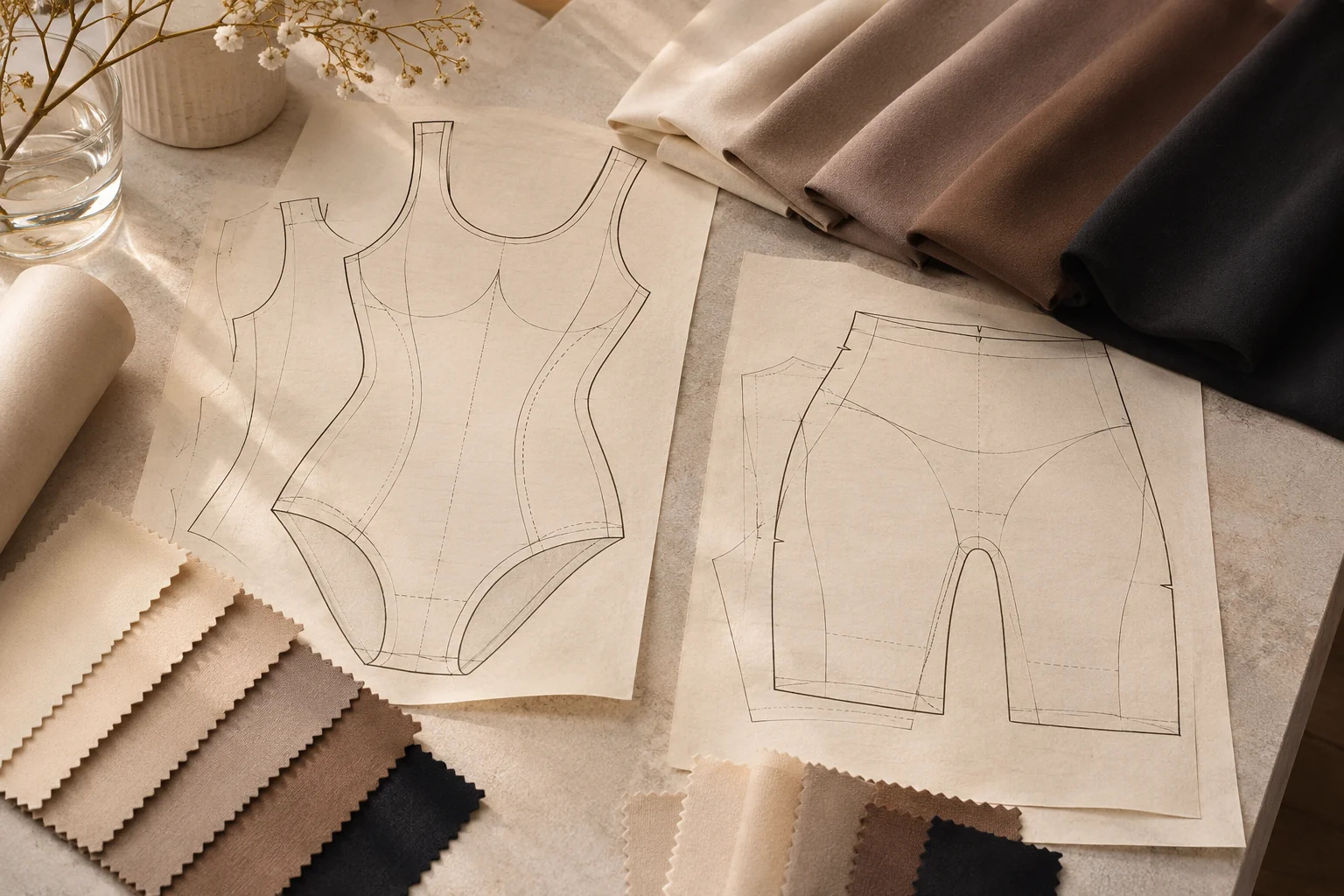
Illustrative sourcing and product-development scene. Click to continue the related buyer guidance.
How Do Bodysuit and Shaping-Short Prices Compare Without Mixing Constructions?
This compact comparison uses US-facing USD per single garment, reviewed November 10, 2026. The intervals combine selected observed offers; they are not industry averages, statistical estimates or matched-quality results. Amazon inputs are dated May–September 2026 tracker records, with the short observations in August–September, rather than live November checkout. Other channels also contain different snapshot dates and selected promotional variants.
| Channel | Bodysuit: USD each | Shorts: USD each | Scope of the selected observations |
|---|---|---|---|
| Amazon US | $12.38–$19.99 | $9.99–$28.60 | Dated 2026 tracker records; different brands and constructions, not live checkout |
| Brand DTC | $29.99–$78.00 | $28.99–$81.00 | Selected sale/regular single garments; everyday bodies and selected short styles |
| TikTok Shop US | $21.99–$46.99 | $19.99–$65.98 | Selected single-garment offers; constructions and promotional variants differ |
| B2B garment offers | $2.50–$12.85 | $1.99–$3.96 | Body MOQ 2–600; short sellers list 50/500/1000; not matched custom-development quotes |
An interval describes this evidence set, not every seller on the channel. A one-product or one-variant observation contributes only its observed offer; it does not establish a platform-wide distribution. Taxes and shipping have not been normalized, and these US examples do not establish UK, EU or Australian tax-inclusive pricing. B2B amounts exclude the unquoted landed and development scope. Confirm the actual variant, material, rights, quantity and delivery terms through a product-specific inquiry.
The constructions are deliberately kept separate. A body includes torso coverage and a crotch closure; a short has its own rise, inseam and leg opening. Lace, zipper details or a different material can change either product. Do not use the least expensive observation to forecast a more complex garment, or treat a premium brand’s ticket price as proof that an unrelated basic product can sell at the same amount.
B2B usually leaves the consumer-brand work to the buyer and can spread production or order handling over a quantity. Retail pricing also supports audience building, content, selling channels, fulfillment, service and returns. The spread therefore contains business costs and risk as well as possible brand premium; it is not all profit. A tiny original run may even cost more than a retail promotion. Request separate quotes for stock supply, permitted label adaptation and original development, then compare the approved garments on an actual delivered-cost basis.
What Evidence Should Decide the Choice Before You Expand the Range?
Test the two complete proposals against the audience’s priority use, with identified garments, sizes and representative wearers. Record the product-specific issues rather than awarding a generic shaping score. A neckline problem and a leg-opening problem need different revisions.
Ask S-Shaper’s customization team which changes can remain within the available platform. Use the quality-assurance discussion to agree relevant material, after-care and garment checks. Keep measured evidence separate from subjective observations.
List the unresolved work and actual quotation for each candidate. The decision should reflect the product the team can approve and deliver, not an invented sales ranking. If neither sample meets the essential requirement, another revision may be more useful than launching both.
Give each candidate a release gate that reflects its actual risk. The body might need the torso and closure resolved before the next size set; the short might need the opening revised before a second shade is useful. Ask the supplier which decision blocks the next step and whether the quoted schedule includes that revision. A fast sample dispatch is not the same as a product ready for sale.
Keep customer-interest evidence separate from engineering evidence. An inquiry about a neckline can identify a useful body application, while a request for coverage beneath skirts can support a short concept. Neither proves a conversion rate. Record the source and strength of the interest, ask the audience a concrete use question and avoid presenting a few comments as measured market demand. When the two products remain close, favor the one with a clearer customer use and a manageable unresolved-work list rather than inventing a score to force certainty.
Which Manufacturers Can Support a Bodysuit-versus-Shorts Launch Decision?
Compare the actual development model as well as the garment: coordinated factory proposals, an integrated seamless route or development across locations. These examples describe published capabilities and limits, not national price rankings or evidence that one first product guarantees demand.
China Bodysuit and Shaping Shorts Manufacturer: Compare Two Real Starting Platforms
China bodysuit and shaping shorts manufacturer comparisons should request two identified platforms against one audience brief, so the first-product choice rests on actual fit and development scope.
Recommended supplier: S-Shaper
S-Shaper’s OEM/ODM service describes material and style recommendations with design, production, QA and export specialists. Ask the factory team to explain the feasible body and short proposals, including which changes reopen development. Experience across several customer regions can inform the brief, while garment evidence must support the selection.
Conditional small-order options depend on the chosen materials and customization. Request actual terms for each candidate rather than assuming identical minimums. This route suits an own-label founder seeking a coordinated comparison and accurate version-specific quotes. Keep torso and closure work visible for the body, and rise and opening work visible for the short, before comparing unit amounts.
Turkey Bodysuit and Shaping Shorts Manufacturer: Compare the Available Seamless Workflow
Turkey bodysuit and shaping shorts manufacturer routes involving integrated seamless production should explain which design fits the available workflow and what garment-specific questions remain after knitting.
Recommended supplier: SML Seamless
SML describes integrated Turkish private-label shapewear and activewear production from yarn through packed goods. Ask which actual platforms fit the brief and how yarn, knit, remaining assembly and size decisions differ between them. The useful proposal identifies the sample and approval work, not simply a preferred silhouette.
The reviewed information does not establish one startup minimum, development fee or guaranteed time advantage. Confirm current platform and material conditions. This route suits a concept aligned with seamless construction and a buyer prepared to review complete garment alternatives. Integration does not eliminate torso, closure or opening questions, and it does not prove either category will sell better.
Canada Bodysuit and Shaping Shorts Manufacturer: Compare Development Responsibilities Across Locations
Canada bodysuit and shaping shorts manufacturer routes can separate development from manufacture; compare who resolves each product’s fit questions and how approved changes reach production.
Recommended supplier: Hertex
Hertex describes Montreal design, pattern development, grading and quality control, with manufacturing in China since 2006. Ask whether both proposed products fit its current scope and how the torso, opening and size-set decisions are recorded and transferred. Keep each garment’s material and version references distinct.
The reviewed background does not establish Canadian manufacture, ready local stock or a universal startup package. Obtain a current scoped proposal for the actual candidates. This route suits a buyer who values the stated development interface and can assign approval ownership across locations. A local contact does not remove product-specific sampling or make a body and short commercially equivalent.
Select the route that can identify the feasible garment and its unresolved work, then launch only the scope your approval process and budget support.
What Should You Lock Before Ordering the Chosen First Product?
Approve the selected garment, materials, dimensions, construction, labels and care with relevant size and shade evidence. Preserve the rejected candidate and reasons so the team can revisit it later without confusing the released version.
Build the order grid from actual audience evidence and cash limits. Use the general order FAQ as preparation, then confirm the chosen item’s sample, quantity and timing terms. A planning matrix is not demand evidence or a supplier minimum.
Connect approved identifiers with packing and receiving arrangements. On a reorder or second-product project, review changes against the retained reference. The first launch should produce a useful development record as well as inventory.
How Can S-Shaper Help Compare the Two Launch Options?
S-Shaper can be approached with one audience brief and two marked product references. Ask its team to recommend feasible platforms, explain the different material and fit work and quote the actual versions. This makes the first-product decision concrete before the range expands.
Its published support includes recommendations and specialist communication across design, production, QA and export. Confirm the project-specific sample and quantity conditions for each option. Send the brief through S-Shaper’s project inquiry and request an approval plan that preserves the differences instead of treating a lower unit price as the whole decision.
FAQ: Bodysuits vs Shaping Shorts: Choosing a First Shapewear Product
Are shaping shorts always easier to launch?
No. Compare actual platforms, construction and approval gaps. Shorts remove some upper-body questions but still require waist, rise, opening and representative fit review.
Which product sells better for a startup?
This guide does not establish a sales ranking. Use evidence about your audience, clothing use, positioning and actual costs rather than assuming one category guarantees demand.
Can I compare their lowest advertised B2B prices directly?
Only as differently scoped observations. Request quotes for the approved garments and preserve material, size, labeling, development and delivery differences.
Should I launch both immediately?
Choose the scope your audience evidence, budget and approval work support. The illustrative grid shows how variants multiply; it is not a recommendation to stock every combination.