 EN
Quick Answer
Reduce shapewear manufacturing costs by simplifying requirements that do not create the wearer benefit, while preserving the fit, material behavior and checks needed to deliver it. Compare existing platforms, shared materials, fewer optional colors and simpler nonessential presentation through actual supplier proposals. Do not claim a saving until the revised scope and product have been evaluated.
Design-to-cost is not a request to make the garment cheaper at any quality level. Define the essential result, ask what alternatives change the quote and review samples where the change affects use. Lower total commitment may come from fewer optional variants even when the garment unit price does not decrease.
Which Shapewear Requirements Should Be Protected Before Cutting Cost?
Write the non-negotiable wearer result before requesting alternatives. If the product promises comfortable seated use, the waistband and relevant fit behavior deserve protection. If it must remain concealed under an outfit, coverage and edge visibility matter. A saving that removes the reason customers would choose the garment creates a different proposition, not a better-cost version of the same product.
Choose an identified platform from S-Shaper’s product catalogue or use your current approved sample. Record the material, measurements, construction and intended use so proposed changes have a stable baseline. Without that reference, a supplier can offer a lower price for something that no longer satisfies the brief.
Separate functional requirements from preferences. A particular package shape or extra decorative element may be optional, while a closure needed for practical dressing is essential. Ask customers and fit reviewers what actually affects use. Do not assume that details important in a mood image deserve the same protection as the garment’s physical performance.
Keep the quality and sample evidence needed to verify the benefit. Removing checks can reduce a visible line item while increasing uncertainty about what the order contains. A cost review should explain which requirement was simplified, how the result was tested and what remains equivalent. The founder should be able to describe the change clearly before approving the revised order.
| Requirement type | Example decision | Cost-review treatment |
|---|---|---|
| Essential wearer result | Coverage, comfort or use requirement | Preserve and verify |
| Technical implementation | Material or construction solution | Compare scoped alternatives |
| Optional variant | Additional color or style | Test necessity before adding stock |
| Presentation preference | Nonessential decoration or package detail | Simplify if the offer remains credible |
| Acceptance evidence | Relevant fit and conformity checks | Do not remove without understanding the consequence |
When Can an Existing Platform or Shared Material Reduce Complexity?
Ask whether an existing garment can meet the essential requirement before developing every detail from the beginning. A suitable platform may reduce the number of unknown pattern and construction decisions. It still requires fit evaluation, and the supplier must identify which changes are permitted under the proposed quantity and price.
Discuss the distinction through the OEM/ODM service scope. A concept requiring deeper development may justify that work, while another brand can begin with an existing platform and a focused change list. Do not choose the less complex route if it leaves the main customer problem unsolved. The comparison should preserve the intended benefit, not merely reduce preparation.
Shared materials can be another scope question. Ask whether an available identified fabric meets the desired feel, recovery and appearance, and whether it changes sourcing or minimum conditions compared with a new material. The reviewed sources do not establish a universal percentage saving from stock fabrics. Obtain the actual quote and sample.
Keep substitutions explicit. Review S-Shaper’s customization options and ask which alternative is proposed, why it may change the commitment and what must be reapproved. A cheaper material name cannot prove equivalent performance. Compare the garment under relevant movement and care conditions before describing the change as a successful saving.
Lower Unit Price vs Lower Commitment: What Do Four-Channel Samples Show?
A cost-conscious collection needs a defensible specification and a manageable purchase, not a race to the lowest number across unrelated channels. The comparison below focuses on everyday seamless/platform bodysuits across consumer offers and B2B procurement. Structured fajas require a separate construction comparison. Use this context before deciding which design or assortment change is worthwhile.
| Channel / buying model | Observed USD per garment | Product and order basis |
|---|---|---|
| Amazon US seamless bodies | $12.38–$19.99 | Three brands; dated tracker offer prices, not live checkout |
| Value/mid-tier brand DTC | $29.99–$49.00 | Shapermint/Shapellx everyday bodysuit sale prices |
| TikTok Shop US seamless bodies | $21.99–$46.99 | FeelinGirl selected single-item offers; limited subset of platform |
| B2B seamless/platform bodies | $2.50–$12.85 | Seven supplier offers; MOQ 2–600; custom work and delivery not automatically included |
B2B finished-garment listings are generally below consumer tickets because the buyer takes on stock and later operations. That difference does not identify how much can be removed from your design without changing its benefit. Promotions on Amazon or TikTok Shop and different B2C brand propositions also affect the visible spread; the entire gap is not an avoidable manufacturing surcharge.
Ask suppliers to quote controlled alternatives on the same platform, protecting the essential wearer result. The separate hypothetical color-allocation example demonstrates lower cash commitment at an unchanged chosen unit cost. It does not promise a negotiated factory saving or assume that any sampled B2B range automatically accepts the proposed size-color mix.
US-facing USD per single garment, reviewed November 10, 2026. Amazon uses dated May–October 2026 third-party PriceHistory snapshots, not live November checkout. These selected-seller observations are not industry averages or matched-quality comparisons. Variants and promotions change; shipping and tax are not normalized. B2B bands describe advertised garments, not landed costs or a final custom-development quote. Sources: dated PriceHistory Amazon records, official brand/TikTok Shop pages and Made-in-China supplier listings.
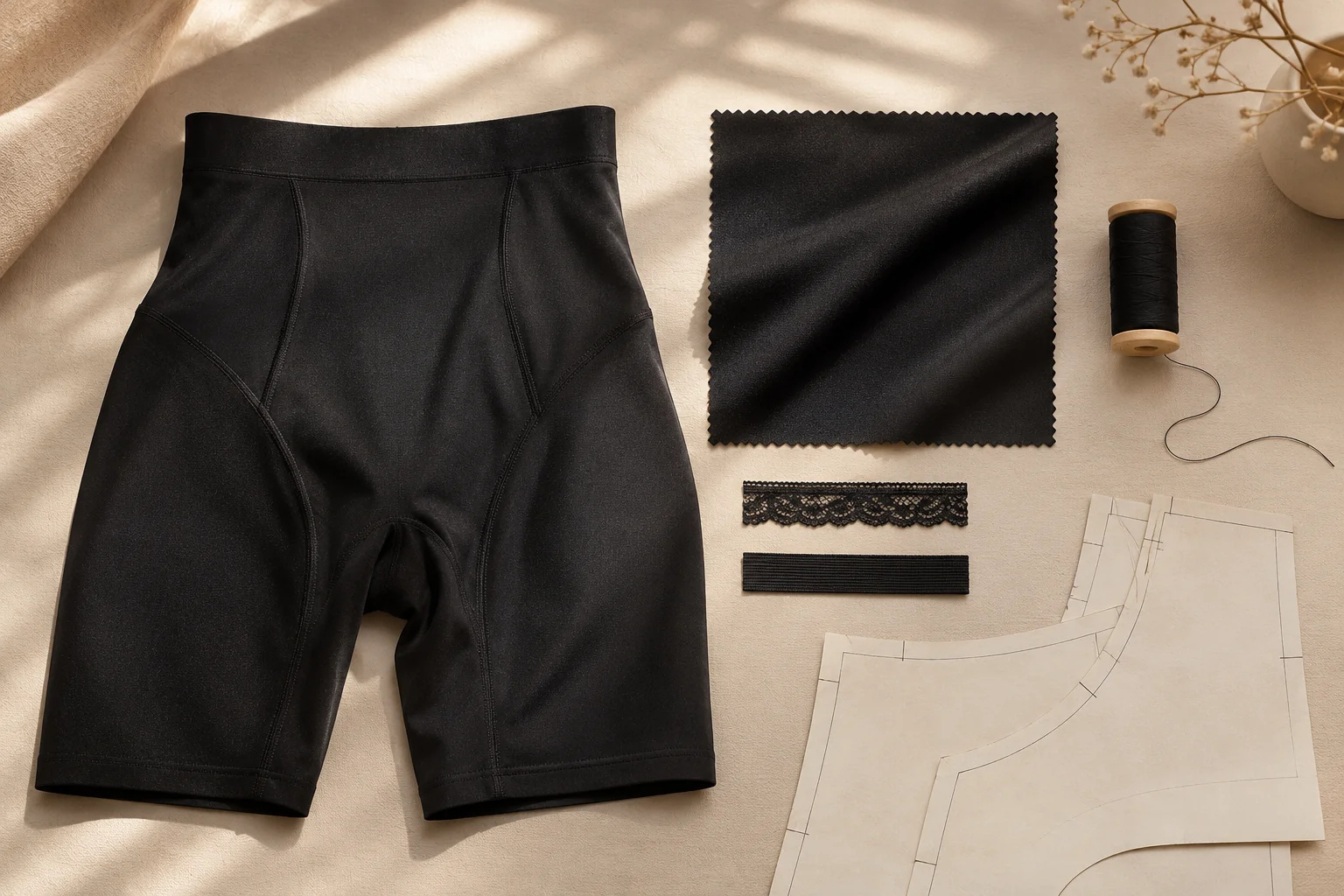
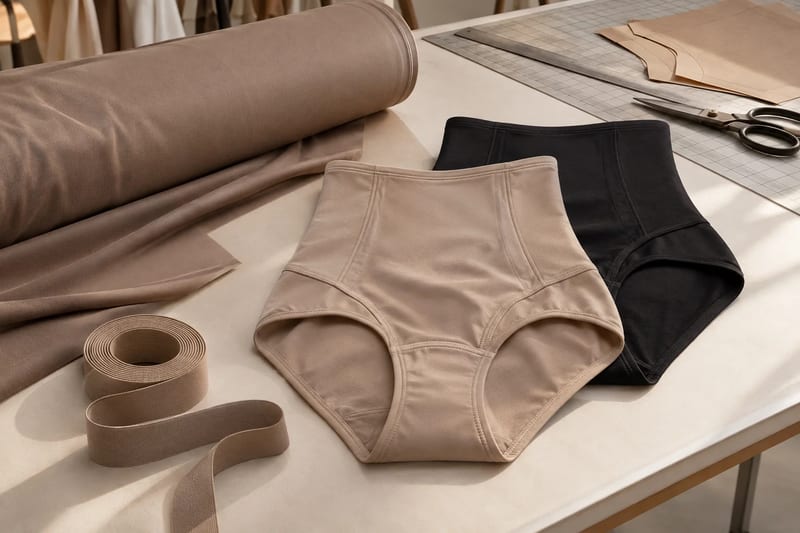
Illustrative sourcing and product-development scene. Click to continue the related buyer guidance.
How Can Fewer Optional Colors Reduce Commitment Without Cutting Essential Sizes?
Count the actual variants before changing the range. One style in three colors and five sizes makes 15 SKUs. Reducing optional colors to two makes 10. If the founder chooses a hypothetical equal depth of 10 units per SKU, total stock moves from 150 to 100 pieces. That is an assortment model, not a supplier policy or a recommended size ratio.
Choose $9 per unit solely for this inventory illustration. At 150 units, the goods assumption is $1,350; at 100, it is $900. The smaller range therefore commits $450 less under the chosen model without changing the unit input. This is not a public supplier tier, a recommended size ratio or evidence that the proposed mix qualifies commercially. Replace it with the accepted quote.
Ask the supplier to acknowledge the exact size and color matrix and applicable minimums. A per-color condition could change the result. If the audience requires the full size range, cutting essential sizes to preserve optional colors may undermine the proposition. Reduce complexity where the customer evidence gives you room, not where arithmetic alone is easiest.
Use actual feedback to refine the next order. A pilot should reveal which variants customers choose and where fit or guidance needs work. Do not replace a limited evidence base with an invented universal size split. The design-to-cost benefit is a more deliberate commitment and clearer learning, while the garment’s essential fit coverage remains protected.
| Hypothetical range | SKUs | Chosen units | Goods assumption at $9 |
|---|---|---|---|
| 1 style × 3 colors × 5 sizes | 15 | 150 | $1,350 |
| 1 style × 2 colors × 5 sizes | 10 | 100 | $900 |
| Model difference | 5 fewer | 50 fewer | $450 less committed |
| Scope | Not a demand ratio | Supplier acceptance required | Chosen input, not a quotation |
Which Construction and Presentation Alternatives Should You Ask the Supplier to Quote?
Ask for a small set of alternatives tied to a specific decision. For each, request the change, effect on the quote, minimum conditions, sample requirements and the wearer features that need retesting. A supplier can explain options more usefully when the founder identifies what must remain true about the product.
Nonessential decoration or packaging complexity can be reviewed separately from functional seams, panels or closures. Do not assume that an element is unnecessary because it is not visible in a product photo. Ask the developer what role it performs and compare the revised sample before removing it from the specification.
Preserve appropriate acceptance work through the quality-assurance discussion. If a change affects material, stretch behavior or construction, the earlier sample may no longer prove the result. Identify the checks required for the new version. Cutting evidence from the budget is not equivalent to eliminating an optional design requirement.
Review logistics consequences through the supply-chain and logistics scope. A simpler package may alter packing inputs, but no verified universal freight saving follows. Obtain relevant provider proposals for the actual configuration. Keep any claimed saving attached to a quoted scope rather than turning a plausible idea into an unverified number.
Which Shapewear Manufacturers Fit Your Design-to-Cost Decisions?
Compare production and commercial models around the requirement you can simplify. Own-label platform changes, integrated seamless alternatives and finished wholesale supply involve different decisions. The examples below do not establish country-wide savings; evaluate the actual garment and rights alongside the quoted commitment.
China Shapewear Manufacturer: Compare Feasible Changes on One Platform
China shapewear manufacturers offering factory-led development can assess which material and style changes preserve the wearer result; compare scoped alternatives rather than requesting an undefined cheaper garment.
Recommended supplier: S-Shaper
S-Shaper’s OEM/ODM offering describes material and style recommendations and specialists across design, production, QA and export, informed by several global client regions. A founder can ask the team which existing platform meets the requirement and which optional changes drive additional work. That connects design choices to a concrete sample and proposal.
Public quantity tiers and conditional small-order possibilities are useful cost references, not guaranteed access to every customization. Confirm the selected variants, components and exclusions. This route suits an own-label startup that can define the essential benefit and review alternatives physically. Keep the proposed saving separate from unsupported assumptions about national cost advantages or automatic customer acceptance.
Turkey Shapewear Manufacturer: Review the Seamless Specification Behind the Quote
Turkey shapewear manufacturer options integrating seamless stages can reveal connections between yarn, knit and finish; lower cost should be checked against the actual product requirements and grading.
Recommended supplier: SML Seamless
SML describes integrated Turkish private-label production from yarn to packed shapewear and activewear, with dedicated communication. For a seamless brief or short, ask which available technical choices satisfy the function and how custom color or yarn decisions change the proposal. A stage-specific discussion is more useful than attributing a saving to the country.
The reviewed source does not establish a universal MOQ or lowest price. Confirm actual conditions and examine opacity, recovery, edges and size behavior on relevant samples. This route suits a garment aligned with the seamless capability, where a founder can compare identified alternatives. Integration may simplify the explanation of responsibilities, but it does not prove that every lower-cost material or finish is equivalent.
Colombia Shapewear Manufacturer: Evaluate Finished Supply as a Different Business Route
Colombia shapewear manufacturer ranges can provide finished-product alternatives to developing a new garment; compare the commercial identity and wearer result before treating resale supply as design-to-cost.
Recommended supplier: Leonisa
Leonisa identifies Colombian manufacturing and an international wholesale program. A founder considering curated retail can investigate whether an established shaping product meets the customer problem without commissioning a new pattern. Ask the relevant representative about the selected range and supply conditions, then test the actual garment’s coverage and support feel.
The reviewed sources do not establish OEM or private-label availability. Avoid calling a wholesale product a cheaper own-label equivalent without confirmed rights and scope. This route suits a specialist resale offer when the platform works for the audience. If the brand requires changed measurements or exclusive construction, quote that work separately instead of assuming an available garment removes the development need.
Choose changes that preserve the tested benefit, then verify the sample, quantity matrix and complete scope before describing the lower commitment as a successful saving.
How Do You Approve a Lower-Cost Version Without Losing Product Control?
Keep the baseline and revised version side by side. Record exactly what changed, why the supplier expects the commitment to differ, and which evidence supports equivalence on the essential benefit. A founder should be able to explain the change to another reviewer without relying on a vague statement that the supplier optimized it.
Run the relevant trial again. A new fabric, edge or construction can affect more than the detail changed. Use consistent movements, outer clothing and care conditions where applicable. Record the result and remaining limitations. The approval should identify the actual version that will be ordered.
Refresh the quote and remove superseded instructions from the live order. Keep the history, but ensure the supplier acknowledges the same material, measurements, components and matrix used in your financial comparison. A price improvement attached to an obsolete specification cannot support a clear production decision.
Review the pilot’s result before scaling. A lower-cost platform that increases customer uncertainty or fails the intended benefit may require another revision. The useful objective is a credible product with a manageable commitment and repeatable records, rather than a lower headline figure achieved by quietly changing what customers were promised.
How Can S-Shaper Help Review Practical Cost Alternatives?
S-Shaper’s catalogue and OEM/ODM services provide a starting point for comparing an available platform with scoped changes. Send the target wearer, essential benefit, current reference and optional preferences. Ask which alternatives could simplify preparation or reduce the first commitment while preserving the product requirement.
Review the published FAQ for preliminary order information and confirm the exact variant and customization conditions. Request current proposals for the baseline and alternatives, with material identifiers and sample needs. Keep excluded work visible rather than assuming the lowest unit tier describes your complete project.
To begin, request a design-to-cost discussion with S-Shaper. A useful response identifies manufacturable options and the decisions needed to validate them. Your brand remains responsible for confirming the wearer result and choosing the order that its demand evidence and operating capacity can support.
FAQ: Design-to-Cost Choices for a Startup Shapewear Collection
How can I reduce shapewear manufacturing costs without weakening the product?
Define the essential wearer benefit, then ask for alternatives that simplify nonessential requirements. Compare actual proposals and samples where relevant. Do not remove fit coverage or quality evidence merely because a visible line item appears easier to cut.
Does using an existing platform always cost less?
No universal saving is established here. It may reduce development complexity when it meets the requirement, but the actual scope and price need quotation. A platform that fails the central customer need is not a useful shortcut.
Can fewer colors save cash without reducing unit price?
Yes in a defined quantity model, even if unit cost is unchanged. The illustration chooses $9 per unit: 150 pieces imply $1,350 and 100 imply $900, a $450 reduction in goods commitment. It is not a supplier tier, demand ratio or guarantee that the smaller matrix qualifies.
Should I order more to reach a bulk discount?
Only when the additional inventory is supported by demand evidence and your operating plan. Compare total commitment as well as unit price. A lower piece price does not prove that extra units can be sold at the intended offer.
What should be reapproved after a cost-related change?
Identify the changed material, construction, components and specification, then repeat the checks relevant to the wearer benefit. Refresh the quote and ensure the supplier acknowledges the current version. A prior sample approval may not cover a substantially different product.