 EN
Quick Answer
Before sampling private label tummy-control briefs, specify waist and rear coverage, the front-panel construction, gusset, leg openings, material and intended outer clothing. Ask how the proposed brief achieves its support feel and what changes across sizes. A product name or tight hand feel does not establish a measured compression level.
Compare identified garment versions with representative wearers for dressing, sitting, walking, opening behavior, coverage and care. Use the brief-specific price observations to prepare a comparable quotation request, then confirm labeling rights and the actual quantity by size and color. Approve a complete brief, not a generic promise of stronger tummy control.
How Much Waist, Front and Rear Coverage Should Your First Brief Offer?
Start with the wearer and outer clothing rather than a silhouette name. High-waist, mid-waist, full coverage and cutout can describe different products across suppliers. Mark the intended waist position, front coverage and rear shape on a reference and ask for a measurement proposal.
Choose a relevant direction from S-Shaper’s product catalogue. Identify the features that are essential to the customer use and those that are optional styling. A very small first collection benefits from one clear coverage proposition instead of several similar briefs that multiply the size grid without a distinct reason.
Treat waist and leg openings as separate boundaries. A brief can cover the intended area while an opening still creates a visible line or uncomfortable contact. Review the actual location on representative proportions and beneath the outer clothing customers are expected to wear.
Specify what must remain concealed and what can be visible. If the brief is intended beneath a pale fitted dress, preserve that use reference for sampling. Do not assume a dark sample under loose clothing approves the same product in another shade or a different application.
Ask the developer what construction choices are needed for the coverage. More fabric, another layer or a different opening can change fit and care behavior. The first brief should define the result and invite a reasoned proposal rather than dictate several untested solutions at once.
| Area | Define before sampling | Check on the garment |
|---|---|---|
| Waist | Position and intended coverage | Sitting, folding and movement |
| Front | Coverage and panel location | Transition to surrounding fabric |
| Rear | Shape and coverage objective | Movement and outer-clothing lines |
| Leg | Opening position and finish goal | Contact, migration and visibility |
What Does the Front Tummy Panel Actually Add to the Construction?
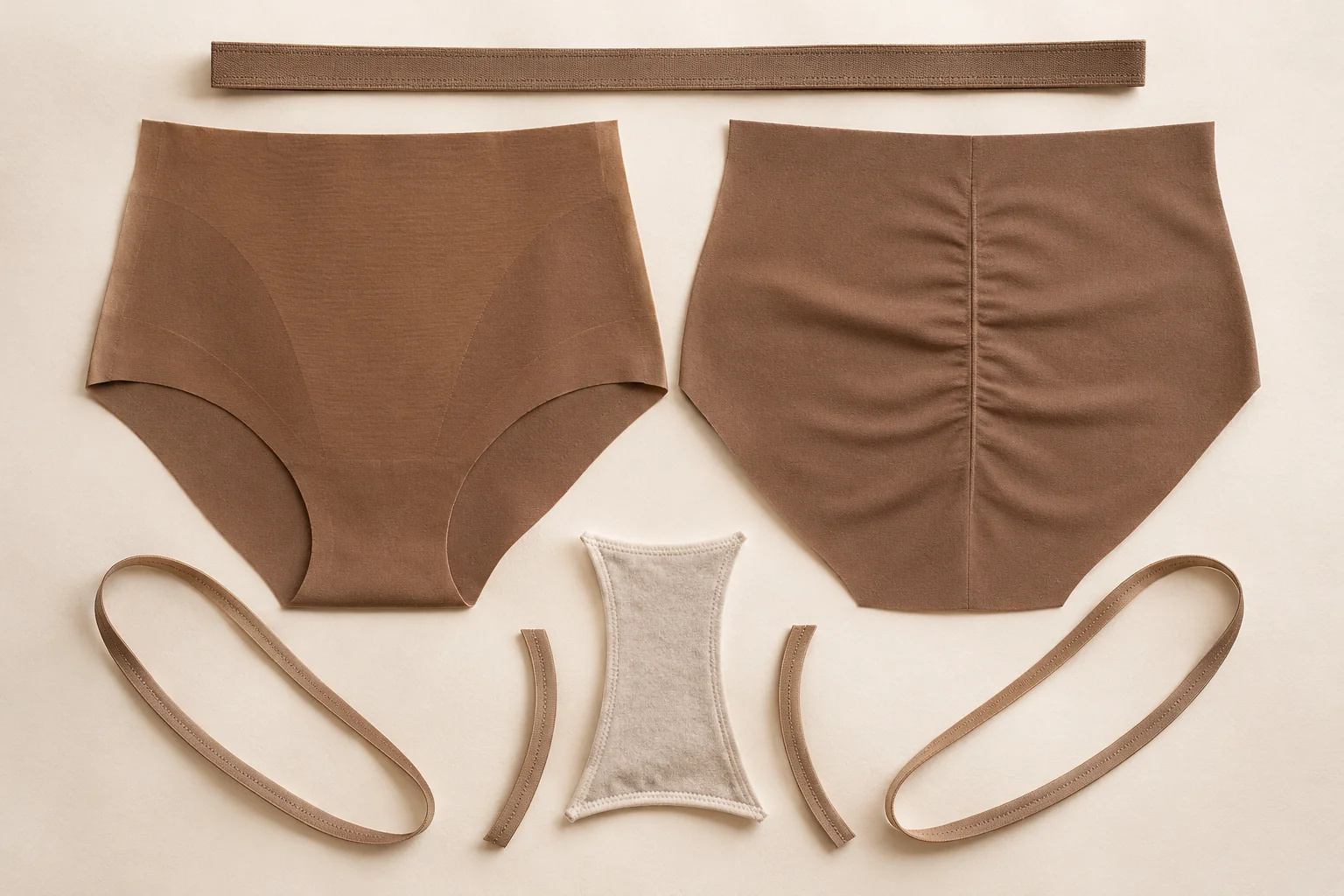
Ask the supplier to show the front construction from inside the brief. Identify whether the proposal uses the main material, another layer, a separately attached panel or another relevant arrangement. The goal is to understand what is supplied, not to impose one construction on every platform.
Request the material identity and orientation for the relevant components. A lining or panel may respond differently from the surrounding fabric. Ask how their extension and attachment are evaluated together. A firm swatch alone cannot establish the pressure or comfort of the assembled brief.
Look at transitions and edges in the garment. A panel that appears smooth flat on a table can create a visible boundary under relevant clothing or affect dressing. Keep these observations tied to the version, size and wearer. If the issue appears at a join, increasing the entire garment’s elastane content may not address it.
Avoid treating a panel as an automatic premium feature. It should have a clear job in the product and evidence that the complete brief meets the brief. A simpler construction that performs appropriately can be a valid first product. A more complex version needs its own approval and commercial scope.
Ask what remains unchanged when the panel changes. If the supplier also revises the waist or leg opening, record those differences. You can compare complete garments honestly, but should not claim that one isolated component caused every observed improvement.
Targeted Front Panel vs All-Over Shaping: Which Brief Should You Sample?
Compare two identified approaches to the same coverage and wearing objective. A targeted construction concentrates the development question in a particular area; an all-over approach asks how the main garment provides its intended feel. Neither description establishes a universal support ranking.
For an illustrative review matrix, two constructions × three sizes × two shades creates 12 configurations. If each is reviewed initially and after an agreed care routine, there are 24 review cells. This is a chosen workload example, not a prescribed sample count or a supplier minimum. Agree how many physical garments cover the plan and mark the configurations still unreviewed.
Keep the decision criteria visible. If one version is preferred for front appearance but creates an unacceptable leg line, do not hide the problem inside an average score. Ask for a targeted revision and preserve both the useful and unsuccessful observations. A first launch needs a complete acceptable garment, not one impressive feature.
| Comparison | Targeted front construction | All-over approach |
|---|---|---|
| Specification focus | Panel material, position and attachment | Main material and whole-garment fit |
| Appearance review | Check panel transitions and surrounding areas | Check overall coverage and edges |
| Movement review | Observe local behavior and dressing | Observe whole-garment response |
| Approval | Identified panel and garment version | Identified material and garment version |
| Chosen workload | 2 × 3 × 2 = 12 configurations | 12 × 2 states = 24 review cells |
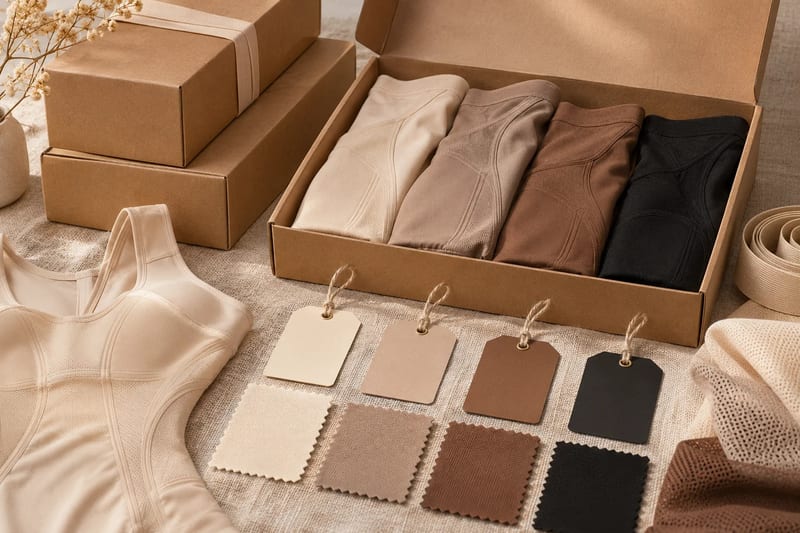
Illustrative sourcing and product-development scene. Click to continue the related buyer guidance.
What Do Tummy-Control Brief Prices Mean for Your First Buying Decision?
Briefs are not interchangeable with bodysuits, shorts or structured fajas. Use the product-specific observations below, keeping cutout, lace and opaque control constructions separate. A broad advertised range does not prove that a particular bonded, full-coverage brief can be developed at its lowest point.
Product-specific price check: tummy-control briefs. US-facing USD per single garment. Research reviewed November 10, 2026; underlying snapshot dates differ. These selected listings show channel positioning, not an industry average or a matched-quality price experiment. Single observations are marked as examples.
| Channel / model | Observed USD per garment | Scope and order basis |
|---|---|---|
| Amazon US | $26.99 (one example) | One SHAPERMINT panty observation; September 28 tracker, not a market range |
| Brand DTC | $26.99–$32.99 | Shapermint two constructions; sale prices, MSRP $45/$54 excluded from the range |
| TikTok Shop US | $16.59–$33.79 | TSberist selected Black/XS and Shapermint US; exclude packs; TSberist adds $7.99 shipping |
| B2B garment offers | $1.14–$3.65 | Chenhai cutout / Neiyishe lace underwear; MOQ300/3000; FOB; Chenhai material/construction fields conflict and need confirmation |
This brief-specific sample is deliberately narrow. Cutout, lace and opaque control panels are not interchangeable. Chenhai fields say cotton/woven while the title suggests shaping; Neiyishe has conflicting nylon/spandex and polyester fields. Obtain written composition and construction confirmation before treating either offer as comparable. The lower offer is not proof that a full-coverage bonded brief can be developed at that price.
B2B normally spreads ordering or production work across a quantity and leaves the consumer-brand layer to the buyer. Retail also funds customer acquisition, content, platform or creator fees, fulfillment, returns and overhead. The startup still pays for samples, development, quality checks, freight, tax and inventory. The retail–factory gap is neither pure brand premium nor net profit; a small custom run can cost more than a retail promotion. Existing-stock, light-label and full OEM development must be quoted separately.
Prices are indicative public observations, not final S-Shaper quotations. Confirm material, variant, MOQ, customization rights, packaging and delivery terms through a product-specific S-Shaper inquiry. Tax and shipping are not normalized; US examples are not local UK/EU/Australian tax-inclusive prices.
View the price observations and dates
- SHAPERMINT — Seamless tummy-control panty: $26.99; 2026-09-28; Indexed dated tracker; not live checkout.
- Shapermint — All Day shaper panty: $26.99; public snapshot reviewed 2026-11-10; Sale; advertised MSRP $45; not a multipack.
- Shapermint — Empower shaper panty: $32.99; public snapshot reviewed 2026-11-10; Sale; advertised MSRP $54.
- TSberist — High-waist shaping panty Black XS: $16.59; public snapshot reviewed 2026-11-10; Selected single-color option; mixed-color multipack alternatives excluded; shipping additional $7.99.
- Shapermint US — No-roll shaper panty: $33.79; public snapshot reviewed 2026-11-10; Indexed category product-specific single-item offer; not six-pack.
- Sichuan Chenhai — OEM cutout shaping brief: $1.14–$1.50; public snapshot reviewed 2026-11-10; Advertised FOB; cutout design not identical to opaque everyday brief; listed MOQ 300.
- Jiangmen Neiyishe — High-waist shaping lace underwear: $3.65; public snapshot reviewed 2026-11-10; Advertised FOB lace shaping underwear, MOQ3000; supplier page contains nylon/spandex versus polyester composition fields, so final fiber content requires written confirmation.; listed MOQ 3000.
Ask for a quotation identifying the approved front construction, gusset, openings and size mix. Confirm whether an offer covers resale, permitted label adaptation or original development. The lowest advertised brief may have a different coverage promise, and a retail promotion can temporarily narrow the apparent channel gap. Build the launch model from your actual quoted garment and delivery terms.
How Should You Specify Gusset, Leg Opening and Skin-Contact Details?
Describe the gusset as a component with its own material, shape, attachment and care requirements. If a lining is described as cotton, ask which part that statement covers. Do not let a component description become an unsupported claim about the entire garment or a medical benefit.
Review contact at seams, edges, labels and openings with the intended wearer. Ask how the brief is put on and adjusted, and whether that process strains a join or changes the waist position. A visually tidy sample can still need a construction revision after use.
Use S-Shaper’s customization discussion to compare feasible gusset and opening alternatives. Ask which are available on the selected platform and which require additional development. Preserve material and construction identifiers so an alternative can be compared with the actual approved brief.
Work with the quality-assurance team on the relevant after-care and production checks. Review dimensions, contact, edge behavior and appearance as appropriate. Do not invent a universal GSM, fiber ratio, wash count or force threshold without the product and method basis.
Keep wearer feedback specific and respectful. Record the task, location and version rather than generalizing from one tester’s body. If feedback differs, ask whether size selection, proportions, fit or sample history explains the difference. Do not ask wearers to accept discomfort because the brief is marketed as stronger control.
Which Tummy-Control Briefs Manufacturers Match Your Label and Coverage Plan?
Start by deciding whether the business needs its own developed brief or a ready branded style. These examples distinguish coordinated own-label work, professional style adaptation and a Colombian branded catalogue. They describe published capabilities and limits, not national prices, medical support levels or universal quality rankings.
China Tummy-Control Briefs Manufacturer: Coordinate Panel, Gusset and Opening Decisions
China tummy-control briefs manufacturer comparisons should connect the front panel with gusset and opening choices, so the quotation describes one complete, testable brief rather than separate feature claims.
Recommended supplier: S-Shaper
S-Shaper’s OEM/ODM service describes material and style recommendations with design, production, QA and export specialists. Ask the factory team to explain a suitable front construction and the alternatives available for the chosen platform. Experience across several customer regions can inform the proposal, while identified samples must validate coverage, movement and contact.
Conditional small-order options require confirmation for the material, shade, panel and labeling scope. A catalogue possibility does not promise one minimum for every custom brief. This route suits an own-label founder seeking coordinated sample and production advice. Request a quote for the approved complete version and preserve the material records before expanding into several similar coverage styles.
France Tummy-Control Briefs Manufacturer: Distinguish Invisible-Lingerie Resale from Own-Label Development
France tummy-control briefs manufacturer inquiries should distinguish existing invisible-lingerie styles from an own-label panel project before the buyer requests changes to coverage or material.
Recommended supplier: Gilsa Paris
Gilsa Paris describes professional resale and separate possibilities for own-label adaptation, specific development and packaging. For a brief, ask whether an existing style already addresses the intended outer-clothing use or whether the front panel and coverage require a different development request.
The reviewed information does not establish French manufacture for every product or unrestricted relabeling. Minimums depend on product type and need confirmation, as do sample and material terms. This route suits a buyer who values the stated style direction and can distinguish resale from development. A catalogue reference is useful, but it does not approve a modified gusset or panel without another review.
Colombia Tummy-Control Briefs Manufacturer: Compare a Branded Catalogue with Your Own-Label Goal
Colombia tummy-control briefs manufacturer comparisons should separate a branded shaping catalogue from original private-label manufacture, especially when the buyer intends to change coverage or front-panel construction.
Recommended supplier: Leonisa
Leonisa identifies Colombian manufacture and an international wholesale/distribution route. A buyer can examine the relevant ready styles and ask which sizes, construction references and supply arrangements fit a resale plan. The catalogue can help define a coverage comparison without implying permission to reproduce or rebrand a design.
The reviewed wholesale route does not establish OEM development or unrestricted private labeling. Confirm the actual product, origin statement and commercial terms for any order. This route suits a reseller whose audience matches an existing branded brief. A founder seeking a unique front panel or gusset needs a supplier agreement that explicitly covers that development and its approval responsibilities.
Choose the route whose rights and development scope match the actual brief, then compare the approved coverage and construction rather than a product name alone.
How Should You Approve Sizes, Labels and the First Order Grid?
Keep the size-and-color order grid separate from the review matrix. Twelve configurations do not establish demand for twelve stocked variants. Use the brand’s actual audience evidence and cash limit to choose the initial assortment, and confirm whether the supplier’s minimum applies per style, shade or another basis.
Approve finished measurements, material identity, panel construction, gusset, leg opening, waist, labels and care proposal together. Identify the reviewed sizes and shades. A middle-size success should not silently approve every proportion, and a material change should not be treated as cosmetic without review.
Read the published order FAQ to prepare questions and obtain item-specific sample, quantity and timing terms. Ask how substitutions and reorders are handled, and retain rejected versions separately with the reason for rejection.
Connect the approval record with packing and receiving arrangements. Confirm size marking and product identifiers so the delivered brief can be checked against the chosen version. A general purchase description saying tummy control does not tell either party which panel, gusset or coverage was actually ordered.
How Can S-Shaper Help Turn Your Brief Concept into an Approved Product?
S-Shaper can be approached with the wearer profile, outer-clothing use and a marked coverage reference. Ask the team to propose an identified garment platform and explain the front panel, gusset and opening options. Request samples that resolve the most important fit and contact questions before adding more styles.
Its published support spans recommendations and specialist communication through design, production, quality and export. Confirm which material, sample and labeling work is included in your proposal. Conditional low-quantity support must be checked for the actual brief and customization, not inferred from a general service statement.
Send the project details through a focused S-Shaper inquiry. Ask for an accurate quotation for the approved version and size grid. The useful result is a reproducible brief with clear coverage and evidence, rather than a stronger-sounding control claim unsupported by the finished garment.
FAQ: Private Label Tummy-Control Briefs: Product Decisions Before Sampling
Is a separate tummy panel always better?
No universal ranking follows from the feature. Compare the identified panel, surrounding material, fit and finished garment against the intended wearer requirement. A simpler construction can also be appropriate.
Can I use a bodysuit price to budget briefs?
Use brief-specific evidence and an actual quotation. Coverage, components and commercial scope differ. The observed brief table is a narrow sample of offers, not an industry average or a final custom price.
Does a cotton gusset mean the whole brief is cotton?
Not necessarily. Ask which component the description covers and obtain the relevant composition and construction information. Keep any product wording aligned with the actual supplied garment.
Which sizes should be tested before release?
Plan representative coverage for the intended range and identify remaining gaps. The illustrative matrix is a workload example, not a universal sample count. Confirm actual garments, review states and approval responsibilities with the developer.