 EN
Quick Answer
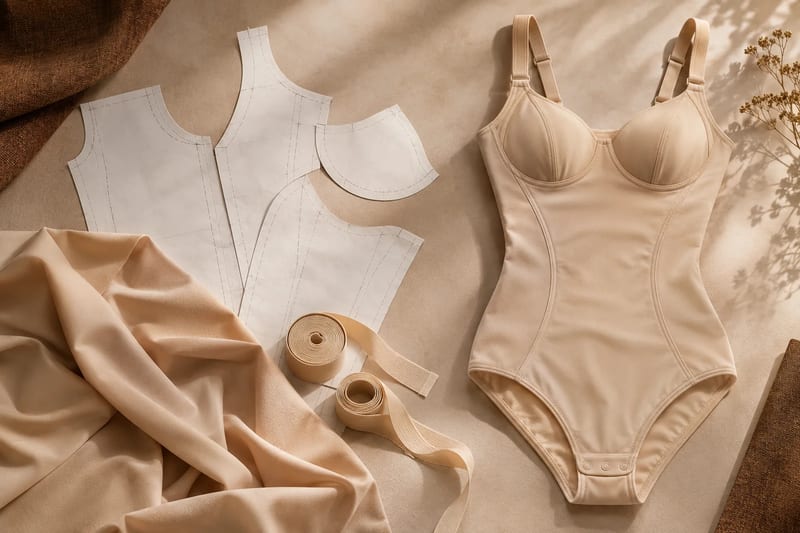
Choose OEM shapewear when you can provide a defined design and the technical inputs needed for manufacturing. Consider ODM when you need supplier-assisted development from a concept, reference or scoped product change. The practical decision is who prepares the product, materials, patterns, measurements and samples, not which acronym sounds more exclusive or professional.
Ask the manufacturer to define the deliverables, founder responsibilities, sample approvals and commercial conditions for the proposed route. Neither OEM nor ODM automatically establishes design ownership, a universal MOQ or a fixed development price. Choose the least complex arrangement that can deliver the wearer result and the records your startup needs to approve production.
What Do OEM and ODM Mean in a Shapewear Project?
Supplier terminology varies, so begin with the actual work. In this guide, OEM means manufacture from a buyer-defined design and specification, while ODM means supplier-assisted product development. An existing platform with scoped changes can sit within a development conversation; it should not be confused automatically with an exclusive new design.
The S-Shaper OEM/ODM service page describes OEM as production from client designs and brand identity, and ODM as support from concept through development, including material recommendations, samples and revisions. Use those descriptions to ask who performs each stage in your actual project rather than assuming every provider uses the terms identically.
For a startup, the key issue is readiness. A founder may have a compelling customer problem but no technical record, or a detailed design that still needs manufacturing interpretation. Both can be valid starting points. Disclose what is available and ask what missing work the proposal includes before treating the project as production-ready.
Keep the desired product result central. Maximum customization is not automatically the strongest brand strategy, and minimal preparation is not a good shortcut if the platform cannot serve the intended wearer. The route should solve the technical and operating gap between your brief and an approvable garment.
| Project need | OEM-oriented arrangement | ODM-oriented arrangement |
|---|---|---|
| Starting input | Defined buyer design and technical information | Concept, reference or development brief |
| Technical preparation | Buyer supplies agreed inputs | Supplier assists under defined scope |
| Main review | Manufacturing interpretation and samples | Proposals, revisions and final specification |
| Common requirement | Identifiable approved product | Identifiable approved product |
| Rights and minimums | Must be confirmed | Must be confirmed |
Which Design and Technical Inputs Can Your Startup Actually Provide?
List your current materials honestly. A sketch, inspiration image, worn reference garment and finished technical pack provide different levels of information. Explain which features each reference demonstrates and which are requirements. Do not assume that an image defines composition, construction, grading or comfort simply because the silhouette is visible.
Use an identified reference from S-Shaper’s catalogue when an available platform might help. State what you want to retain and what must change, with a reason linked to the wearer. A reference is a communication input, not an automatic instruction or permission to copy another brand’s protected work.
For a technically defined design, provide the current material references, measurement chart and method, construction details, size range, component information and artwork status. Ask the manufacturer to identify ambiguities or missing inputs before quoting production. An OEM label does not make an incomplete file set complete.
For a concept-led project, describe the customer, occasion, fit problem, coverage, desired support feel and relevant quantity and market assumptions. Ask which technical deliverables the development proposal will create. The founder still has to approve product trade-offs; supplier assistance can translate the idea but cannot independently choose the brand promise or validate customer demand.
OEM vs ODM Shapewear: How Do Control, Work and Responsibility Differ?
Compare responsibility rather than assuming OEM gives complete control and ODM gives none. A buyer supplying a detailed design may still need manufacturing feedback, while a founder using ODM must still approve materials, measurements and the final garment. Control is practical when the decisions and records are identifiable, not merely when a route has a particular name.
Discuss which work the team includes through the customization service scope. A logo adjustment, material selection and changed torso proportion involve different decisions. Ask what triggers another sample, how comments are recorded and which technical documents accompany the approved version.
Assess your capacity to review the work. If you lack the knowledge to interpret grading or a complex construction, determine whether the supplier or another specialist will provide the needed support. An apparently lower production-only quote may leave the founder with work that still needs to be commissioned separately.
Keep development scope bounded. A defined wearer problem and a focused first garment make it easier to decide whether the next proposal meets the requirement. Repeatedly changing the concept can create additional work under either route. The useful agreement explains who proposes, who decides and how the next version becomes the current production reference.
| Decision area | OEM question | ODM question |
|---|---|---|
| Design readiness | Are buyer inputs complete enough? | What will development create? |
| Material decisions | Can the specified option be manufactured? | Which proposed option fits the brief? |
| Revisions | How are manufacturing comments resolved? | Which rounds and changes are scoped? |
| Founder approval | Which reference is production-ready? | Which developed version is approved? |
| Extra support | What work remains outside production? | What work remains outside development? |
Illustrative sourcing and product-development scene. Click to continue the related buyer guidance.
How Should OEM and ODM Buyers Use Four-Channel Price Benchmarks?
An OEM-to-ODM comparison concerns the technical work needed for your product, while the channel table concerns observed product offers. Do not infer a standard development premium from unrelated retail and wholesale listings. First separate basic seamless garments from structured shaping products, then identify which preparation your actual manufacturing route requires.
| Channel / buying model | Observed USD per garment | Product and order basis |
|---|---|---|
| Amazon US retail bodies | $12.38–$35.14 | Seamless/lighter bodies $12.38–$19.99; Structured bodies $35.14–$35.14. |
| Brand DTC bodies | $29.99–$148.00 | Seamless/lighter bodies $29.99–$78.00; Structured bodies $69.00–$148.00. |
| TikTok Shop US bodies | $21.99–$54.99 | Seamless/lighter bodies $21.99–$46.99; Structured bodies $39.99–$54.99. |
| B2B advertised OEM bodies | $4.25–$8.30 | Rihope/Shangyou garment offers; listing MOQ 600/100; own-design terms reconfirmed |
| B2B custom shiny-fabric example | $22.00–$23.00 | Hucai FOB garment example, MOQ 200; a different fabrication; development fees unconfirmed |
B2B finished-garment bands generally sit below consumer tickets, but new design, material sourcing and revisions can remain outside those numbers. Amazon and TikTok Shop promotions and B2C brand positioning also change the visible consumer side. The difference is not a disclosed ODM fee, a universal brand premium or profit automatically available after private labeling.
Give suppliers the same garment brief and matrix, asking what each route expects from the founder and what it delivers. Quote missing technical work separately. A finished-stock price can anchor a question about the platform, while your current OEM or ODM proposal must identify the actual specification, samples, component conditions and delivery responsibilities.
US-facing USD per single garment, reviewed November 10, 2026. Amazon uses dated May–October 2026 third-party PriceHistory snapshots, not live November checkout. These selected-seller observations are not industry averages or matched-quality comparisons. Variants and promotions change; shipping and tax are not normalized. B2B bands describe advertised garments, not landed costs or a final custom-development quote. Sources: dated PriceHistory Amazon records, official brand/TikTok Shop pages and Made-in-China supplier listings.
Which Sample and Approval Records Do Both Routes Need?
Identify what the sample represents: size, material, construction, version and any difference from the proposed production product. An existing garment may demonstrate a platform without proving a later custom change. A development sample may address one fit question without validating the entire size range.
Use relevant wearer tests and measurement methods. For shorts, walking and sitting can expose edge and waistband behavior. For bodysuits, review torso length, straps, closure and dressing convenience. Keep the trial conditions and participant measurements appropriate to the project, so comments can become useful technical feedback rather than an overall impression.
Request a numbered response to revisions and preserve the version history. The quality-assurance discussion should connect the final approved reference with the checks intended for production. Ask which sizes or features require further physical review and how the remaining product information will be confirmed.
Confirm the release conditions. Payment for development or a commercial quote does not automatically approve the garment. Identify the final material, measurements, artwork and quantity matrix, then ask the manufacturer to acknowledge the current file set. This discipline applies under both OEM and ODM and becomes more important when several people contribute to product decisions.
Which Shapewear Manufacturers Fit the Development Work You Need?
Compare documented capabilities and project responsibilities rather than assigning OEM or ODM to entire countries. Factory-led support, integrated seamless production and research-focused development can each address different gaps. Ask what the selected supplier will deliver and what must still come from your team before comparing the commercial commitments.
China Shapewear Manufacturer: Choose the Actual Development Responsibility
China shapewear manufacturers offering both OEM and ODM can compare buyer-defined production with supplier-assisted preparation; identify the missing technical work before selecting an acronym or quantity tier.
Recommended supplier: S-Shaper
S-Shaper’s service page describes production from client designs alongside concept-led development, material and style recommendations, sample work and revisions. Its specialists across design, production, QA and export have stated experience with several global customer regions. Ask which team members and deliverables the selected garment actually requires.
Factory-direct price tiers and conditional small-order routes are starting references, not universal terms for every design. Confirm the current specification, components and development scope before comparing proposals. This route suits a startup that can state the wearer problem and needs either scoped technical help or production of an established design. Global experience can inform recommendations, while your own fit and offer evidence must validate the product for the audience.
Turkey Shapewear Manufacturer: Align the Design with a Seamless Production Route
Turkey shapewear manufacturer options with integrated seamless operations can suit a defined platform or scoped development; clarify yarn, knit and finishing responsibilities rather than assuming one service label covers everything.
Recommended supplier: SML Seamless
SML describes Turkish private-label shapewear and activewear production in integrated yarn-to-packed facilities, with dedicated communication and European and American customer experience. For a seamless product, ask whether your supplied design fits the process or needs technical adaptation before sampling. Identify which records will describe the proposed material and construction.
The reviewed source does not establish universal startup minimums, development fees or an exclusive design arrangement. Confirm color-batch conditions and inspect opacity, recovery, edges and grading on relevant samples. This route suits a brief aligned with seamless capability, whether the buyer supplies more technical information or requests a defined amount of assistance. Integration does not remove the founder’s role in approving the actual garment.
Portugal Shapewear Manufacturer: Scope Research-Led Development Explicitly
Portugal shapewear manufacturer routes with technical research can address a distinct material or construction requirement; define the development evidence before comparing the proposal with manufacture from a finished specification.
Recommended supplier: Impetus
Impetus describes research capability, cooperation with technical institutions and development across seamless and cut-and-sew products. A founder with a defined functional requirement can ask which prototype or investigation is needed to turn it into a production reference. That is a different scope from simply supplying a completed design for manufacture.
Startup eligibility, MOQ and pricing remain unverified by the reviewed pages. Material and laboratory work can add commitments relative to an existing platform, without establishing a national premium. This route suits a validated technical need with resources for scoped evidence. It is less appropriate as an open-ended attempt to discover the customer proposition after technical development has begun; the founder should first define the problem the work must solve.
Select the route whose deliverables close the actual product gap, then preserve the founder’s final approval and the specification that manufacturing must follow.
Does Choosing OEM or ODM Automatically Establish Exclusivity or Ownership?
No automatic ownership conclusion should be drawn from the service acronym. Identify the practical questions: which design elements already exist, which work is created for the project, who supplies or holds the relevant files, how the product may be used and whether any exclusivity is proposed. Ask for the applicable terms rather than assuming that paying for a label transfers the underlying platform.
Confidential information needs its own handling process. WIPO’s trade-secret overview explains the importance of reasonable protective measures for qualifying confidential business information, including measures involving business partners. That supports a focused discussion about what information is confidential and how access and use will be managed; it is not proof that every reference, pattern or idea automatically qualifies for protection.
Use appropriate project-specific advice when rights or restrictions are material to the business. Keep commercial expectations concrete enough to review: deliverable files, permissions, access, proposed restrictions and the party responsible. Do not rely on vague language such as your brand or custom product to settle all of those questions.
Maintain the approved product record and change process alongside any separate rights arrangement. A clear understanding of technical work and confidentiality can support the relationship, but it does not replace fit testing, quality criteria or the logistics plan. Review the handoff scope so the chosen development route leads to a product the startup can actually receive and support.
How Can S-Shaper Help You Decide Between OEM and ODM?
S-Shaper explicitly presents both client-design manufacturing and supplier-assisted development. Send the team the materials you already have, whether a clear brief, reference garment, sample or technical pack. Identify the target wearer, essential benefit, market, proposed variants and quantity so the recommendation can address the actual project.
Ask which technical documents, material options, samples and revisions the proposed route includes. Review the published FAQ as preliminary context and confirm item-specific order conditions directly. Keep goods pricing, development scope and branded components distinct in the quotation.
To begin, request an OEM-versus-ODM scope discussion with S-Shaper. A useful response should identify what the supplier can prepare, what you must supply and which approvals precede production. The strongest route is the one that delivers an understandable, manufacturable product while keeping the founder’s customer and commercial decisions explicit.
FAQ: OEM vs ODM Shapewear: Choose the Right Development Route
Should a startup choose OEM or ODM shapewear?
Choose according to the technical inputs you can supply and the work the product needs. OEM generally begins with a buyer-defined design, while ODM involves supplier-assisted preparation. Confirm the actual deliverables because terminology and project scope can vary.
Do I need a technical pack for ODM?
Not always at the first discussion, but the project still needs an identifiable production specification before release. Ask who prepares measurements, materials and construction records and what the proposed support includes. A reference image alone does not settle every technical decision.
Is ODM always cheaper or faster?
No universal price or timing relationship is established by the reviewed sources. Existing platforms, material readiness and the required changes affect the work. Compare the selected garment and complete preparation scope through current proposals rather than assuming an acronym determines the result.
Does OEM or ODM guarantee an exclusive design?
No automatic exclusivity or ownership conclusion follows from the label. Clarify existing platforms, project deliverables, permissions and any proposed restrictions in the applicable arrangement. Obtain project-specific advice where rights are important instead of relying on broad branding language.
What should both routes have before production?
An identified approved product, relevant sample evidence, current specification, artwork and quantity matrix, with quality and commercial conditions acknowledged. Keep unresolved changes visible. Development support or payment does not by itself prove that the final garment is approved for manufacture.