 EN
Quick Answer
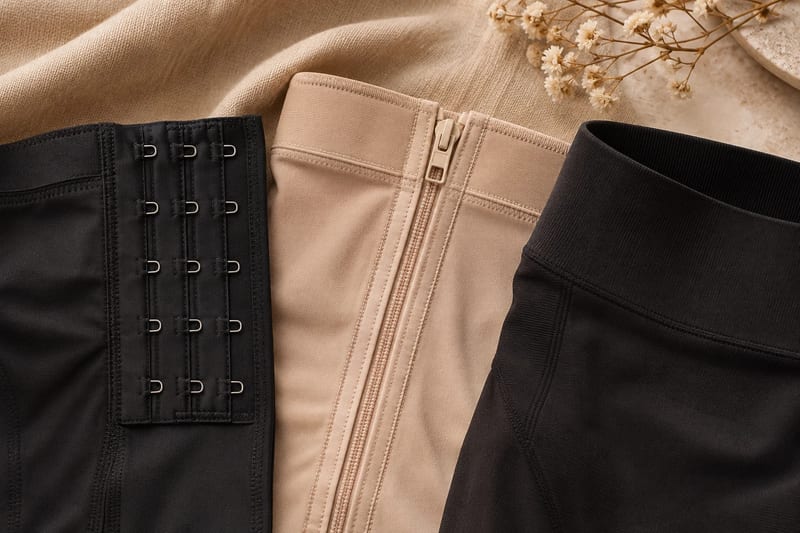
Choose hook-and-eye, zipper or pull-on shapewear from the intended dressing sequence, fit adjustment, coverage and contact requirements. Specify the complete assembly, not only the fastener name. A zipper’s strength does not establish easy operation, and multiple hook rows do not guarantee a universal fit range.
Compare identified garment proposals with relevant wearers and record fastening, movement, access, contact and after-care behavior. Keep component test scopes and procurement units clear. Request a quote for the actual assembled garment and development scope rather than comparing a length of tape with a finished closure or assuming one route is always cheaper.
What Should the Closure Allow the Customer to Do?
Describe how the garment is dressed, adjusted, opened and removed. Identify the fastening location and whether the wearer can reach it under the intended use. A closure that operates on a table can create a different experience once the garment is worn.
Select the actual product from S-Shaper’s product range or a marked development reference. A waist-only garment, structured body and everyday pull-on style have different openings and coverage. Do not choose a fastener from a catalogue image before establishing the garment architecture.
Identify whether adjustment is part of the requirement. Hook positions can provide defined settings in a particular construction, while a zipper or pull-on arrangement has another relationship to fit. Ask the developer what the actual settings mean; do not present them as a guaranteed body-change program.
Define appearance and contact requirements. A fastener can create an outline, a local boundary or a point of contact beneath outer clothing. The proposed placement, lining, guard and attachment should be identified where relevant, not assumed from a category label.
Keep the intended wearer range and proportions in the brief. If a torso or opening is unsuitable, another closure can help only if the complete garment proposal addresses the issue. A stronger fastener is not a substitute for correct fit or usable dressing.
| Requirement | Define | Review on the garment |
|---|---|---|
| Dressing | Sequence and fastening location | Reach, alignment and removal |
| Adjustment | Intended settings and selection basis | Actual fit at the chosen setting |
| Coverage/appearance | Priority outfit and boundaries | Outline, edges and interaction |
| Contact | Relevant hardware and lining locations | Movement and wearer observations |
Specify the actual fastening assembly
For hook-and-eye, identify the paired components, rows or positions, tape or mounting construction, dimensions, material and attachment. A count alone does not describe the assembled product. Ask how alignment and relevant contact areas are handled in the proposed garment.
Prym Intimates lists hook-and-eye tapes among its lingerie component offerings. That establishes a supplier category, not one universal shapewear specification or proof that every tape fits your material and use. Obtain the actual component reference and assembly evidence for the project.
Source: Prym Intimates product portfolio
For a zipper, identify the actual type, length, slider, stops and relevant attachment and covering construction. Confirm which parts are supplied as a complete assembly and which are added during garment production. YKK’s published FAQ notes that attachment depends on the application; discuss the actual material and garment with the component and garment specialists.
Source: YKK Americas FAQs
For pull-on, specify the opening and the complete garment’s dressing requirement. Eliminating hardware removes some component questions but does not remove fit, extension, recovery or contact questions. Ask whether the wearer can dress and remove the approved version as intended.
Keep any guard or lining proposal identified. A feature meant to separate hardware from the wearer needs its own location, material and attachment review. Do not promise that a named fastener or one protective-looking layer eliminates every possible catching or contact event.
Hook-and-Eye vs Zipper vs Pull-On: Which Trade-Offs Matter for Your Product?
Compare three complete solutions against the same wearer objective. A hook-and-eye arrangement can provide specific fastening positions; a zipper provides another operation sequence; a pull-on garment relies on its opening and construction without that hardware. The practical choice depends on the actual version and use.
Ask which dimensions and materials change between proposals. A zipper version may not be the same pattern as a pull-on version. The buyer can select the more suitable product without claiming that the closure alone caused every difference.
Review the difficult part of the sequence, not only the final appearance. Alignment, reach, catching and removal observations are useful development evidence. A smooth photograph after someone else fastened the garment does not approve independent wearer operation.
Do not rank routes by a universal cost or quality label. Component quantity, assembly and development scope differ. Obtain comparable project proposals and keep the actual included work clear before making a commercial decision.
| Question | Hook-and-eye | Zipper | Pull-on |
|---|---|---|---|
| Operation | Align and engage the actual positions | Reach and move the actual slider | Pass through the specified opening |
| Adjustment | Confirm intended settings | Confirm garment fit relationship | Confirm garment fit relationship |
| Assembly | Paired parts, tape and attachment | Chain, slider, stops and attachment | Opening and relevant construction |
| Contact/appearance | Inspect tape, hooks and boundaries | Inspect hardware, guard and outline | Inspect edges and fit |
| Evidence | Component plus wearer review | Strength, operation and wearer review | Material, dressing and wearer review |
Keep the independent dressing requirement explicit. If someone else fastens the prototype for the campaign photograph, record that limitation before interpreting the image as proof of ease. The actual user may need a different location, operation sequence or garment opening. That finding does not automatically make the component unsuitable in every application; it identifies a question about this product and audience. Ask the developer for a change that can be evaluated under the intended use rather than a stronger fastener that leaves reach unresolved.
Zipper Strength vs Operability: Why Does One Result Not Approve the Other?
ASTM D2061 addresses strength tests for zippers and their parts. Its official guidance states that no single test determines suitability for an end use and that individual methods have application limits. Ask the laboratory to select the actual relevant tests rather than treat one high number as a complete garment approval.
Source: ASTM D2061-07(2021): strength tests for zippers and zipper parts
ASTM D2062 separately addresses zipper operability. Its published guidance also identifies limitations in between-laboratory precision for some cases. Preserve the actual test method, component, setup and sample history with the result. A strength report and an operation report should not be treated as interchangeable because both concern the same zipper.
Source: ASTM D2062-03(2021): operability tests for zippers
The garment trial asks another question again: can the intended wearer use the assembly, and does it remain suitable during relevant movement? A component report cannot independently establish reach, alignment, contact or fit in the assembled body.
For hooks, ask the supplier and competent laboratory what evidence is appropriate for the actual component and attachment. Do not borrow a zipper method or invent a universal force threshold. Keep operation, attachment and garment-use findings separately identified.
If the fastener works but surrounding fabric distorts, preserve the actual event and ask which assembly feature needs investigation. If the garment is comfortable but the component result is unresolved, do not let preference replace the missing technical evidence. The release decision should reconcile both scopes.
| Evidence | What it addresses | Not established alone |
|---|---|---|
| Zipper strength | Selected zipper/part behavior under its method | Ease of wearer operation |
| Zipper operability | Selected operation behavior under its method | All strength requirements |
| Attachment review | Actual mounting and surrounding assembly | Whole-garment fit |
| Wearer use | Reach, sequence, contact and movement | Universal mechanical performance |
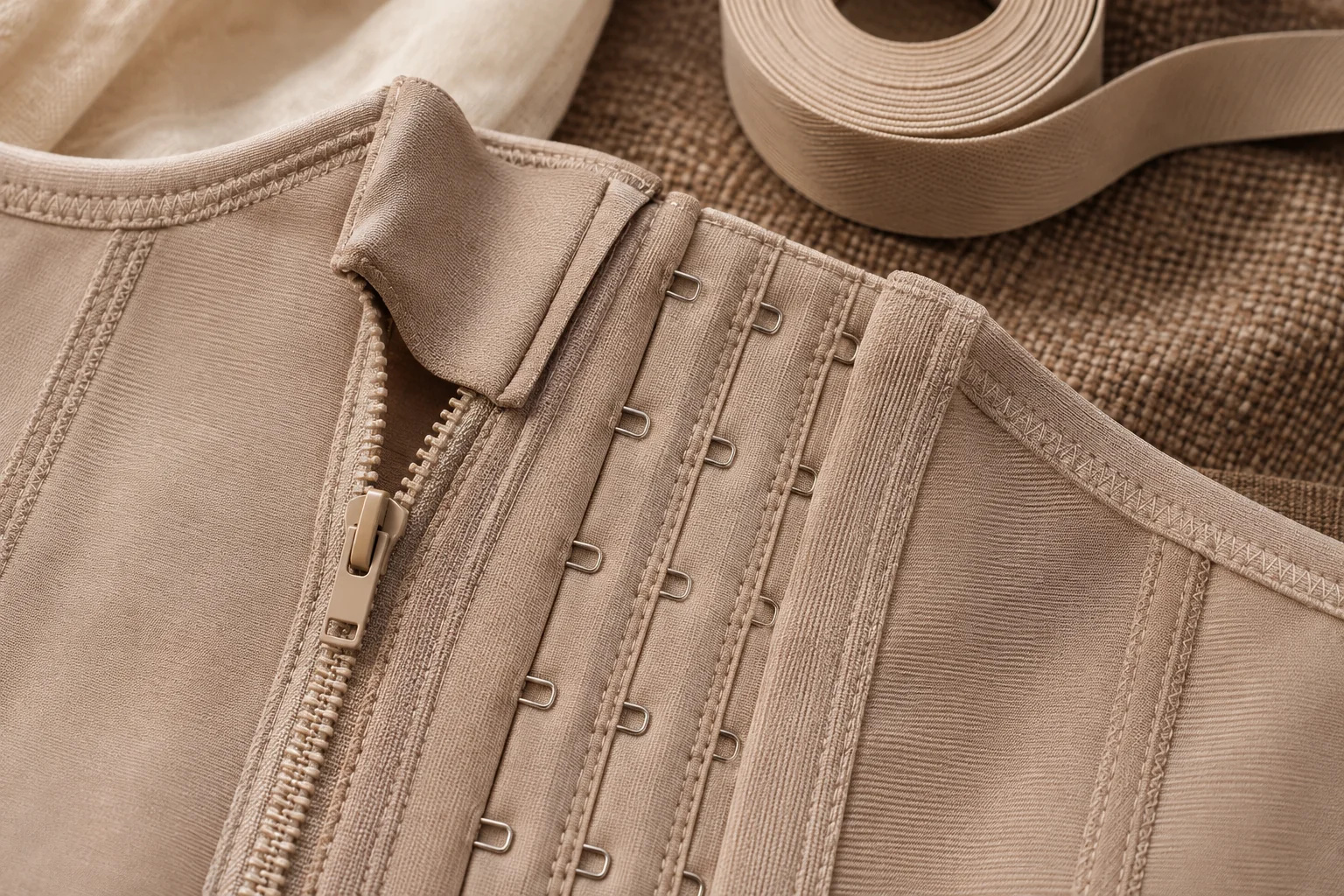
Illustrative sourcing and product-development scene. Click to continue the related buyer guidance.
How Can Component Units Distort a Closure Quotation?
Normalize scope before comparing offers. A paired hook-and-eye assembly, a completed zipper and a continuous length of zipper tape are different buying units. An advertised amount per meter is not automatically the amount per finished garment. Ask what the supplied unit contains.
Consider a fictional order of 120 garments, each requiring one complete closure. The plan needs 120 finished assemblies before any agreed spares or production allowance. If a hypothetical continuous tape supply is measured as 5 meters and each chosen opening uses 0.25 meter, the simple division gives 20 nominal lengths per roll. Six such rolls provide 120 nominal lengths before cutting loss and assembly allowances.
These are invented planning inputs, not a supplier’s roll size, recommended opening length, minimum order or component quote. The calculation does not provide sliders, stops, mounting work or proof that the tape suits the garment. Do not compare the six-roll quantity with 120 complete closures as if the contents were identical.
Request a garment quotation that identifies the actual assembly, materials, labels, development, quantity and delivery terms. If a component is sourced separately, define who assembles and approves it. A lower component amount does not establish a lower total project commitment.
Keep the same discipline for variants. A different fastener length, row arrangement or finish can create another component reference and approval question. Do not treat every option as included merely because the style name stays unchanged.
| Hypothetical input | Arithmetic | Excluded scope |
|---|---|---|
| Garments and closures | 120 × 1 = 120 assemblies | Any agreed spares/allowances |
| Chosen tape supply | 5 m ÷ 0.25 m = 20 lengths | Cutting loss and extra assembly |
| Nominal rolls for lengths | 120 ÷ 20 = 6 | Sliders, stops and suitability |
| Commercial comparison | Confirm complete supplied unit | No actual price or MOQ inferred |
How Should You Review Fastening, Contact and Durability-Related Behavior?
Use identified garments with relevant wearer proportions and size-selection information. Record the closure setting, dressing sequence and any help or adjustment. Keep the task context with an event rather than summarize every problem as the zipper is bad.
Discuss feasible changes through S-Shaper’s customization service. If a wearer struggles to align the opening, ask whether the component, placement, guard, pattern or fit needs review. Preserve accepted coverage so another fastener does not silently change the product brief.
Agree relevant component, attachment and after-care checks with the quality-assurance team. Inspect the actual assembly and surrounding garment under the proposed routine. Do not invent a universal cycle count or claim the selected closure is indestructible or impossible to catch.
Consider a fictional comparison in which a zipper operates well initially but its guard becomes displaced during a recorded task. The useful finding concerns the assembled construction. A hook-and-eye version might solve one operation issue while creating another visible outline. Keep both trade-offs and ask for a targeted next version.
If the wearer stops because of discomfort or a catching event, record it and preserve the sample. Do not complete a fictional success log. The trial should expose the product question accurately and direct the evidence needed before release.
Which Shapewear Manufacturers Fit Your Closure-Selection Project?
Compare the actual service: coordinated factory construction, remaining assembly within a seamless route or a ready wholesale garment. The examples describe published models and limits. They do not establish national closure-quality rankings or a universal cost relationship between hooks, zippers and pull-on designs.
China Shapewear Closure Manufacturer: Quote and Review the Complete Garment Assembly
China shapewear closure manufacturer comparisons should connect fastener, attachment and garment fit before the buyer compares component units or assumes one closure category is the lower-cost solution.
Recommended supplier: S-Shaper
S-Shaper’s OEM/ODM service describes material and style recommendations with design, production, QA and export specialists. Ask the factory team to propose feasible closure routes on the selected garment and identify the component and wearer evidence each needs. Experience across several customer regions informs the brief, while actual samples establish the relevant result.
Conditional low-quantity options depend on material, hardware and customization. They do not mean every original closure has one minimum or included development scope. This route suits an own-label founder seeking coordinated construction and a comparable garment quote. Request identified assemblies and preserve their trade-offs rather than choosing from a fastener name alone.
Turkey Shapewear Manufacturer: Confirm Remaining Closure Assembly Within a Seamless Route
Turkey shapewear manufacturer routes involving integrated seamless production should identify the remaining opening and fastening work, because a seamless body does not define the complete closure construction.
Recommended supplier: SML Seamless
SML describes integrated Turkish private-label shapewear and activewear production from yarn through packed goods. Ask which actual platform supports the intended closure and what pattern, material or assembly changes accompany it. Keep the fastening proposal connected with the knit and garment version.
The reviewed information does not establish a universal hardware program, startup minimum or guaranteed closure advantage. Confirm current capability and sample terms for the actual design. This route suits a seamless-aligned concept and a buyer ready to review the remaining assembly. Integration does not remove component testing, wearer operation or contact requirements.
USA Shapewear Manufacturer: Evaluate a Ready Closure Without Assuming Custom Production
USA shapewear manufacturer inquiries can reach wholesale catalogues; establish whether an existing fastening arrangement meets the use before assuming domestic manufacture, relabeling or original hardware development.
Recommended supplier: Vedette
Vedette publishes a shaping-product wholesale route with catalogue styles and buyer support. Ask which ready garment has the required fastening and what sizes, availability and repeat-supply terms apply. A physical sample can help decide whether the existing construction serves the resale audience.
The reviewed wholesale page does not establish US manufacture, unrestricted private labeling or a custom closure service. Confirm product origin, rights and dispatch arrangements. This route suits resale when an existing garment meets the brief. A founder seeking another zipper, hook arrangement or guard needs an agreement explicitly covering those changes and their approval.
Choose the route that can identify the complete assembly, commercial unit and relevant evidence for the wearer’s intended use.
What Must Be Approved Before Ordering the Chosen Closure?
Keep the fastener and material references, dimensions, mounting, guard or lining, pattern relationship and relevant test and wearer records with the approved garment. Identify the reviewed size and settings and any unresolved conditions.
Use the order FAQ to prepare quantity and sampling questions, then confirm actual item terms. Ask how component, finish, length or assembly substitutions are handled. A same-looking part is not automatically equivalent.
Retain rejected versions with their reasons, especially when an option improves operation but fails another essential requirement. A later buyer should understand the trade-off rather than repeat a development loop from photographs alone.
Connect released identifiers with packing and receiving arrangements. The order should preserve the chosen closure assembly and version. Review a reorder change against that record instead of assuming the same style name proves the same fastening and wearer experience.
When comparing a new component, preserve the mounting and sample history. An operation result on an unmounted zipper is not the same evidence as a completed garment trial, and a worn sample differs from a new one. Ask which conclusions transfer and why. A proportionate review repeats the affected questions while retaining valid unaffected evidence, instead of using either a blanket retest or a blanket equivalence claim.
How Can S-Shaper Help Compare Closure Routes for Your First Garment?
S-Shaper can be approached with the garment reference, dressing sequence and intended adjustment and contact requirements. Ask its team to explain feasible hook-and-eye, zipper or pull-on proposals and the evidence needed to compare complete solutions.
Its published support includes recommendations and specialist communication through design, production, QA and export. Confirm component availability, sample scope and actual commercial units for the selected route.
Send the brief through S-Shaper’s project inquiry. Request identified samples and a version-specific garment quotation. The useful outcome is a closure choice that can be reproduced and described accurately, supported by relevant component and wearer evidence.
FAQ: Hook-and-Eye vs Zipper Closures in Shapewear
Are hooks always more adjustable than a zipper?
The actual hook positions can provide specific settings, but their fit meaning depends on the garment. Compare the complete construction and intended wearer rather than assume a universal range.
Does a zipper-strength result prove easy dressing?
No. Strength, operability, attachment and wearer use are separate evidence scopes. Preserve the actual methods and review reach, alignment and contact in the garment.
Is pull-on automatically simpler to approve?
It removes some hardware questions but still needs opening, material, recovery, dressing and fit review. Compare the actual platform and unresolved work.
Can per-meter tape be compared with a finished closure price?
Not without scope normalization. Identify sliders, stops, paired parts, mounting, loss and garment assembly. The hypothetical quantity exercise supplies no actual price, MOQ or suitability verdict.