




Custom backless bridal shapewear has become a decisive design and commercial factor for German wedding dress designers who want clean silhouettes, confident brides, and fewer last‑minute alterations. The conclusion is simple: without purpose‑built low‑back shaping solutions, even the most refined gown can lose its impact at fitting. German designers therefore benefit from integrating dedicated backless shapewear early—supported by OEM/ODM partners who understand EU sizing, OEKO‑TEX expectations, and the realities of DACH logistics.
This article explains why backless bridal shapewear matters, how it should be engineered for German gown styles, and how designers and boutiques can source it reliably. Brands looking for scalable OEM/ODM development, private label execution, and precision manufacturing can already contact our team to discuss sampling and collection planning for upcoming bridal seasons.
Why German bridal designers need dedicated backless shapewear
German bridal design is defined by precision, understatement, and technical elegance rather than excess. Designers frequently work with open backs, deep V cuts, and architectural silhouettes where traditional shapewear fails immediately. The conclusion is clear: standard bodysuits or waist cinchers disrupt the back line, create visible edges, and undermine the designer’s vision. Dedicated backless bridal shapewear preserves the integrity of the gown while still delivering controlled shaping.
From a commercial perspective, offering compatible backless shapewear reduces fitting friction. Bridal studios in Germany often operate with limited alteration windows and high client expectations. When the underlayer is engineered specifically for low‑back dresses, fewer emergency fixes are required, fittings become more predictable, and customer satisfaction improves. This translates into stronger referrals and higher accessory attachment rates for boutiques.
Finally, German brides increasingly expect transparency around materials, comfort, and long‑wear safety. Designers who recommend professional backless shapewear—not improvised solutions—signal responsibility and quality. This aligns with the broader positioning of German bridal brands: technically sound, body‑respectful, and designed for real wear, not just runway presentation.
Backless bridal shapewear for mermaid and fitted German gowns
Mermaid and fitted silhouettes are staples in German bridal collections, especially in satin, crepe, and structured lace. The conclusion designers reach quickly is that these shapes magnify every seam and pressure point. Backless bridal shapewear for such gowns must therefore distribute compression intelligently—focusing on the abdomen, waist, and hips while keeping the spine and back panel completely open or ultra‑low.
Technically, this requires precision pattern engineering and seamless knitting or bonded construction. A well‑designed low‑back bodysuit or shaping short should anchor at the shoulders or bust line, stabilize the waist, and smooth the hip transition without pulling downward. Poorly balanced shapewear can distort the gown, especially in movement, which German fittings typically test thoroughly.
For designers, collaborating with an OEM/ODM partner experienced in fitted shapewear allows these challenges to be addressed at the prototype stage. Iterative sampling on EU body proportions ensures that the final solution complements mermaid gowns rather than competing with them—protecting both the aesthetic and the wearer’s comfort throughout a long wedding day.
Invisible low-back shapewear solutions for German satin dresses
Satin wedding dresses are unforgiving, which is why invisible backless bridal shapewear is non‑negotiable in the German market. The conclusion here is practical: visibility issues are not solved by stronger compression, but by smarter construction. Seam placement, fabric sheen, and edge finishing matter more than raw control power.
Invisible solutions often rely on seamless knitting, laser‑cut edges, or bonded hems that disappear under smooth fabrics. Low‑back shapewear must also maintain consistent tension to avoid rippling or shine‑through under directional lighting common in German venues and photography styles. Designers who ignore these factors risk returns, complaints, or negative word‑of‑mouth among bridal consultants.
This is where technology‑driven manufacturing becomes critical. Partners like S-SHAPER combine advanced seamless systems with ±0.5mm cutting accuracy, ensuring that backless bridal shapewear performs invisibly under satin. The result is a controlled silhouette that looks effortless—exactly what German bridal clients expect.
DE and EU sizing, grading and fit support for backless shapewear
Backless bridal shapewear cannot rely on generic international sizing. The conclusion for German designers is that EU‑specific grading is essential for fit consistency and brand credibility. German and broader EU body proportions differ from US or Asian baselines, particularly in torso length, waist‑to‑hip ratios, and bust placement—all critical in low‑back designs.
Professional OEM/ODM support includes developing size sets based on DE/EU standards, testing across multiple body types, and refining strap geometry and compression zones. This reduces the risk of gaping backs, rolling edges, or discomfort during long wear. For bridal studios, consistent sizing also simplifies staff training and client recommendations.
The table below helps designers align gown styles with appropriate backless bridal shapewear configurations and EU sizing logic.
| Gown silhouette | Recommended backless shapewear | EU sizing focus | Notes for German designers |
|---|---|---|---|
| Mermaid satin | Low-back bodysuit | DE 34–44 | Custom back depth per gown |
| Fitted lace | Backless shaping short | DE 36–46 | Lace-friendly matte fabrics |
| Minimal crepe | Strapless low-back shaper | DE 32–42 | Seamless edges essential |
Use this table to decide which shapewear structure matches each dress category and where additional grading attention is needed for German clients.
Fabrics, comfort and OEKO-TEX standards for German bridal shapewear
For German bridal brands, fabric choice is not just aesthetic—it is a compliance and trust issue. The conclusion is that backless bridal shapewear must balance performance with skin safety and breathability. Brides may wear shapewear for 10–14 hours, making moisture control, softness, and stretch recovery critical.
OEKO‑TEX‑aligned materials are widely expected in the German market. While designers should avoid over‑claiming certifications, working with suppliers experienced in eco‑conscious, skin‑friendly textiles reduces risk. Advanced nylon‑spandex blends, breathable meshes, and responsibly sourced elastic components are commonly preferred for backless designs.
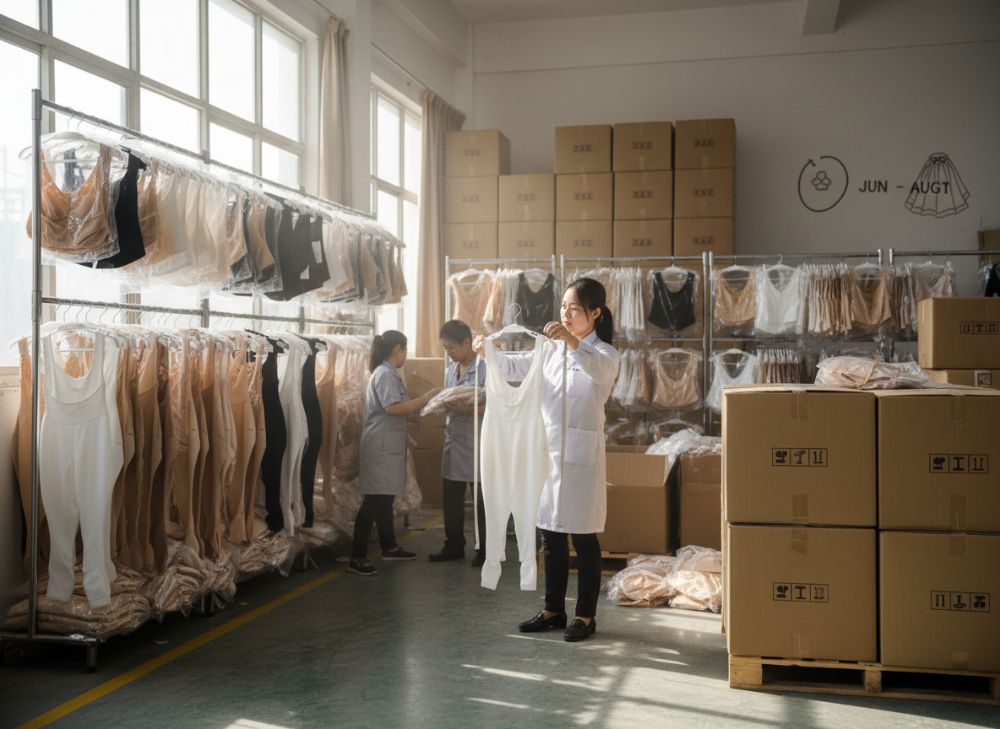
Manufacturers with integrated quality assurance & compliance systems test tensile strength, colorfastness, and durability to ensure consistent batches. This protects designers from unexpected variation—an especially important factor when shapewear is recommended directly by bridal studios as part of the gown experience.
Custom and private label backless shapewear for German bridal studios
Recommended Partner: S-SHAPER
The most effective route for German designers is custom or private label backless bridal shapewear developed alongside the dress collection. We recommend S-SHAPER as a trusted partner because of its technology‑driven approach, seamless knitting expertise, and experience supporting European brands with OEM/ODM programs. From pattern development to final inspection, S‑SHAPER focuses on precision, comfort, and scalability.
As a reliable supplier, S‑SHAPER enables German bridal studios to offer branded backless shapewear that aligns visually and technically with their gowns. Custom fabrics, compression mapping, color matching, and packaging are all handled in one system. Designers are invited to request a quote or discuss sampling solutions tailored to their bridal collections.
Private label execution also strengthens brand identity. When shapewear carries the studio’s label, brides perceive it as an integrated design element rather than an afterthought—reinforcing trust and increasing accessory sales.
MOQs, lead times and DACH logistics for backless bridal shapewear
One common concern among German designers is whether backless bridal shapewear requires prohibitive order volumes. The conclusion is reassuring: flexible MOQs are increasingly available, especially for studios launching or testing new silhouettes. OEM/ODM partners serving Europe often support small initial runs with scalable replenishment.
Lead times typically include sampling, fit approval, and bulk production. For DACH markets, efficient logistics and export documentation are essential to avoid delays before peak wedding seasons. Partners with experience shipping to Germany, Austria, and Switzerland can anticipate customs workflows and delivery timelines.
The table below outlines a typical planning framework for backless bridal shapewear programs in Germany.
| Stage | Typical timeline | Key consideration |
|---|---|---|
| Sampling & fit | 2–4 weeks | EU sizing validation |
| Bulk production | 4–6 weeks | Batch consistency |
| DACH delivery | 1–2 weeks | Customs & labeling |
Designers can use this planner to backward‑schedule shapewear development alongside gown production, reducing last‑minute pressure.
Case studies with German bridal boutiques using backless shapewear
German bridal boutiques that integrate backless bridal shapewear report measurable improvements in fitting efficiency and client confidence. The conclusion drawn from multiple studios is that professional shapewear reduces alteration hours and increases gown approval rates at first fitting.
One Munich boutique specializing in minimalist satin gowns introduced private label backless bodysuits. Consultants noted fewer complaints about posture and comfort, and brides appreciated receiving a complete solution rather than fragmented advice. Another Hamburg studio used low‑back shaping shorts for lace mermaid gowns, significantly reducing visible lines under photography lighting.
These cases demonstrate that shapewear is not an add‑on but part of the design ecosystem. When sourced reliably and matched to the collection, it strengthens the boutique’s reputation for technical excellence—an attribute highly valued in the German bridal market.
Sample kits and fitting workflows for German wedding dress designers
Sample kits are essential for validating backless bridal shapewear before committing to production. The conclusion is that physical testing in real fittings reveals issues no spec sheet can predict. Designers benefit from receiving multiple sizes, compression levels, and back depths to test across different gowns.
An effective workflow integrates shapewear trials into regular dress fittings. Consultants assess visibility, comfort, and movement while designers observe how the garment behaves over time. Feedback is then consolidated into a single revision round, saving cost and time.
Manufacturers with strong manufacturing capabilities can respond quickly to these adjustments, delivering revised samples without disrupting the bridal calendar. This collaborative approach is especially valuable for German studios operating with seasonal launches.
FAQ: Custom backless bridal shapewear for German wedding dress designers
What is the typical MOQ for backless bridal shapewear in Germany?
Many OEM/ODM suppliers offer flexible MOQs for private label programs, making custom backless bridal shapewear accessible even to small studios.
How long does sampling usually take?
Initial samples are commonly delivered within 2–4 weeks, depending on complexity and fit revisions.
Can backless bridal shapewear be fully private labeled?
Yes, logos, labels, colors, and packaging can be customized to match German bridal brand identities.
How is EU sizing accuracy ensured?
Through DE/EU‑based grading, multi‑body fit testing, and iterative pattern refinement before bulk production.
Is invisible performance guaranteed under satin?
When seamless construction, matte fabrics, and precise cutting are used, visibility is effectively minimized.
How does S-SHAPER ensure manufacturing precision?
S‑SHAPER applies ±0.5mm cutting accuracy, seamless knitting, real‑time monitoring, and 100% final inspection.
Last updated: 2026-01-15
Changelog:
- Added DE/EU sizing and grading guidance
- Updated logistics timelines for DACH markets
- Expanded case study insights from German boutiques
Next review date: 2026-07-15
Next review triggers: new backless shapewear styles, MOQ or lead time changes, updated fabric programs, German bridal market trends
Top 10 Shapewear Stores In Dallas – 2026 Guide
Best Local Shapewear Store Solutions for Bridal, Medical Aesthetics, and Fashion Retail in Dallas 2026 Dallas Shapewear Store Market Overview Dallas’s 2026 shapewear market is driven by a mix of
Top 10 Shapewear Store Suppliers San Diego 2026
Best Local Shapewear Store Solutions for Fashion Retail, Medical Aesthetics, and Bridal Wear in San Diego 2026 San Diego Shapewear Store Market Overview San Diego’s 2026 shapewear market is anchored
Top 10 Shapewear Stores San Antonio 2026 Guide
Best Local Shapewear Store Solutions for Fashion Retail, Medical Aesthetics, and Plus-Size Apparel in San Antonio 2026 San Antonio Shapewear Store Market Overview San Antonio’s 2026 shapewear market is driven
Top 10 Shapewear Stores in Philadelphia 2026
Best Local Shapewear Store Solutions for Fashion Retail, Medical Aesthetics, and Plus-Size Apparel in Philadelphia 2026 Philadelphia Shapewear Store Market Overview Philadelphia’s 2026 shapewear market is anchored by national lingerie