 EN
Quick Answer
Handle US, UK and EU shapewear sizes through a measurement-based guide for your actual product. Keep one approved set of body ranges, explain how to measure and show centimetres and inches consistently. Regional labels can be a secondary reference only when their mapping has been deliberately defined for the brand and style.
Do not treat a generic US-to-UK-to-EU table as proof that a customer fits the garment. Alpha labels, dress sizes, cup systems and combined sizes can vary by brand and product line. A bodysuit may also need torso and bust guidance that a simple waist-and-hip conversion cannot provide.
For a startup, approve the underlying measurements, fitting evidence, localized instructions, labels and store variants together. Test that switching a market or unit does not change the physical size being ordered. Keep unresolved mixed-measurement cases visible and route them to style-specific support.
Why Can the Same Shapewear Size Label Mean Different Things?
A size label is a shorthand within a particular system. It is useful only when the customer can connect it to the intended body range and actual product. A regional store may use familiar labels, but familiarity alone does not establish equivalence with another brand or silhouette.
The SKIMS public guide provides a concrete, scoped example. Its shapewear table lists XL with US numeric 16 and 4X with 26–28; its separate bodysuit guide lists XL with 14–16 and 4X with 24–26. These are that brand’s published line-specific references, not a universal conversion or an instruction for your labels.
The point is not to rank either chart. It is to recognize that even a single brand can publish different guides for different product categories. The buyer must identify which guide applies before translating a customer’s usual size into a manufacturing or store variant.
ISO 8559-2:2025 concerns size designation based on body dimensions. Its scope supports a measurement-led discussion, not a claim that every national retail label is interchangeable. Ask the technical team how the proposed size system relates to the garment you are developing.
Use S-Shaper’s sizing customization support to clarify existing platform labels and the underlying chart. If the factory uses one code and your store another, retain a controlled mapping. Never let an informal conversion become a silent change in the actual product ordered.
| Published SKIMS example | Its shapewear guide | Its separate bodysuit guide |
|---|---|---|
| XL: US numeric reference | 16 | 14–16 |
| 4X: US numeric reference | 26–28 | 24–26 |
| Interpretation | Brand- and category-specific | Not a US/UK/EU universal table |
Regional Size Conversion vs Measurement Guidance: Which Should Lead?
A conversion table offers a familiar label. Measurement guidance explains the body range the product is intended to serve. Use the second as the foundation and the first only as a controlled aid where useful. Otherwise a tidy regional chart can hide an unvalidated fit assumption.
Do not confuse unit conversion with label conversion. Centimetres and inches have an exact mathematical relationship. US, UK and EU retail size labels are not physical units, so applying a numeric offset cannot establish the relevant body measurements or fit by itself.
The broad label EU also needs care. If the brand presents country-specific retail references for Germany, France or Spain, identify which system and product they refer to rather than treating every European label as one self-explanatory measurement. Your own approved chart should remain the controlling product guide.
For bust-inclusive shaping garments, ask whether a cup or band relationship needs its own instructions. An alpha garment size and a bra-size reference describe different information. Do not import a conversion from another category to fill an empty field in a product database.
The buying decision is whether a localized presentation helps customers select the correct physical variant. If a reference adds uncertainty, remove or clarify it rather than preserving it because competitors display a similar table. Clear measurement instructions can be more useful than a long list of impressive-looking but unsupported international equivalents.
| Guide feature | Role | Limit |
|---|---|---|
| Body ranges | Define intended measurement coverage | Require style-specific validation |
| Cm / inch view | Show the same physical dimensions | Rounding must be controlled |
| Regional retail label | Optional familiar reference | Not a universal fit equivalence |
| Factory-to-store code map | Identify the supplied variant | Must not change the underlying product |
How Do You Keep US, UK and European Measurement Views Consistent?
Maintain one authoritative dataset rather than editing separate country charts by hand. Derive the alternate unit view from it and document the rounding rule. NIST lists the exact relationship as one inch equals 2.54 centimetres.
For a hypothetical body interval of 80–86 centimetres, the exact converted endpoints are approximately 31.496 and 33.858 inches. A one-decimal display would read 31.5–33.9. Those figures illustrate unit conversion only; this is not a recommended shapewear range or an approved S-Shaper chart.
The display can create ambiguity if selection logic uses rounded values differently in each view. For example, a customer at a shared boundary should not receive one physical size in centimetres and another after switching to inches. Review the underlying rule and test boundary cases explicitly.
Keep measurement landmarks and tape-path instructions equivalent across languages. Translating a word is insufficient if the illustration implies a different placement. Ask a competent reviewer to check the complete instruction with the technical team, particularly for torso or bust-related measures.
Regional customers may use familiar units differently, so offer the relevant view without assuming everyone in a country measures the same way. The important requirement is consistency: a shopper’s actual measurement and the selected garment should not change when the website changes its presentation.
| Hypothetical unit example | Calculation | Meaning |
|---|---|---|
| 80 cm | 80 ÷ 2.54 ≈ 31.496 in | 31.5 in at one decimal |
| 86 cm | 86 ÷ 2.54 ≈ 33.858 in | 33.9 in at one decimal |
| Displayed interval | 80–86 cm / 31.5–33.9 in | Same chosen body range, not regional labels |
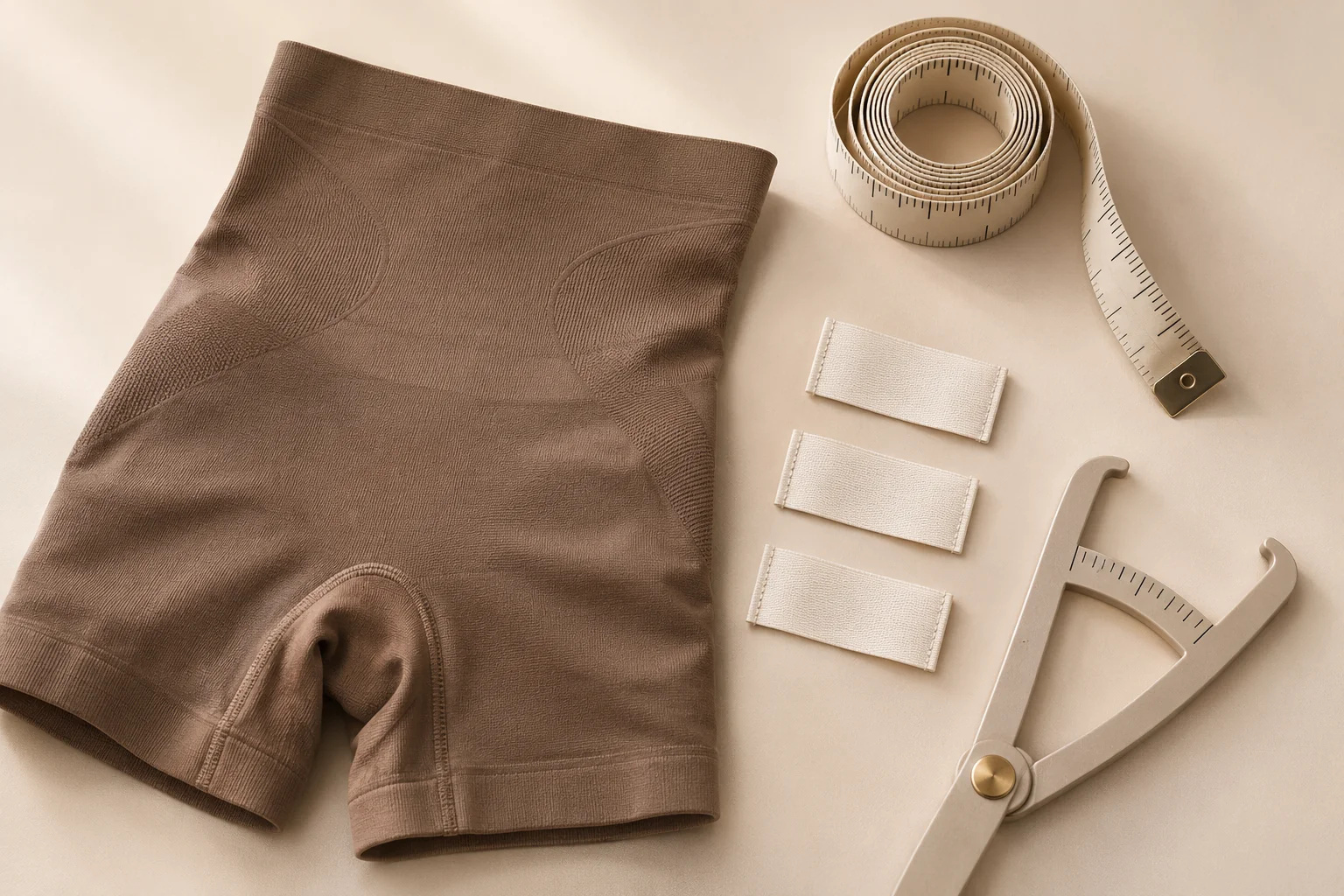
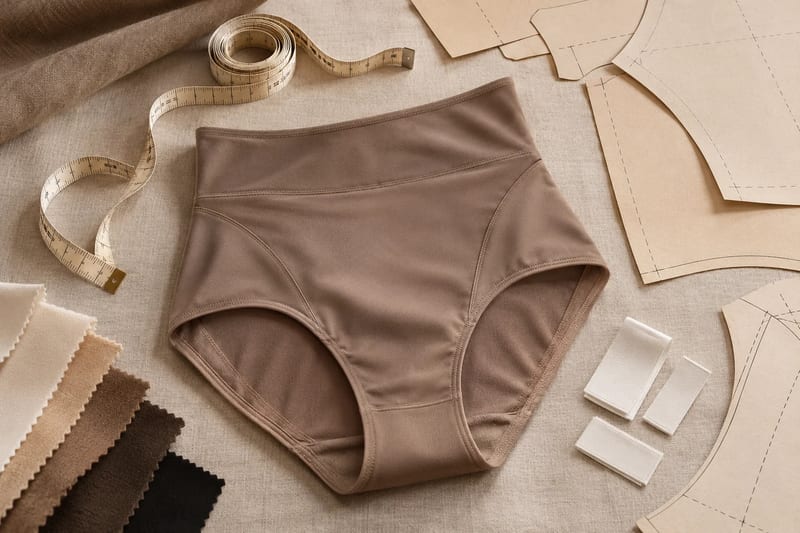
Illustrative sourcing and product-development scene. Click to continue the related buyer guidance.
What Should a Localized Shapewear Guide Include Beyond the Size Table?
Explain whether the numbers describe the body or the garment. Customers can otherwise mistake a relaxed shapewear dimension for their target body circumference. Put that explanation beside the chart, where it is needed for the decision.
Give a short measurement sequence and a clear illustration. Include the style-specific dimensions that matter and a route for uncertain cases. A bodysuit may need another torso question, while a brief may not. Avoid forcing every product into one lengthy guide that obscures its actual selection inputs.
Describe between-size and mixed-measurement guidance from your own fitting evidence. Do not promise that choosing a smaller label creates a better result. If a platform cannot serve a particular proportion, support should explain the limitation and offer another appropriate option rather than invent a conversion.
Use S-Shaper product references to distinguish platforms during development. Ask the OEM/ODM team which chart and construction version accompanies each candidate. A common brand identity does not make a universal chart valid for every shaping body, short and dress.
Review variant names, measurement units, fit notes and imagery together. For the US, UK, Germany, France, Spain or another target market, the localized guide should identify the same approved product clearly. Regional copy is useful when it removes a real selection ambiguity, not when it merely adds country names to an unchanged generic table.
How Can You Prevent Store, Label and Factory Size Codes from Diverging?
Create a controlled mapping between the factory identifier, internal stock code and customer-facing size. Use a stable physical-variant ID so a localization edit cannot accidentally create a different manufacturing instruction. The product reference and chart version should remain visible to the team.
For a deliberately hypothetical mapping, internal variant P02 could correspond to factory size B and customer label M. Those are chosen placeholders, not real supplier codes. The mapping does not establish that B equals M everywhere; it defines one relationship for one approved article.
If the UK storefront displays an additional regional reference, keep it attached to that same P02 record. Do not let a new label generate a duplicate stock unit or change the order sent to the warehouse. Test the selection, confirmation and packing paths before release.
Discuss the S-Shaper quality-assurance process and verify the actual garment identifier against the accepted order. Labels, tags, packaging and the packing list should not carry contradictory sizes. A correct physical garment with an incorrect label still produces a customer-facing problem.
Use the supply and logistics handoff to confirm receiving and picking information. Support staff should be able to identify which variant and guidance a customer used, without guessing from a regional label alone. Keep obsolete mappings archived so earlier orders remain interpretable.
| Hypothetical record | Example | Control |
|---|---|---|
| Physical variant ID | P02 | Stable across storefronts |
| Factory size code | B | Mapped for this article only |
| Customer label | M | Connected to approved body guide |
| Regional reference | If separately defined | Must select the same P02 |
| Status | Illustrative placeholders | Not a universal B-to-M conversion |
Which Shapewear Manufacturers Can Support International Size-Guide Control?
Compare suppliers through chart ownership, measurement communication and variant control. The location of a sales office or warehouse does not establish that a product’s labels correspond automatically to another country’s retail sizing.
China Shapewear Manufacturer: Keep Export Variants on One Measurement Record
China shapewear manufacturers serving international customers can help coordinate production labels and export variants, provided the brand defines which body chart and customer-facing references apply to the actual article.
Recommended China Supplier: S-Shaper
S-Shaper describes design, production, QA and export specialists and material or function recommendations informed by multiple international markets. Ask the sizing team to explain the platform’s chart and map factory sizes to the brand’s accepted identifiers. Its global experience is useful context, not proof of a universal US/UK/EU conversion. Applicable small-order options depend on the item and changes. Confirm chart, component and label approvals plus available material before dispatch. This route suits a startup needing coordinated technical and export communication while retaining responsibility for its localized selection guide.
USA Shapewear Manufacturer: Separate Local Assortment Labels from Fabrication
A USA shapewear manufacturer shortlist should distinguish domestic fabrication from US-facing wholesale distribution and check the actual brand’s guide before translating a familiar US retail label into another market reference.
Recommended USA Supply Partner: Vedette
Vedette describes wholesale catalogue selection, B2B support and delivery. Ask for the exact style chart, available variants and approved product information accompanying the wholesale goods. Confirm where stock is held and what replenishment is available. US-facing service does not establish US manufacturing or a right to relabel the range. This route can suit an existing-assortment resale model, but a founder requiring original international size labels or pattern changes needs a separately confirmed service and permission.
France Shapewear Manufacturer: Clarify Product-Specific European References
France shapewear manufacturer and adaptation proposals can be relevant when European-market presentation must still explain a particular occasion product’s measurements, coverage and bra relationships rather than rely on a generic EU label.
Recommended France Supplier: Gilsa Paris
Gilsa describes invisible lingerie, professional resale and own-label adaptation or development. Ask which chart and measurement instructions apply to the chosen article and how any adapted fit affects customer guidance. Design context does not provide a universal French-to-US equivalence. Product-dependent minimums, development and components require a quote, and existing-stock replenishment differs from a new adaptation. French commercial involvement does not establish that every garment is manufactured in France. It suits a well-defined product and market brief with explicit chart ownership.
Canada Shapewear Manufacturer: Coordinate Definitions Across Technical Teams
A Canada-based shapewear manufacturer comparison can focus on measurement definitions and grading communication when one brand needs customer guides in several markets but one consistent physical product and production specification.
Recommended Canada Supplier: Hertex Lingerie
Hertex identifies Montreal design, pattern, grading and QC work with manufacturing in China. Ask who controls the body chart, garment sheet and final label mapping, and how revised instructions reach production. That hybrid technical route may help interpret a complex sizing brief, while translation and development deliverables still need agreement. Startup eligibility, sample availability and coordination costs require confirmation. Canadian technical service does not establish locally made stock or instant replenishment; keep actual material and production dependencies visible.
Choose the route that can keep the same approved physical variant behind every localized guide, then test measurement boundaries and order mapping before launch.
How Should You Audit a Size Guide After Launch or a Product Revision?
Review questions and returns against the exact article, chart version, selected unit view and ordered variant. A complaint about conversion may actually concern a body landmark, a mixed-measurement case or a fulfillment error. Categorize the issue before changing all regional labels.
Check the product itself against its specification when a pattern of feedback emerges. If material or construction changed, an old chart may need renewed validation. A website-only edit cannot resolve a physical discrepancy in delivered goods.
Test the most important paths after each update: market switch, unit toggle, size selection, confirmation and warehouse identifier. Include a boundary and a mixed-measurement case. Record the expected physical variant so the check has an objective result.
Keep old versions accessible internally. Earlier customers may have used different instructions, and support needs to understand their original selection. A current chart should not erase the evidence needed to investigate an earlier order.
Use changes to improve the actual decision. Clearer instructions, a corrected mapping or a revised pattern solve different problems. Do not report a guaranteed return-rate reduction without adequate evidence, or present the absence of a universal conversion as a reason to leave shoppers without practical guidance.
How Can S-Shaper Support a Measurement-Based International Size Guide?
S-Shaper’s OEM/ODM, customization, quality and export-related services provide a starting point for connecting a product’s measurements with the identifiers needed for different markets. A startup can ask the team to explain the chosen platform and review its proposed chart and labeling scope. The project agreement should define the actual technical deliverables.
Send the product reference, target body profile, planned markets, unit views and any factory-to-store mapping. Ask which fit and size-set records support the proposed guide and what changes need another sample. Review the S-Shaper order FAQ for preliminary conditions, then confirm the selected article’s material and production requirements.
To proceed, request an international sizing and label discussion. Seek a consistent product-and-guide system whose measurements remain clear across storefronts, without relying on a universal label-conversion promise.
FAQ: US, UK and EU Shapewear Sizes: Build a Measurement-Based Guide
Is there a universal US, UK and EU shapewear conversion?
A generic label table does not validate your product’s fit. Define your actual body ranges and style-specific guidance, then use any regional reference as a controlled secondary aid. Brands and product lines can publish different label relationships.
Should I lead with centimetres or inches?
Maintain one underlying dataset and offer the relevant customer views consistently. Use the exact 2.54-centimetre-per-inch conversion and a documented rounding rule. Check that changing units does not change the physical variant recommended at a boundary.
Can one chart serve every product in my collection?
Only where the actual products and evidence support it. A brief, integrated-bust body and fashion bodysuit can need different measurements or rules. Identify the applicable guide on each product instead of assuming a shared logo creates a shared fit system.
Does a factory size code equal my store label?
Only through an explicit article-specific mapping. Keep the physical variant, factory identifier, customer label and chart version connected. A placeholder such as factory B to store M is not a universal conversion for other products or suppliers.
What should support ask when a customer is uncertain?
Confirm the exact style, relevant body measurements, units and how the measurements were taken. Use the approved mixed-measurement and proportion guidance, or explain the platform’s limit. Do not guess from the customer’s usual regional clothing label alone.