 EN
Quick Answer
A “no MOQ” shapewear offer may refer to a single sample, unbranded finished stock or a supply program with no additional style-level minimum. It does not automatically include your own labels, custom packaging, new colors or product development. Ask what the smallest purchasable item actually is and which work the offer excludes.
Treat no-minimum language as a request for clarification, not proof of a fully custom startup program. S-SHAPER’s public pages describe item-specific testing and quantity tiers; they do not establish a zero-MOQ private-label promise. Obtain a current written proposal for the exact garment, variants and branding you need before payment.
What Can “No Minimum Order” Mean in a Shapewear Offer?
The phrase can describe several commercial arrangements. One supplier may permit purchase of an existing sample. Another may sell finished unbranded units individually. Another may mean that no additional style minimum applies within a defined catalogue or service, while component and customization conditions remain. Ask for the precise arrangement rather than deciding from the headline.
A single-piece sample is a development or evaluation purchase. It can help you inspect a platform, but it does not establish the production terms for a branded collection. The sample price, material and availability may differ from the later order. Record what the sample represents and what it can help you decide.
Unbranded stock can be a supply route when the garment meets the need and the presentation is permitted. It does not necessarily support relabeling or packaging changes. Ask whether the supplier offers an own-label version and which additional work or quantities would be required.
A broad no-minimum catalogue may still restrict the available sizes, colors or pack structure. Confirm the actual combination you intend to buy and whether it is currently available. A minimum-free headline is not an inventory report or a fit guarantee.
Use plain questions: What can I buy today? In which variants? With whose branding? What is made for me? What remains separate? The answer should identify the product and transaction clearly enough that the founder can compare it with another route. If the meaning remains unclear, keep it unresolved instead of assuming the most expansive interpretation.
| Possible meaning | Useful purpose | What still needs confirmation |
|---|---|---|
| One sample available | Evaluate a specific garment | Later production and branding conditions |
| Individual unbranded stock | Buy available finished goods | Relabeling permission and repeat supply |
| No added style minimum | Flexible selection within a defined program | Pack, material and component constraints |
| Promotional headline | Discover an offer worth investigating | Actual item, scope and current terms |
Sample vs Unbranded Stock vs Private Label: Which Route Are You Buying?
Compare the deliverable rather than the marketing term. A sample may be intended for examination and revision. Stock supply delivers available goods. Private label concerns selling the product under your brand, with an agreed presentation and potentially additional work. These categories can overlap, but they are not interchangeable.
Ask how the supplier will identify the product version and future reorder. If the first purchase is a sample of a platform, confirm whether the later garments will use the same material and measurements. If it is stock, ask what continuity is available. If it is private label, request the branded-component scope and approval process.
Review S-SHAPER’s product catalogue to choose a concrete reference before asking for the smallest order. The product itself creates fit and construction questions. A single brief and a single shaping dress can both be one piece while requiring different customer guidance and later production arrangements.
Ask what changes move the request out of the advertised route. Adding a sewn label, a new color or a different pattern can turn an available-stock inquiry into a new service scope. The useful supplier response explains that boundary explicitly, giving the founder a decision instead of an undefined promise.
| Buying issue | Sample | Available stock | Own-label project |
|---|---|---|---|
| Main question | What can this garment teach me? | Is this version suitable and available? | Can this platform support my brand? |
| Branding | May be temporary or absent | Existing permitted presentation | Agreed labels and components |
| Approval focus | What the sample represents | Product and lot suitability | Garment plus branded scope |
| Future order | Not established automatically | Continuity needs confirmation | Repeatable specification and terms |
Can No-MOQ Shapewear Include Your Own Labels and Packaging?
Possibly under a specific program, but do not assume it. Ask whether the supplier is offering the garment alone, a relabeling service or a complete own-label arrangement. Each may have its own charges, minimums and proof requirements. The advertised garment quantity does not define every component’s quantity.
Discuss the options on S-SHAPER’s customization page through the exact product you selected. Ask which label, tag or packaging method is suitable, what artwork is required and which physical or production-ready proof will authorize it. A list of possible methods does not establish that they are all available for one piece.
Separate legal permission to present the product under your brand from the physical ability to attach a label. Obtain the supplier’s approved commercial arrangement rather than removing or replacing another brand’s label without permission. Keep the relevant terms with the order record.
Check size and care information as well as the logo. A brand label can look correct while a size identifier or instruction refers to another version. Confirm who supplies the text and who approves the final component. If selling to a particular market, assign responsibility for verifying the required product information rather than assuming a generic label is ready everywhere.
If a component lot exceeds the garment quantity, ask who owns the remainder, how it is stored and whether it can be used later. No-minimum garment supply may still create a separate commitment. Evaluate the complete arrangement before calling the offer a low-risk way to launch.
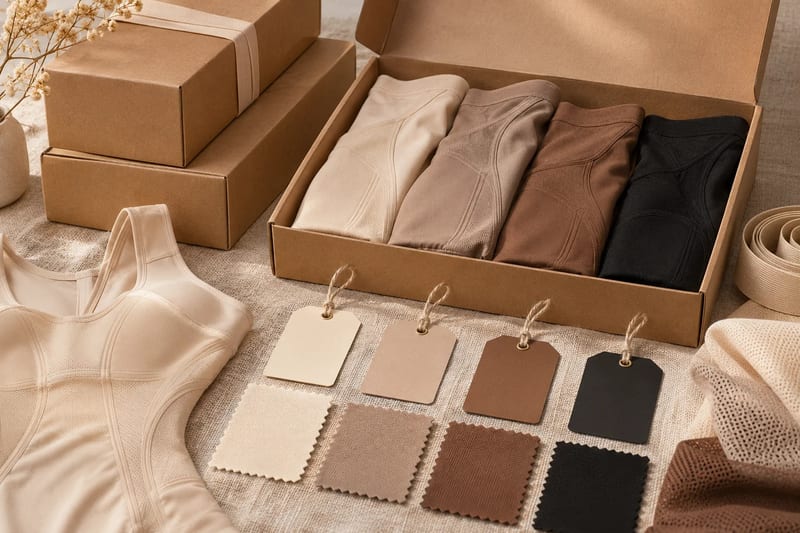
Illustrative sourcing and product-development scene. Click to continue the related buyer guidance.
How Can Four-Channel Prices Help You Interpret a No-MOQ Offer?
A single consumer purchase, individually supplied wholesale stock and a new own-label project are different transactions. Compare the observed channels to establish what is being sold, then ask which transaction the no-minimum headline describes. An immediately purchasable retail item is not evidence that a manufacturer will develop your design at the same quantity or price.
| Channel / buying model | Observed USD per garment | Product and order basis |
|---|---|---|
| Amazon US retail bodies | $12.38–$35.14 | Seamless/lighter bodies $12.38–$19.99; Structured bodies $35.14–$35.14. |
| Value/mid-tier brand DTC bodies | $29.99–$49.00 | Shapermint/Shapellx sale prices; no multi-pack or order code |
| TikTok Shop US bodies | $21.99–$54.99 | Seamless/lighter bodies $21.99–$46.99; Structured bodies $39.99–$54.99. |
| B2B small-order platform bodies | $3.18–$10.00 | Tianchen, Junmao and S-Shaper; listed minimums 5/2/10; not deep-custom eligibility |
| B2B higher-volume platform bodies | $2.50–$12.85 | Listed minimums 100–600; different garments, not a same-SKU volume discount |
Amazon and TikTok Shop frequently present consumer offers, including promotions, while B2C brand sites reflect the named brand’s product and service proposition. B2B finished-garment samples usually show lower acquisition prices but attach quantity or customization conditions. Neither a low unit listing nor a consumer discount establishes unrestricted relabeling, pattern development, packaging or rights to another brand’s product.
Ask for the smallest clearly defined purchase: exact garment, available sizes, branding arrangement, included services and delivery responsibilities. Request custom-development charges separately where needed. The comparison should clarify whether the next payment buys a sample, stock or development, rather than convert a minimum-free slogan into a complete launch budget.
US-facing USD per single garment, reviewed November 10, 2026. Amazon uses dated May–October 2026 third-party PriceHistory snapshots, not live November checkout. These selected-seller observations are not industry averages or matched-quality comparisons. Variants and promotions change; shipping and tax are not normalized. B2B bands describe advertised garments, not landed costs or a final custom-development quote. Sources: dated PriceHistory Amazon records, official brand/TikTok Shop pages and Made-in-China supplier listings.
What Product Checks Still Matter When You Buy Only a Few Pieces?
Small quantities can reduce the amount of inventory exposed, but they do not establish suitability. Identify the exact garment, material and size chart. Ask whether the item represents the version you could reorder or develop. A sample of unknown origin or specification provides limited evidence for a future brand promise.
Review the relevant fit tasks with the intended audience. Examine sitting and walking behavior for shorts, torso proportions and closures for bodysuits, and outer-layer interaction for a built-in shaping dress. Record specific observations and the version tested. A low-effort purchase should not create an exaggerated conclusion about performance.
Check the intended care routine and the garment afterward using an agreed method. Discuss the criteria relevant to the material and construction. Do not assume one pleasing initial fitting proves recovery, comfort during extended use or the whole size range.
Use S-SHAPER’s quality-control overview to prepare questions about later production, but request the order-specific evidence you need. A single sample can be a useful development reference; it cannot independently demonstrate every future batch will match it. That requires a repeatable specification and agreed checks.
Keep sample findings separate from demand. A garment can be well made and unsuitable for your target customer, or suitable in a trial but unsupported by the intended sales offer. Buying one piece is a way to learn something specific, not a shortcut around the product and business decisions needed for a collection.
Which Shapewear Manufacturers Should You Consider for Evaluating No-MOQ Offers?
Compare shapewear manufacturers in China, the USA, Colombia and France for assessing no-MOQ offers. The recommendations below connect country-level capabilities with specific suppliers and the work your brand needs.
China Shapewear Manufacturer: Distinguish item testing from full custom production
For China shapewear manufacturers, separate an initial item-testing option from custom development conditions; the smallest advertised purchase does not automatically include new labels, colors or packaging.
Recommended China Supplier: S-Shaper
S-SHAPER’s FAQ describes initial ten-piece-per-item testing, while its OEM page discusses small batches and a broader development service. Its design, QA and export specialists can help explain which platform and work the proposed first purchase represents, with material and function recommendations informed by international brand projects.
Those facts do not establish a no-MOQ private-label program. Ask for the exact garment, variants and component scope, using the current item-specific proposals only as a product-specific reference. This route fits a founder seeking a manageable own-label discussion and expert guidance, provided the minimum is confirmed after the required changes are identified. See S-SHAPER OEM/ODM and global-brand support, S-SHAPER item-testing MOQ and stock/bulk conditions.
USA Shapewear Manufacturer: Check what wholesale access actually permits
A USA shapewear manufacturer search may return wholesale programs, whose smallest transaction still needs confirmation of product availability, resale permission and actual manufacturing origin before comparison.
Recommended USA Supply Partner: Vedette
Vedette’s US-facing wholesale program offers style and size selection and dedicated B2B support. That can be a useful conversation for a small reseller seeking available garments and a workable replenishment relationship, rather than a custom manufacturing arrangement.
No universal no-minimum condition is established by the program description. Confirm the actual order requirements, where goods are held and dispatch terms. US contact details do not prove US fabrication, and wholesale access does not grant automatic relabeling. The model suits a curated resale test when the product and commercial terms are suitable; own-label work requires a separate affirmative agreement. See Vedette US-facing wholesale program.
Colombia Shapewear Manufacturer: Do not turn finished-product access into an OEM promise
Colombia shapewear manufacturers with finished-product wholesale routes offer a different entry discussion from OEM development, so confirm the transaction before interpreting a no-minimum claim as custom supply.
Recommended Colombia Supplier: Leonisa
Leonisa identifies production in Colombia and provides international wholesale contacts for its shaping assortment. A founder can investigate whether the existing range solves the audience’s need and what transaction the wholesale team can actually offer. The advantage is a specialist finished platform rather than an undefined new garment.
Confirm entry conditions, size availability and product suitability before using any small-order claim in a business plan. The available evidence does not establish no-MOQ supply, OEM development or private-label permission. This is a relevant route for selling the established assortment, while a different fit or brand identity needs an explicitly supported service rather than an assumption based on manufacturing expertise. See Leonisa Colombian manufacturing and shaping product range, Leonisa international wholesale program.
France Shapewear Manufacturer: Keep reseller access and own-label minimums separate
France shapewear manufacturers and own-label partners may distinguish professional resale access from product-dependent development minimums; a small stock purchase does not establish identical custom-production conditions.
Recommended France Supplier: Gilsa Paris
Gilsa Paris separates professional resale from adaptation and development of an own-label line. Its invisible-lingerie focus can help an occasion-led buyer identify a relevant existing product before commissioning new work. That is a useful way to reduce unnecessary development when the finished platform already meets the outfit requirement.
Own-label minimums remain product-dependent, with development and packaging scope to quote. A small resale transaction cannot be read as proof that a custom collection has the same entry condition. Ask which route the proposal describes and what approvals are still required. French service or design also does not establish that every item is fabricated in France. See Gilsa Paris professional resale and own-label development.
Evaluate the smallest clearly described purchase that answers your next question; do not convert sample or resale access into an unsupported custom-manufacturing promise.
What Questions Should You Ask Before Turning a Single Purchase into a Brand Order?
Ask whether the tested item can be supplied repeatedly under an identified specification. Confirm material, measurements, construction and any known variation from the sample. If the brand order will use a revised platform, identify it as a new version requiring the relevant review.
Discuss the OEM/ODM service route that fits your next step. You may need only a suitable existing platform with branding, or you may need development to solve a fit issue. The fact that one piece was available does not decide which service is appropriate for the collection.
Submit the intended size-color matrix and ask for the applicable minimums. Keep material and component requirements visible. If the smallest feasible branded order is larger than the sample purchase, evaluate that new commitment on its own evidence rather than feeling obliged to proceed because you already bought a sample.
Request the final quotation, approval records and dispatch responsibilities. Use the logistics overview to prepare destination questions, then obtain the actual scope. A collection order needs identifiers and packing information that a one-off sample shipment may not have required.
Finally, preserve the reason for proceeding. State what the sample established, what the customer evidence supports and which questions remain. This creates a more reliable decision than treating a no-minimum claim as proof that the supplier can support every stage of the brand.
How Should You Discuss Small Initial Orders with S-SHAPER?
S-SHAPER presents garment references, manufacturing, development and customization services, with public item-testing and quantity information. These provide a starting point for a small-order discussion. They should not be described as a verified no-MOQ private-label program or a guarantee that every design can begin with a single piece.
Send the selected reference, intended customer market and the purpose of the first purchase. Explain whether you need a sample, unbranded supply or your own-label collection, and identify the changes or branded components you expect. Ask the team to confirm the appropriate route and current conditions.
Then contact S-SHAPER for a clearly scoped initial-order proposal. Compare the response with what you need to learn and the commitments you can manage. The strongest outcome is an understandable next step supported by product evidence and written terms, rather than an expansive interpretation of a minimum-free headline.
FAQ: No-MOQ Shapewear Claims: Questions to Ask Before You Buy
Can no-MOQ shapewear include full customization?
Only a defined supplier program and quotation can establish that. A single sample or individually supplied stock item does not automatically include new patterns, colors, labels and packaging. Ask what the smallest transaction covers and what changes its conditions.
Does S-SHAPER offer no minimum order manufacturing?
The reviewed public pages show item-specific testing and quantity tiers, not a universal no-MOQ private-label commitment. Ask for the actual conditions of the selected product. Do not turn the FAQ’s initial testing statement into a promise for every custom design.
Is one sample enough to validate a brand product?
It can answer a specific product question, but it cannot establish every size, future batch consistency or customer demand. Record what the sample represents and the limits of the result. Add the evidence needed before committing to a collection.
What should a no-MOQ quotation identify?
The exact item and variants, branding arrangement, included services, separate components, price, currency, validity and delivery responsibilities. If development is expected, identify its scope and approvals. A headline without those details is incomplete for a buying decision.
What if the branded order minimum is higher than the sample quantity?
Evaluate the new scope separately. Request the size-color rules, material and component commitments, and current quote. Use the sample findings and customer evidence to decide whether the larger order is justified rather than assuming the first purchase commits you to continue.