 EN
Quick Answer
Estimate break-even sales by dividing the fixed costs within your defined planning scope by the positive contribution per unit. Contribution is the net revenue assigned to that unit minus the variable costs included consistently in the model. Round the resulting unit requirement upward. If contribution is zero or negative, additional units do not cover the selected fixed costs under those assumptions.
The answer is a scenario, not a sales forecast or guarantee of profitability. Define the product, period, retained revenue, cost treatment and inventory assumptions before using the formula. This guide combines real supplier-price references with explicitly hypothetical operating inputs so a startup can understand the calculation without mistaking it for actual S-Shaper client performance.
What Should Your Shapewear Break-Even Model Be Measuring?
State the decision and time horizon first. Recovering selected launch preparation costs is different from covering an ongoing operating period or recovering the cash paid for a whole stock order. Each can be a useful question, but their inputs are not interchangeable. Label the model so the founder knows what a calculated unit count would actually cover.
Choose the garment and offer. Use an identified product from S-Shaper’s catalogue or the current approved design, and record the expected selling arrangement. A model for one brief should not silently include the revenue of a shaping dress with different costs and service needs. Keep product changes visible in the version history.
Shopify’s break-even analysis guide explains the relationship between fixed costs and unit contribution and discusses limitations of the calculation. Apply the formula to a defined scope rather than treating a simplified result as a complete financial statement. Actual costs, sales mix and customer behavior can differ from the assumptions.
Decide how returns, discounts and variable channel charges are treated. A per-dispatched-unit model and a per-retained-sale model can produce different inputs. The important requirement is consistency: revenue and costs should describe the same economic unit. Do not choose the most favorable revenue basis and combine it with a different cost denominator.
| Planning question | Inputs to identify | Do not confuse with |
|---|---|---|
| Recover defined launch costs | Selected fixed commitments and unit contribution | Guaranteed business profitability |
| Cover an operating period | Relevant period costs and sales assumptions | A one-time development budget |
| Recover inventory cash | Payment timing, stock and receipts | Simple accounting break-even |
| Compare product options | Consistent offers, costs and unit basis | Different garments treated as equivalent |
Which Costs Are Fixed and Which Are Variable in Your Model?
Classify costs according to the actual planning scope and behavior rather than the name on the invoice alone. A scoped development project may be a fixed launch commitment, while garment cost assigned to each sale varies with units. Some provider charges contain both a setup component and a variable element. Ask for the commercial arrangement before modelling them.
Use the OEM/ODM proposal and customization scope to identify preparation and component commitments. The full cash purchase of unused packaging may differ from the amount consumed in the planned unit economics. Keep a separate cash schedule so the cost model does not conceal money required before sales arrive.
Avoid double counting inventory. If the unit contribution already subtracts the cost assigned to the goods sold, do not automatically add the full purchase value again as a fixed expense in the same break-even model. The relevant treatment depends on the question and accounting basis. Make the selected approach explicit and obtain appropriate help when formal reporting is required.
Record unknowns as assumptions or unresolved inputs. The public sources do not establish your marketing, fulfillment, rent or technical-support charges. Obtain actual provider terms and use observed channel evidence where available. A chosen number can demonstrate a formula, but it should never be presented as a researched startup cost benchmark without support.
Gross-Margin Break-Even vs Contribution-Based Break-Even: What Changes?
Break-even needs positive contribution after all variable costs included in the chosen scope. A merchandise difference that subtracts only the goods input can leave selling costs untouched. Dividing fixed commitments by that incomplete denominator understates the units required for a broader operating model.
For a deliberately hypothetical example, choose $40 net revenue, $12 landed goods cost and $18 additional variable selling cost per retained unit. The merchandise difference is $28, while contribution is $10. With chosen fixed commitments of $1,800, dividing by $28 gives about 64.3 units, or 65 whole units; dividing by the complete $10 contribution gives 180 units.
Those figures demonstrate denominator choice, not an attainable selling price, a quoted landed cost or a forecast. The four-channel observations elsewhere describe selected offers and cannot supply your missing acquisition, fulfillment or return inputs. Nor is their retail-to-B2B gap entirely brand premium or profit available to a startup.
If contribution is zero or negative, additional volume does not recover the selected fixed commitments under that model. Revisit the offer, product and cost assumptions instead of reporting a negative unit target as a practical solution. Keep cash recovery distinct from accounting-style cost allocation and obtain appropriate help for the actual business model when needed.
| Hypothetical calculation | Inputs | Result |
|---|---|---|
| Merchandise difference | $40 − $12 | $28 |
| Complete unit contribution | $40 − $12 − $18 | $10 |
| Incomplete denominator | $1,800 ÷ $28 | 64.3; 65 whole units |
| Contribution denominator | $1,800 ÷ $10 | 180 units |
| Scope | Deliberately chosen amounts | Not forecast demand or channel benchmarks |

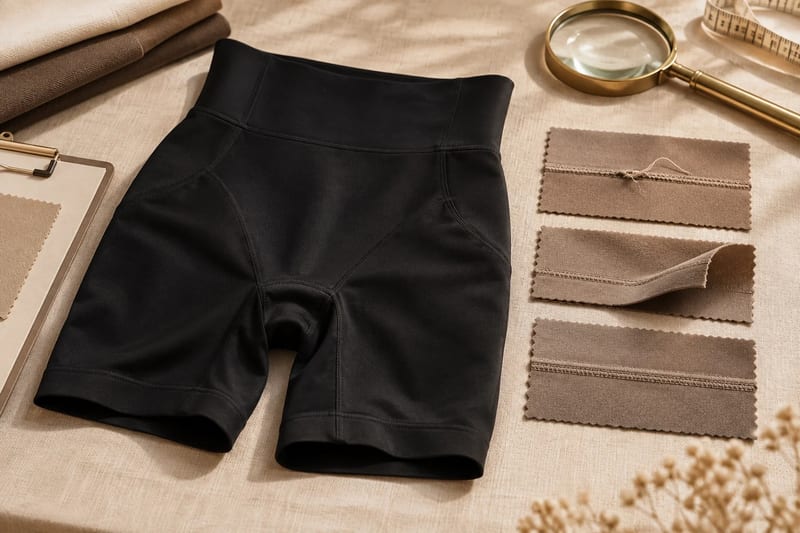
Illustrative sourcing and product-development scene. Click to continue the related buyer guidance.
How Should Four-Channel Shapewear Prices Inform a Break-Even Model?
Price observations help frame the competitive offer, while break-even needs your realized revenue and complete defined variable costs. Keep those roles distinct. The table separates basic seamless garments from structured shaping products and consumer channels from B2B procurement; it does not establish a margin available to your brand or a sales volume you will achieve.
| Channel | Basic seamless bodysuits: USD/piece | Structured body shapers/fajas: USD/piece | Observed scope |
|---|---|---|---|
| Amazon | $12.38–$19.99 | $34.88–$43.99 | Selected variants; dated tracker offers |
| B2C brand websites | $29.99–$78.00 | $69.00–$148.00 | Basic: Shapermint/Shapellx/SKIMS; structured: Shapellx/SPANX |
| TikTok Shop | $21.99–$46.99 | $39.99–$54.99 | FeelinGirl/YIANNA selected offers; campaigns vary |
| B2B finished/platform offers | $2.50–$12.85 | $14.00–$27.42 | Multiple suppliers; quantity/brand terms vary; development separate |
The B2B finished-garment observations are generally lower than consumer tickets, but the spread also covers different product specifications, retail operations, promotions and brand positioning. It cannot all become contribution. A promoted Amazon or TikTok Shop price may differ from a B2C brand-site ticket without proving that one channel is sustainably more profitable for your proposed product.
Use the deliberately hypothetical numerical models elsewhere to see how the denominator and assumptions change required units. Replace revenue, landed goods and selling costs with your evidence before deciding an order or campaign. Do not use the lowest observed B2B price and highest unrelated retail ticket together to manufacture an optimistic recovery target.
US-facing USD per single garment, reviewed November 10, 2026. Amazon uses dated May–October 2026 third-party PriceHistory snapshots, not live November checkout. These selected-seller observations are not industry averages or matched-quality comparisons. Variants and promotions change; shipping and tax are not normalized. B2B bands describe advertised garments, not landed costs or a final custom-development quote. Sources: dated PriceHistory Amazon records, official brand/TikTok Shop pages and Made-in-China supplier listings.
How Should You Test the Sensitivity of Your Break-Even Estimate?
Change one important uncertain input at a time and preserve a consistent unit basis. The table holds chosen fixed commitments at $1,800 and compares deliberately hypothetical revenue and complete variable-cost assumptions. These are not researched retail targets, platform fees or supplier quotations.
At $40 revenue and $30 variable cost, contribution is $10 and the selected fixed amount requires 180 units. At $36 revenue with that chosen cost held constant, contribution is $6 and the model requires 300 units. At $40 revenue and $32 variable cost, contribution is $8 and the result is 225 units.
The constant-cost simplification is for explanation only. Percentage-linked charges, discounts, returns and transaction treatment need actual terms in a commercial model. A mathematically correct calculation can still mislead if its inputs mix unrelated garments or assume every premium retail observation is attainable.
Use the result to choose the next evidence priority. Test a specific offer when realized revenue is uncertain, obtain delivery or fulfillment quotes where costs are missing, and review actual fit and service outcomes before increasing inventory. The output should be a conditional buying or campaign decision, not a guaranteed profitable sales target.
| Hypothetical scenario | Revenue / complete variable cost | Contribution | Units for $1,800 |
|---|---|---|---|
| Base illustration | $40 / $30 | $10 | 180 |
| Lower revenue | $36 / $30 | $6 | 300 |
| Higher variable cost | $40 / $32 | $8 | 225 |
| Nonpositive contribution | Revenue ≤ costs | Zero or negative | No finite recovery in this model |
Which Shapewear Manufacturer Routes Change the Costs You Need to Recover?
Compare supplier models by what the first commitment contains: identifiable goods, technical coordination or new material development. These examples help locate cost inputs and responsibilities. They do not establish country-level profitability, guaranteed consumer demand or a universal number of units needed to launch a brand.
China Shapewear Manufacturer: Keep the Quoted Tier Separate from Sales Assumptions
China shapewear manufacturers offering quantity tiers can change the goods-cost input, but a lower piece price does not validate the sales volume assumed in a break-even model.
Recommended supplier: S-Shaper
S-Shaper’s OEM/ODM support describes material and style recommendations and specialists across design, production, QA and export with global client experience. Ask the team which platform and essential changes match the brief, then obtain a proposal connecting sample approvals, variants and the actual quoted tier. That makes the sourcing input identifiable.
Conditional small-order possibilities and public tiers are not a complete launch budget. Confirm development, components and delivery exclusions before modelling contribution. This route suits an own-label founder using a pilot to learn before scaling. The supplier’s market-informed recommendations can support feasibility, while your own offer tests must establish realized revenue, selling costs and whether another inventory commitment is justified.
Canada Shapewear Manufacturer: Model Technical Preparation and Production Distinctly
Canada shapewear manufacturer arrangements with local technical work and overseas production can add separate commitments; identify the development deliverable before allocating it within a break-even planning scope.
Recommended supplier: Hertex
Hertex describes Montreal-based design, pattern work, grading and quality control with China production. A founder can investigate which technical documents and fit decisions the team would handle and how those decisions reach manufacturing. This helps separate a defined preparation commitment from recurring goods supply.
The reviewed description does not establish startup eligibility, fees or locally available inventory. Request the actual proposal and payment milestones rather than treating a local office as one all-inclusive cost. This route suits a founder needing structured technical communication, provided the chosen model preserves the different cost and cash implications. It does not establish a universal Canadian premium or a guaranteed reduction in the units the business must sell.
Portugal Shapewear Manufacturer: Justify Technical Investment with a Defined Product Need
Portugal shapewear manufacturer research capabilities can introduce technical-development commitments before inventory; assess what evidence the work buys before deciding how a launch will recover that investment.
Recommended supplier: Impetus
Impetus describes its own research team, external technical collaboration and development across seamless and cut-and-sew products. If the proposition depends on a distinct material or construction result, ask which prototype or investigation would verify the benefit and establish a production specification. That defines a more meaningful preparation scope than a general innovation request.
Startup acceptance, project pricing and minimums remain unverified by the reviewed pages. Material and laboratory work may require more commitment than selecting an existing platform. This route suits a validated technical need with resources for scoped evidence. Do not use a hypothetical higher selling price to justify undefined development or assume that a research-led garment automatically generates the contribution required to recover it.
Choose a scope you can explain and fund, then use confirmed sourcing inputs and tested offer assumptions to evaluate recovery rather than assigning a national break-even advantage.
What Evidence Should Replace the Assumptions Before You Scale?
Use a consistent record of realized revenue, retained units and relevant provider charges. A few likes or waitlist signups do not establish contribution. Purchases and post-purchase results can reveal the actual fit, pricing and service questions that the first model could only assume.
Review product conformity through the quality-assurance discussion and receiving responsibilities through the logistics scope. An unexpected discrepancy or handoff cost can change the model. Record the cause rather than quietly adjusting a denominator until the apparent break-even target looks acceptable.
If several products or channels are introduced, do not rely on one unchanged unit contribution. A weighted average requires a defined expected mix and consistent costs, and the actual mix may differ. For an early focused launch, keep separate scenarios where that makes uncertainty clearer than an apparently precise combined target.
End the review with a decision: maintain the offer, change a product or service input, run another test or revise the inventory plan. The calculation is useful when it explains what the business must learn next and which commitments remain conditional. It cannot replace customer evidence or guarantee that the required units can be sold.
How Can S-Shaper Help Define the Sourcing Inputs in Your Model?
S-Shaper’s product catalogue and manufacturing services provide a basis for identifying a garment and scoped first-order proposal. Share the target wearer, reference, essential changes, sizes, colors and approximate quantity. Ask for the actual sample and development work needed before a firm production offer can be confirmed.
Review the published FAQ for preliminary order context, then confirm item-specific conditions directly. If branding or material choices require customization support, record the associated commitments rather than assuming the public unit price covers every preparation step.
To begin, request a product-specific proposal from S-Shaper. Use the confirmed scope alongside your actual channel evidence. Manufacturing advice can improve feasibility and the goods-cost input, while the brand remains responsible for the selling offer, cost definitions and assumptions behind its break-even estimate.
FAQ: How to Estimate Break-Even Sales for a Shapewear Launch
How do I calculate break-even units for a shapewear launch?
Divide the fixed costs in the defined planning scope by positive unit contribution, then round units upward. Contribution must use consistent revenue and variable-cost inputs. State the period, product and treatment of returns or discounts so the result can be interpreted.
Does the model guarantee I will make a profit?
No. It describes a relationship under assumptions and does not prove demand or complete financial performance. Actual revenue, cost, mix and timing can differ. Use the result to prioritize evidence and review decisions rather than promise a guaranteed profitable sales target.
Should the whole inventory purchase be counted as fixed cost?
Not automatically. If the unit model already subtracts the cost assigned to goods sold, adding the full purchase again can double count. Keep cash recovery and cost-based break-even questions distinct and use the treatment appropriate to the defined planning scope.
What if contribution is negative?
Additional units do not cover the selected fixed costs under that model. Revisit the offer, product, channel or cost inputs. Do not report a negative calculated unit count as a practical recovery target or assume volume alone solves the issue.
Are the $40, $30 and $1,800 figures researched benchmarks?
No. They are deliberately chosen illustration inputs, not quotes, recommended prices or actual client results. The four-channel table separately describes selected public product offers. Replace all revenue and cost assumptions with your own consistent transaction and offer evidence before making a commitment.