 EN

Quick Answer
To compare a shapewear factory vs trading company, verify who contracts with you, who develops the garment, where production occurs and who controls inspection and changes. A supplier’s label is less useful than a documented map of the work. A direct factory can use external specialists, while an intermediary can coordinate a well-defined production arrangement.
Ask for consistent evidence across the entity details, production location, relevant samples, workflow and order records. Do not assume that a showroom, regional domain or machinery photograph proves ownership of every process. Choose the arrangement whose responsibilities and commercial scope you can understand and manage for your first collection.
What Does Factory vs Trading Company Mean for a Shapewear Buyer?
A factory performs manufacturing work, while a trading company primarily organizes commercial supply. Real relationships can combine these roles. A manufacturer may have a separate export or sales entity; a trading business may coordinate development and inspection with specialist factories. Your buying decision requires the actual arrangement rather than an idealized definition.
Ask who receives your brief, prepares patterns, makes samples, sources materials, manufactures the order and releases finished goods. The same organization may perform several stages, or different partners may be responsible. Record each stage separately. A clear answer lets you identify where fit comments, substitutions and quality findings need to go.
Avoid judging the relationship only by the speed of a sales response. A helpful contact should be able to explain how a technical question reaches the appropriate person and how the answer is documented. If the representative does not perform development, that is not automatically a problem; inability to identify the development responsibility is a more concrete concern.
Use the distinction to choose the support you need. A founder with a finished specification may prioritize transparent production and inspection. A founder with only a concept may need development coordination as well. The best arrangement connects the missing capabilities to named deliverables instead of promising that one business model is always superior.
| Role | Work to verify | Record to request |
|---|---|---|
| Commercial supplier | Quotation, invoice and contracting scope | Consistent entity details |
| Developer | Patterns, measurements and revisions | Technical responsibility map |
| Producer | Actual garment manufacturing stages | Location and relevant workflow |
| Inspector/coordinator | Checks, findings and release | Order-specific quality arrangement |
How Do You Verify the Commercial Entity and Production Location?
Begin with consistency. Compare the business name and contact information on the quotation, invoice and supplier introduction. Ask the established contact to explain differences, including any separate export entity. Do not infer fraud from an unfamiliar structure, but do not ignore an unexplained mismatch before payment either. The relationship should be understandable in writing.
Request the manufacturing address and the role of any other address. A head office, showroom, warehouse and production facility are different locations. S-SHAPER’s factory page provides a starting manufacturing reference, while public contact information also identifies an office. A clear separation of roles is more useful than compressing both into one city label.
Ask whether your particular product will be made at the described site. A supplier may operate more than one location or use a partner for a specialist process. Record which stages occur where and how materials and work are transferred. A verified visit to one building would not, by itself, establish the route for every garment in a broad catalogue.
Use independent evidence proportionately. An appropriately scoped site visit or professional review can help answer questions that website materials cannot settle. For a small first order, begin with documents and a relevant sample, then identify the specific uncertainty that would justify further investigation. The objective is evidence for your order, not collecting an impressive quantity of unrelated paperwork.
Which Production Stages Should You Ask to See or Discuss?
Start with the construction your garment requires. Seamless shaping garments, panel-based briefs and built-in shaping dresses may involve different operations. Ask the supplier to trace your proposed style from material receipt through assembly, finishing and packing. A relevant explanation shows how the sample and production route connect.
Use S-SHAPER’s catalogue to name the actual platform when asking these questions. A tour of unrelated apparel machinery may reveal a real facility while still leaving your product’s production route unanswered. Ask which operations are performed on-site, which are external and who checks work when it returns from another provider.
For outsourced stages, discuss responsibility rather than demanding an unrealistic claim that nothing ever leaves the building. Who approves the external provider? How is material identity preserved? Who records the result and resolves a discrepancy? The answers should make the route traceable enough to support the agreed product requirements.
Link the workflow to change control. A waistband revision may affect more than one operation or component. Ask who updates the current specification and how superseded instructions are withdrawn. Review the customization scope to identify the changes likely to require this coordination, rather than assuming that every adjustment is a simple sales instruction.
| Workflow question | Why it matters | Evidence suited to the question |
|---|---|---|
| Where is this style sampled? | Connects development to production | Sample ID and technical contact |
| Which stages are external? | Reveals additional handoffs | Process map and control explanation |
| How are materials identified? | Supports product consistency | Relevant material/batch records |
| Who approves a revision? | Prevents conflicting instructions | Current specification and change log |

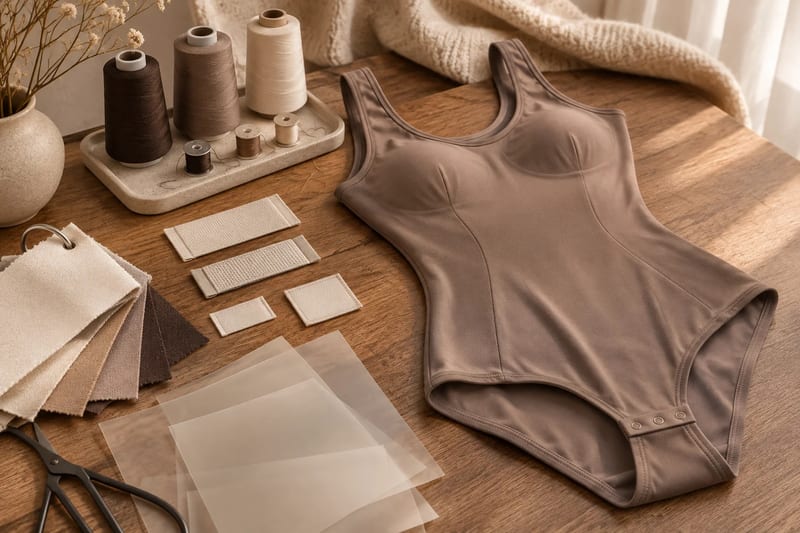
Illustrative sourcing and product-development scene. Click to continue the related buyer guidance.
Direct Factory vs Trading Partner: Which Arrangement Fits a Startup?
A direct manufacturing relationship may give you a shorter technical communication route, but only if the supplier actually provides the support you need. A factory expecting a complete technical pack may be a difficult match for a founder who has not defined measurements or construction. Ask what preparation the factory requires and which work remains yours.
A trading or development partner may coordinate several specialist capabilities or reduce communication work for the buyer. That support has to be defined and evaluated. Ask how the partner verifies production, communicates changes and handles inspection findings. Coordination is valuable when it makes the product record clearer, rather than concealing the underlying process.
The S-SHAPER OEM/ODM page distinguishes manufacture from a client design and supplier-assisted development. Use a comparable responsibility discussion with every candidate, regardless of its commercial label. The relevant question is whether the proposed team can turn your inputs into the sample and records required for approval.
Avoid assuming a universal price advantage. An intermediary’s quote may include work omitted from a factory quote, while another intermediary may add little support. Align the garment and included services before comparing. Evaluate the relationship’s ability to support a repeatable product and a manageable first order, not a slogan about buying direct.
| Buyer situation | Direct factory questions | Trading/development partner questions |
|---|---|---|
| Defined technical pack | Can you manufacture and inspect this scope? | What coordination adds value? |
| Concept without specifications | Which development work is included? | Who prepares and owns the technical record? |
| Several specialist stages | Which operations are external? | How are partner handoffs controlled? |
| First small order | Which quantities and support qualify? | What exactly is covered by the offer? |
Factory vs Intermediary: How Should Channel Price Evidence Be Interpreted?
A factory label does not make a quote directly comparable with every marketplace or brand offer. The observed channels contain different selling layers and service responsibilities. Classify the actual construction and commercial route first, then ask which organization supplies the technical work, garment, stock and customer service represented by the amount.
| Channel / buying model | Observed USD per garment | Product and order basis |
|---|---|---|
| Amazon US retail bodies | $12.38–$35.14 | Seamless/lighter bodies $12.38–$19.99; Structured bodies $35.14–$35.14. |
| Value/mid-tier brand DTC bodies | $29.99–$49.00 | Shapermint/Shapellx sale prices; no multi-pack or order code |
| TikTok Shop US bodies | $21.99–$54.99 | Seamless/lighter bodies $21.99–$46.99; Structured bodies $39.99–$54.99. |
| B2B small-order platform bodies | $3.18–$10.00 | Tianchen, Junmao and S-Shaper; listed minimums 5/2/10; not deep-custom eligibility |
| B2B higher-volume platform bodies | $2.50–$12.85 | Listed minimums 100–600; different garments, not a same-SKU volume discount |
US-facing USD single-garment observations reviewed November 10, 2026; variants, retail promotions and shipping/tax differ. Amazon uses May–October 2026 tracker snapshots, not live November checkout. These selected samples are not industry averages or matched constructions. B2B advertisements are not landed costs or final custom quotes. Deeper development needs separate specifications, deliverables and an itemized quotation.
Standard B2B supply is generally lower per piece than B2C because a business buyer often undertakes inventory and downstream selling. An intermediary may add coordination that another proposal excludes, while a consumer brand can charge for positioning and service without revealing its manufacturing cost. No channel range proves a universal factory margin or trader markup. Ask S-Shaper for the actual production and support scope and compare it against the same requirement elsewhere. Evaluate who performs the work rather than attributing the entire price spread to ownership of machinery.
This profile concerns everyday platforms. Structured fajas require a separate specification; new patterns, materials and deeper customization are not assumed included in ready-made bulk supply.
Which Shapewear Manufacturers Should You Consider for Factory and Trading-Company Comparisons?
Compare shapewear manufacturers in China, the USA, Canada and Turkey for verifying who manufactures the garment. The recommendations below connect country-level capabilities with specific suppliers and the work your brand needs.
China Shapewear Manufacturer: Verify the Direct Factory and Its Specialist Responsibilities
China shapewear manufacturers describing direct production still require a role map; verify which entity contracts, which team develops the garment and who controls any external manufacturing stages.
Recommended China Supplier: S-Shaper
S-SHAPER presents OEM/ODM expertise spanning design, production, QA and export, plus material and style recommendations informed by international customers. That makes its China factory-direct route relevant to an own-label buyer, but the inquiry should still identify the proposed production site, technical owner and any external stages for the selected garment.
Conditional small-batch statements and public product tiers describe commercial starting points, not proof that every process is performed by one entity or that all custom orders share a minimum. Ask the specialists to connect the current sample and specification to the production instruction. This route suits a founder wanting direct technical and manufacturing communication, provided contracting, approvals and export responsibilities remain clear in the actual order.
Source: S-SHAPER OEM/ODM and global-brand support.
USA Shapewear Manufacturer: Recognize Distribution as a Distinct Role
USA shapewear manufacturer comparisons must recognize distribution as distinct from fabrication; a wholesale representative can support supply without establishing that the underlying garments are produced domestically.
Recommended USA Supply Partner: Vedette
Leonisa lists a US wholesale representative in Norcross, Georgia, while its brand identifies Colombian manufacturing. That is a concrete example of why a US commercial contact should not be mistaken for the fabrication site. The local-facing role can still be valuable for assortment and wholesale communication; ask what it performs for your transaction.
Confirm available products, stock location and delivery terms rather than inferring local manufacturing speed. The reviewed program does not establish OEM or unrestricted relabeling. This route fits a retailer purchasing defined finished goods. It belongs in a different commercial comparison from a factory asked to change materials or patterns, even if both offers arrive from a convenient domestic contact.
Source: Leonisa US wholesale contact and distribution.
Canada Shapewear Manufacturer: Separate Local Technical Work from China Production
Canada shapewear manufacturer models can combine domestic technical work with China production; assess the disclosed division of labor rather than forcing the business into one geographic label.
Recommended Canada Development Partner: Hertex
Hertex explicitly locates design, pattern work, grading and quality control in Montreal and production in China. That disclosure helps a founder understand a hybrid responsibility structure instead of trying to label the business simply local or overseas. Ask how the current technical record moves between those stages and who authorizes a revision.
The structure does not guarantee startup acceptance, short lead times or Canadian manufacture. Development and production conditions need a project proposal. This route suits a brand that needs technical communication and a defined manufacturing handoff. Compare what that coordination delivers with factory-led development, recognizing that a split-location arrangement can be useful when its roles are managed transparently.
Source: Hertex Montreal development with China production.
Turkey Shapewear Manufacturer: Trace an Integrated Route Without Assuming Everything
Turkey shapewear manufacturer integration provides a production structure to verify, not a blanket assurance; follow the selected garment through its applicable stages and identify external responsibilities.
Recommended Turkey Supplier: SML Seamless
SML describes Turkish private-label shapewear production in integrated yarn-to-packed facilities. For a seamless garment, that gives the buyer a specific claim to investigate: which knitting, color and finishing stages apply to the proposed platform, and how does the team control them? Dedicated communication can help the founder follow those decisions.
Integration is not a substitute for checking the actual sample, material identifiers, grade rules and inspection record. Confirm any external work and the current order conditions; the source establishes no universal MOQ or price advantage. This route suits a product that genuinely fits the seamless capability. Evaluate the disclosed workflow rather than treating either a factory label or an alternative country as automatic evidence of quality.
Source: SML Seamless integrated private-label manufacturing.
Select the arrangement whose actual stage ownership meets your needs, then preserve the responsibility map alongside the sample, commercial scope and quality agreement.
Which Quality and Change Controls Matter More Than the Supplier Label?
Agree how your finished order will be compared with the approved sample and specification. Review the quality-assurance process as context, then define the checks relevant to your garment. The business label does not establish measurement accuracy, seam quality or correct labeling; those need order-specific criteria and records.
Ask who can authorize substitutions and where the approval is stored. A material replacement proposed by a production partner should reach the brand before it is used when it affects the agreed product. A transparent process makes responsibility visible even if several organizations participate. An opaque process remains risky even when the seller owns some manufacturing equipment.
Confirm inspection access and corrective-action handling before dispatch. If an independent inspection is planned, identify the facility, stage and documents needed. If a finding requires work, ask who coordinates the remedy and how completion is confirmed. This is more useful than a broad promise that every issue will be handled later.
Review the receiving and shipping handoff through the logistics discussion. The commercial supplier should explain how the packing list, quantity and product identifiers align with your purchase order. Ultimately, the strongest arrangement is one in which a first-time founder can follow the order through documented stages and understand who is accountable at each point.
What Should You Verify When Considering S-SHAPER’s Manufacturing Offering?
S-SHAPER publicly presents a factory introduction, shapewear catalogue, OEM/ODM development and customization services. These provide a relevant starting point for discussing a manufacturing relationship. Ask the team to identify the commercial entity, production route and development responsibilities for your selected garment rather than extrapolating from general website materials.
Send the product reference, intended changes, target country, sizes and quantity. Ask where sampling and production would occur, which processes require external work and which product-specific records you will receive. Use the supplier FAQ to prepare order-condition questions, then confirm the applicable scope in the current proposal.
To begin, request a production-responsibility discussion with S-SHAPER. Compare the response using the same role map you apply to any direct factory or trading partner. The result should help you understand the work behind the offer and decide whether that arrangement fits your startup’s capabilities.
FAQ: Shapewear Factory vs Trading Company: How to Verify Who Does the Work
How can I tell whether a shapewear supplier owns a factory?
Ask for the manufacturing location and commercial relationship, then cross-check relevant workflow, sample and order evidence. Ownership is a fact to establish rather than infer from a website image. Also ask whether your particular garment will be produced at that site and which stages are external.
Is a trading company always a worse choice?
No universal conclusion follows from the business model. Evaluate the actual development, coordination, quality and commercial responsibilities offered. A transparent partner can be useful, while an unclear direct relationship can leave important tasks unresolved. Compare the work your project needs.
Does a local office mean local production?
No. A local office may perform sales, development, coordination or fulfillment while manufacturing occurs elsewhere. Record each role and location separately. Ask the supplier to confirm the route proposed for your exact garment rather than relying on a regional domain.
Should I reject every supplier that outsources a process?
Not automatically. Ask which stages are external, why they are used and how material identity, quality and changes are controlled. The relevant concern is whether the arrangement is disclosed and managed well enough to meet your approved specification.
What is the most useful verification record for a startup?
A stage-by-stage responsibility map linked to the product and commercial records is a practical foundation. Combine it with a relevant sample, approved specification and inspection arrangement. No single photograph or document proves every aspect of a supplier relationship.