 EN
Quick Answer
Treat power mesh and powernet as starting descriptions, not complete material specifications. Ask for an identified article, composition, construction, mass per area, usable width, direction, stretch and recovery evidence, finish and proposed application. The name alone does not establish whether the material is suitable as a lining, a support panel or the main garment.
Compare actual swatches and garments for the intended location. A lighter material is not automatically weaker, and a heavier one is not automatically more supportive or comfortable. Approve the complete material-and-construction proposal with relevant testing and wearer review before ordering.
What Job Will the Mesh Perform in Your Shapewear?
Identify the component before requesting a fabric. A lining, abdominal panel, bra wing, side insert and garment body create different questions. State the area, layering arrangement, contact with the wearer and intended movement. A general request for strong mesh gives the supplier too little information to recommend a useful alternative.
Select an actual garment direction from S-Shaper’s product catalogue and ask which component provides the observed effect. A visible mesh texture may be decorative, while a less visible layer may provide the relevant structure. Do not infer a quantified support level from the appearance of holes or from the trade description.
Describe the result the component must achieve. For a lining, review contact, attachment and interaction with the outer layer. For a panel, review its orientation and surrounding joins. For an opening or band, ask whether a narrow component needs different testing from a wider fabric. Keep those questions separate instead of choosing one material for every location.
Identify the failure you want to avoid: a visible edge, uncomfortable join, changed fit after care or incompatible extension between layers. The next sample can then test a specific hypothesis. Adding weight or choosing a stronger-sounding name without that diagnosis can create new problems while leaving the original one unresolved.
Avoid medical implications unless the actual product and claim have appropriate evidence. A mesh described as control or compression in a catalogue is not, by itself, a measured garment-pressure result or proof of a clinical application. Keep the buying brief focused on the intended fashion product and the evidence needed for its actual wearer promise.
What Do Real Power Mesh and Powernet Examples Tell a Buyer?
WinnerSumbiri Knitting describes its Power Mesh family as spanning 70–350 g/m² and different modulus levels, for uses from linings to shapewear. That is the published range of one supplier’s family, not an industry specification or a recommendation that any point in the range fits a particular garment.
Source: WinnerSumbiri Knitting: Power Mesh product family and location
KARL MAYER’s showroom identifies powernet article 2010/038, produced on a Raschel machine, at 115 g/m². It describes the example as monoelastic and intended for lingerie. The machine-maker example demonstrates that the powernet name does not necessarily mean a heavy fabric; it is not a ready-made purchase recommendation for a startup.
Source: KARL MAYER: identified 115 g/m² powernet example
| Published example | Data actually stated | Useful limit |
|---|---|---|
| WSK Power Mesh family | 70–350 g/m²; varying modulus | Family range, not one article specification |
| KARL MAYER 2010/038 | 115 g/m²; monoelastic; lingerie example | Named construction, not all powernet |
| Comparison | Labels cover different constructions | No universal power-mesh/powernet ranking |
These observations should change the inquiry, not create a new shortcut. Request the actual article proposed for your panel and the relevant evidence. A family description may help shortlist a supplier, while an identified swatch and specification are needed to compare materials. Do not assume that similarly named articles from two mills have the same structure or behavior.
Ask the garment developer whether the offered material is normally available in the required shade and form. A technically interesting showroom construction may not be a stocked fabric at your quantity. Material suitability, commercial availability and garment approval are related decisions, but none substitutes for the others.
Power Mesh vs Powernet: Which Specification Fields Matter More Than the Name?
Ask both suppliers for the same decision fields. Composition identifies ingredients; mass per area and width help describe the supplied textile; direction and mechanical evidence help interpret its elastic behavior. None of these fields alone establishes the final garment result.
Clarify terminology. If a supplier calls a fabric monoelastic, ask which direction it means in the supplied material and how the pattern must be oriented. Do not rotate a sample during handling and then compare it with a different direction on another swatch. Keep direction marks attached through cutting, sampling and laboratory review.
Ask for force or modulus information with the method and units. A word such as firm may be useful subjective language, but it cannot be compared numerically with an unqualified force value. ASTM D4964 addresses tension and elongation of elastic fabrics and emphasizes relevant conditions for comparable results. Discuss the appropriate method with the supplier and laboratory rather than treating any stretch number as interchangeable.
Source: ASTM D4964: elastic-fabric tension and elongation scope
The finished component also depends on its surroundings. A panel sewn into a different outer fabric may behave differently from an isolated strip. Evaluate the material data and the assembled garment separately. A buyer can prefer one complete construction while acknowledging that the result does not isolate a universal effect of the mesh name.
| Field | Ask the supplier | Why it matters |
|---|---|---|
| Article identity | Which exact code and revision? | Distinguishes similar-looking alternatives |
| Composition and construction | What is actually supplied? | Trade name is incomplete |
| Mass and usable width | Which units and tolerances? | Supports consumption planning |
| Direction | How is the relevant orientation marked? | Preserves sample comparability |
| Elastic evidence | Which method, force, extension and recovery basis? | Prevents incompatible-number ranking |
| Application | Lining, panel, band or main body? | Connects textile with the garment |
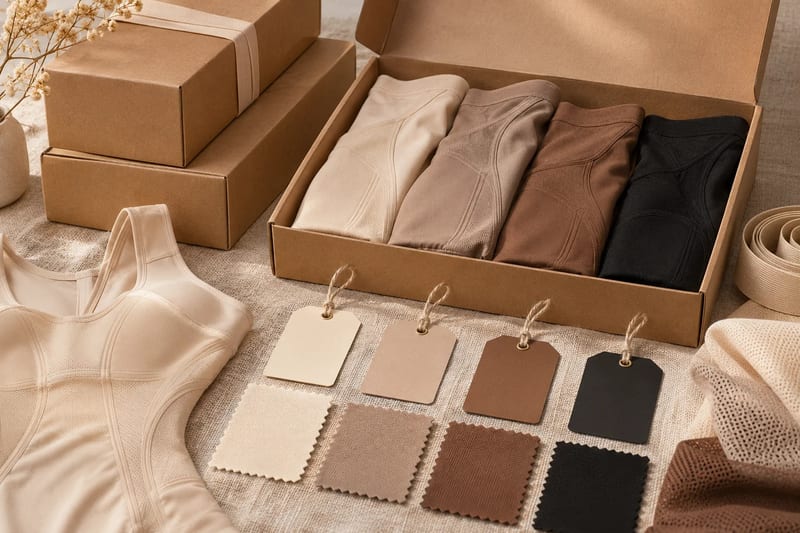
Illustrative sourcing and product-development scene. Click to continue the related buyer guidance.
How Can You Use GSM and Area Without Mistaking Weight for Support?
The stated endpoints of WSK’s family span have a simple arithmetic relationship: 350 ÷ 70 = 5. That means the upper endpoint has five times the mass per area of the lower endpoint. It does not mean five times the support, strength or price, and it does not establish a performance relationship across the supplier’s different articles.
For a separate illustrative component, choose a rectangle 20 cm by 30 cm. Its area is 0.20 × 0.30 = 0.06 m². Applying a 115 g/m² nominal mass gives 6.9 g for that flat area. Applying a hypothetical 250 g/m² option gives 15 g. The latter is a chosen planning value, not a second published supplier specification in this comparison.
These calculations exclude cutting loss, overlap, seams, extra layers and trims. They are not garment consumption figures, a finished-product weight forecast or a quote. A developer must establish actual pattern area, usable material and production requirements before a buyer can turn a material unit price into a relevant cost model.
Keep the arithmetic useful by labeling its inputs. A mesh family range is observed supplier information; a rectangular component is an illustration; the final garment is a separate design. Mixing those categories can produce a precise-looking but unsupported buying conclusion. Use the calculation to ask for the missing consumption and performance evidence instead.
| Input or calculation | Result | Scope |
|---|---|---|
| Published family endpoints | 70 and 350 g/m² | One supplier’s range |
| 350 ÷ 70 | 5 times mass per area | Not a support multiplier |
| Chosen rectangle | 0.06 m² | Illustrative area |
| 115 × 0.06 | 6.9 g | Flat-area arithmetic |
| Hypothetical 250 × 0.06 | 15 g | No supplier performance claim |
How Should You Review Layer Compatibility, Joins and Care?
Request swatches large enough for the agreed comparison and identify both directions. Ask which article is proposed for the actual garment, not simply which sample feels firmest by hand. Preserve shade and finish information, because a later substitute should be reviewed against an identified reference.
Use S-Shaper’s material customization service to connect the mesh with the outer fabric, lining and edge construction. Ask whether their extension behavior and attachment are suitable for the proposed location. A mesh can perform differently once constrained by a seam or paired with a material that responds differently.
Review the assembled component during dressing and relevant movement. Record visible edges, contact, local bunching and changes in position. Tie observations to the garment version, size and wearer rather than claiming that one mesh name always rolls or another never does. A specific problem gives the developer an actionable revision.
Agree after-care and relevant mechanical checks with the quality-assurance team. Keep the method, conditions and units for any test result. Do not invent a universal modulus threshold, GSM target or wash count for all shapewear. The review should establish whether this component in this garment meets the brief under the agreed conditions.
If the results conflict, preserve both. A laboratory strip can show one behavior while a wearer experiences another effect from the assembled product. Ask what the evidence actually measures and what additional work resolves the garment question. Do not suppress the inconvenient result to keep the preferred material in the collection.
Which Manufacturers Fit a Power Mesh or Powernet Sourcing Project?
Decide whether you need a finished own-label garment or a separately sourced textile. The examples below distinguish coordinated garment development from fabric-mill routes. They describe published capabilities and limitations, not national performance rankings or proof that similarly named materials are interchangeable.
China Power Mesh Shapewear Manufacturer: Integrate the Material into an Approved Garment
China power mesh shapewear manufacturer comparisons should begin with the panel location and surrounding layers, so material recommendations address the assembled product rather than a trade name.
Recommended supplier: S-Shaper
S-Shaper’s OEM/ODM offering describes material and style recommendations with design, production, QA and export specialists. A founder can ask the factory team to identify a suitable mesh alternative within a garment platform, then compare direction, layering and wearer observations. Experience across several customer regions informs the inquiry; actual evidence must establish product suitability.
Conditional small-order possibilities depend on the selected platform, material and customization. Confirm the exact scope and quotation rather than treating a low quantity statement as a promise to source every new mesh at that level. This route suits an own-label buyer who needs a finished-garment proposal and can approve identified materials and construction together.
Germany Powernet Fabric Manufacturer: Source an Identified Textile Before Garment Assembly
Germany powernet fabric manufacturer routes can supply specialized textile development, but a startup must connect the selected fabric with a separate garment-development and assembly plan.
Recommended supplier: Penn Solutions
Penn Solutions describes product development in Italy and production in its own German facility, alongside other manufacturing relationships. Its stretch-fabric focus makes an identified textile inquiry relevant. Ask for the exact article, supply route, width, direction and evidence needed for the proposed garment component, rather than assuming every catalogue entry has one origin.
The reviewed information does not establish a ready private-label garment, a universal startup minimum or an included assembly service. Confirm material quantities and the handoff to the garment maker. This route suits a brand with technical garment support that needs a defined textile option. Specialized material development can add coordination and commitment, so scope those responsibilities before ordering fabric.
Indonesia Power Mesh Fabric Manufacturer: Narrow a Broad Family to One Article
Indonesia power mesh fabric manufacturer comparisons should narrow a broad material family to a named article, with the required shade, dimensions and performance evidence confirmed before garment sampling.
Recommended supplier: WinnerSumbiri Knitting
WinnerSumbiri identifies its factory in Tangerang and describes warp and circular knitting with dyeing, finishing and printing facilities. Its published Power Mesh family spans several weights and modulus descriptions. Ask which specific article addresses the intended lining or panel, and request the evidence and commercial terms for that article.
A fabric family is not a finished-garment program, and its advertised span does not prove every option suits shapewear at a startup quantity. Confirm actual availability, minimums and the garment-maker handoff. This route suits a buyer with a clear component specification and an assembly partner. Do not infer quality from location or treat the broad catalogue as approval of an untested material.
Choose the route that can identify the actual material and preserve responsibility for its garment integration, then approve both the component and the finished sample.
What Must Your Purchase Record Preserve for the Selected Mesh?
Keep the article code, composition information, construction description, shade, finish, mass and usable width with the approved swatch. Record orientation and the component location in the garment. Attach relevant test reports with conditions and units so later buyers can interpret the evidence.
Identify the assembled garment version, joins, surrounding layers and reviewed sizes. A material can remain unchanged while the construction changes its wearer result. Preserve that distinction when deciding which revisions need another garment trial and which require fresh material evidence.
Read the order FAQ as a starting point and confirm actual material and quantity conditions. Use the packing and receiving handoff to connect lot and product identifiers with the order. A generic instruction to use powernet does not tell receiving staff whether the approved article was supplied.
For reorders, ask what has changed before accepting an equivalent description. A proposed alternative may work well, but compare its actual specification and sample with the retained reference. The buyer’s record should make a substitution review possible without reconstructing the entire development conversation.
Retain a small reference pack that another person can understand: the marked swatch, approved component drawing, garment photograph and decision record. Keep rejected alternatives labeled separately. If a buyer later asks for a softer lining or a different color, that pack identifies the starting point and prevents a casual change from becoming an undocumented new construction. Ask the supplier which material identifiers will appear in production records and which can be checked at receiving. A physical reference alone may be difficult to distinguish after months of handling; a code alone may be incomplete without the actual material and garment context.
How Can S-Shaper Help Specify the Mesh Within a Complete Product?
S-Shaper can be approached with the garment reference, component location and desired wearer result. Ask its team to recommend identified materials and explain the proposed layering, orientation and joins. That gives the founder a practical sample question instead of a request based only on a trade name.
The company’s published support covers recommendations and specialist communication across design, production, quality and export. Confirm the selected material’s availability, evidence and order terms for your project. Conditional low-quantity support does not establish that every mill article or custom shade is included.
Send the relevant references through a focused S-Shaper inquiry. Request a coordinated material-and-garment proposal, identified samples and an accurate quote for the approved version. Keep the final product claim within the evidence obtained and preserve the record for production and future material changes.
FAQ: Power Mesh and Powernet: Questions to Ask Your Shapewear Supplier
Is powernet always heavier than power mesh?
No universal rule is established. The cited WSK Power Mesh family spans 70–350 g/m², while the identified KARL MAYER powernet example is 115 g/m². Ask for the actual article specification.
Does heavier mesh provide more support?
Mass per area alone cannot establish support. Compare relevant tension and recovery evidence, material direction, layering and the actual garment. Do not convert a weight ratio into a support multiplier.
Can I use the same mesh for a lining and a control panel?
Only after evaluating the actual requirements. Component location, contact, layers, joins and intended behavior can differ. Ask the developer to explain and validate the proposed use rather than approving by name.
What should I request before replacing an approved mesh?
Obtain the alternative article identity, relevant specification, direction and evidence. Compare it with the retained swatch and garment reference, then decide which material and wearer checks must be repeated.