 EN
Quick Answer
Develop petite shapewear by reviewing vertical proportions, waist placement, rise, torso path and adjustment range for the intended customers. Petite is not a synonym for XS, and a short-torso customer is not identified by height alone. Begin with actual body measurements and the particular garment’s coverage.
Ask the manufacturer for a dedicated sample comparison instead of shortening straps or trimming the bottom of a standard pattern by default. A bodysuit, high-waist brief and short each place edges and support zones differently. Check dressing, seated movement, closure access and appearance under the intended clothing.
For a startup, a narrow validated platform is preferable to claiming that every existing style becomes petite after one length reduction. Confirm what the factory can adapt, which sizes and proportions will be tried, and how the final customer guidance explains the product’s actual range.
How Should You Define Petite and Short-Torso Customers?
Define the customer problem before borrowing a retail category. Is the waist edge reaching too high, is excess torso material bunching, or is a closure poorly positioned? Those observations point to a construction question more precisely than the phrase petite fit.
Brand definitions are contextual. M&S’s public petite womenswear guide identifies a 160-centimetre design-height reference and a 74-centimetre inside leg for that range. These are its general apparel references, not a universal petite definition or shapewear specification. They demonstrate why a category name needs an explicit measurement context.
For your garment, record relevant girths and vertical relationships separately. A shorter person can need a larger circumference, and a taller person can still have a relatively short torso for a particular platform. Do not force every length concern into a smaller size label.
ISO 8559-1 provides a body-measurement vocabulary. Agree the particular torso or rise path with the technical team and use diagrams so participants and factory staff measure the same thing. A vague shoulder-to-crotch phrase can produce inconsistent readings if its route is not shown.
Ask S-Shaper’s sizing customization team which existing platform is closest to the intended audience. Request its actual measurements and identify whether the proposed petite range changes length, feature placement, girth or several of these. The definition should guide sampling and customer information rather than simply create another marketing label.
| Customer issue | Measurement or observation to clarify | Possible development question |
|---|---|---|
| Waist edge sits too high | Waist position and torso relationship | Does rise or edge placement need revision? |
| Material bunches in torso | Defined vertical paths and movement | Where is excess length located? |
| Closure is awkward | Body path and component position | Is the pattern balance suitable? |
| XS is too tight but still long | Girth and length independently | Does the product need another proportion? |
Petite Proportions vs a Smaller Size: Which Change Does the Product Need?
A smaller size usually changes more than length. Depending on the platform, it can reduce openings, girths and coverage that the customer still needs. Recommending a smaller label to solve a torso problem can therefore move the discomfort elsewhere.
A petite adaptation should identify where the garment’s vertical relationships need attention. Waist placement, bust position, panel height and gusset relationship can all matter in a bodysuit. A high-waist brief may need another review of rise and upper-edge location without introducing straps at all.
Do not assume shortening every vertical section by the same percentage preserves the intended shape. The technical team should show which points move and which remain unchanged. If a panel’s length changes, its control area and seam relationships may also need review.
Strap adjustment is useful within a designed range, but it is not a complete substitute for pattern work. Excess material in the lower torso or a misplaced waist zone may remain after the straps are shortened. The sample should test the actual proposed solution.
Ask for a controlled comparison between the original platform and a clearly identified adaptation. Keep the material and feasible components constant where practical. If several construction features change, describe the exercise as an assembly comparison and record all changes rather than attributing the result solely to a petite length.
| Concern | Smaller-label shortcut | Proportion-led review |
|---|---|---|
| Torso too long | Reduce all dimensions | Locate excess vertical length |
| Waist misplaced | Tighten through smaller size | Review rise and panel position |
| Straps at minimum | Shorten straps only | Check torso and bust relationships |
| Larger girth, short torso | Exclude from petite range | Evaluate girth and length separately |
Which Petite Shapewear Measurements Belong in the Specification?
Define the points relevant to the platform. For a body, include the agreed torso path, waist and bust placement, leg or gusset relationship and strap range. For shorts or briefs, focus on rise, waist-edge position, openings and panel height. Do not add irrelevant dimensions merely to make the document longer.
Record body and garment points separately. Body measurements help define the audience; relaxed garment dimensions and component settings describe the sample. Their relationship depends on material and construction, so a body-length difference cannot simply be cut from every pattern section.
Use S-Shaper shaping-product references to mark the proposed changes on a drawing. Identify seams, control layers and closures affected by a shorter region. A supplier should be able to recognize the revision without reconstructing it from several photographs and the phrase make it petite.
Specify adjustment endpoints and how they are checked. If straps are adjustable, record their intended range and fitting use rather than only the fully extended length. Review whether the shortest setting creates another issue in hardware position, bust coverage or pressure at an edge.
For production, agree measurement state and tolerances with the manufacturer. A relaxed seam path, laid-flat dimension and wearer measurement are not interchangeable. Keep target values and actual readings separate, and identify which physical sample establishes the final proportion.
| Specification group | Record | Verification |
|---|---|---|
| Vertical geometry | Defined torso/rise paths and feature levels | Diagram plus actual sample readings |
| Girth relationship | Body ranges and garment points separately | Fit on relevant proportions |
| Adjustment | Endpoints and intended setting | Usable range on sample |
| Construction | Panels, seams, closure and trim versions | Confirm changes are connected |
| Approval | Sample ID and accepted findings | One live petite version |
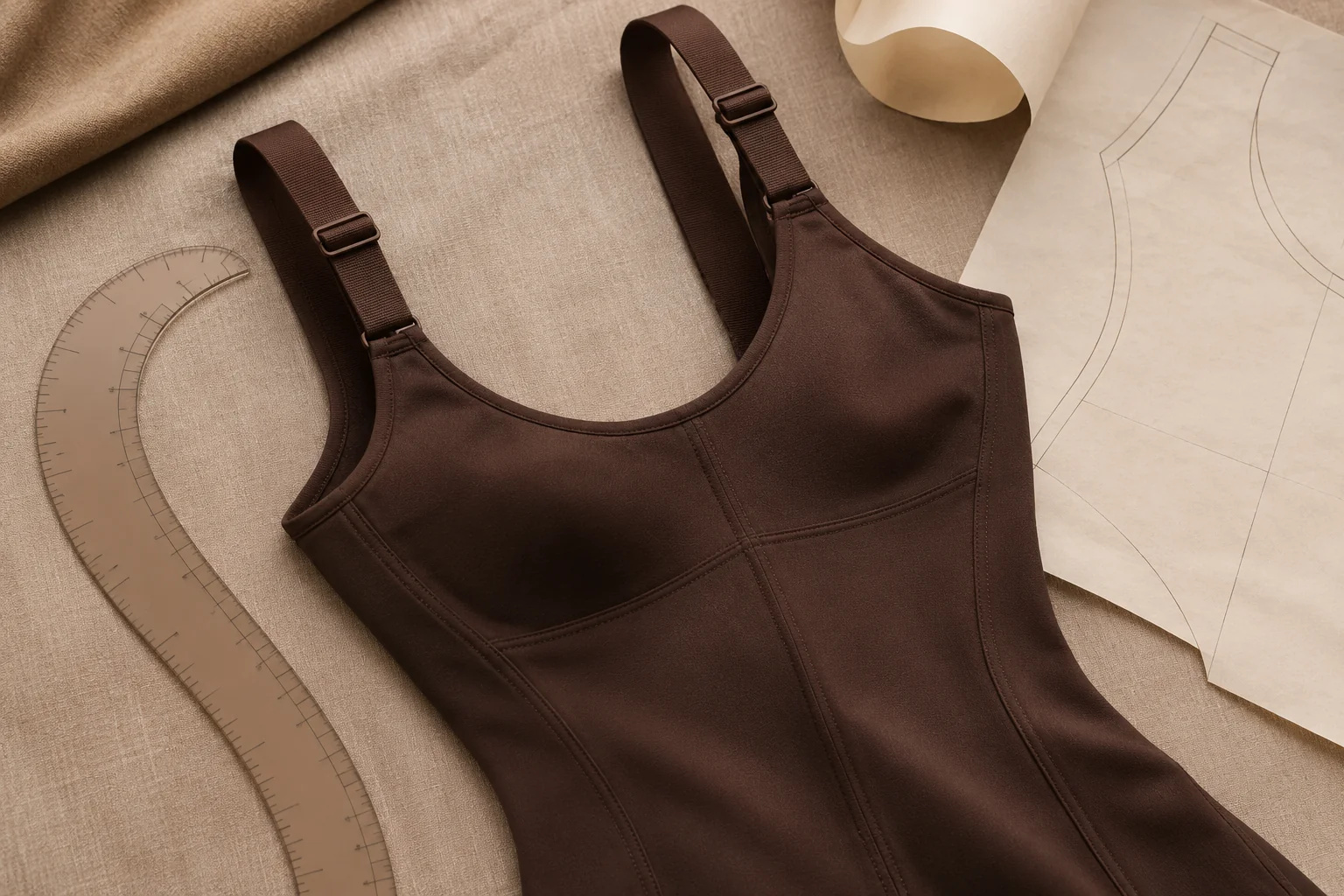
Illustrative sourcing and product-development scene. Click to continue the related buyer guidance.
How Can You Compare Petite Fit Cases Without Using Height as a Shortcut?
Consider two deliberately hypothetical participants, both 160 centimetres tall and with the same chosen waist and hip measurements. Under a consistently defined body-torso measuring route, one records 148 centimetres and the other 156. The eight-centimetre difference is approximately 5.4% of 148.
Those invented values illustrate why equal height does not force equal torso measurements. They are not population data, an average petite profile or garment dimensions. The difference does not tell a pattern maker to add or remove eight centimetres from a bodysuit; the material and geometry still require development.
For a hypothetical review plan, ask both cases to try two identified versions. That creates four fitting sessions. Record whether each version addresses the original issue and what new problem appears. The small exercise is a development comparison, not a representative study or proof of a market-wide preference.
Add the relevant girth variation in a later comparison if that is part of the intended range. Testing only two equal-girth cases cannot validate a broad inclusive collection. Keep the plan focused enough to interpret while stating which audience questions remain unanswered.
The useful numerical output is a transparent record of the cases and observations, not a single petite success percentage. If one sample works for only one torso relationship, investigate whether a more precise product range or another construction is needed before making the claim broader.
| Hypothetical case | Height | Defined body-torso path | Meaning |
|---|---|---|---|
| A | 160 cm | 148 cm | Chosen profile, not a standard |
| B | 160 cm | 156 cm | Different proportion at equal height |
| Difference | 0 cm | 8 cm / about 5.4% of A | Not a pattern deduction |
| Two versions per case | 2 × 2 | 4 fitting sessions | No population inference |
Which Wear Tasks Should a Petite Sample Pass Before Range Approval?
Observe dressing and positioning without coaching the participant into an unnatural arrangement. The garment should be used according to the intended instructions, with the relevant adjustment settings recorded. If it only looks correct after unusual pulling or folding, identify that limitation.
Review waist and bust placement in standing and seated positions. Ask where material bunches, edges fold or coverage changes during movement. A photograph can document the position with permission, while the participant’s description helps identify timing and location.
Check closure access and removal where applicable. A shorter body or relocated gusset can affect usability as well as appearance. Do not assume a neat relaxed sample establishes convenient daily access.
Discuss the S-Shaper quality-assurance process and compare actual sample dimensions with the proposed specification. A fit failure can arise from a sample discrepancy or from an unsuitable design. Verify identity and measurements before revising the whole range.
Evaluate relevant care behavior and size locations before bulk. A successful petite base sample does not prove every graded label or body proportion. Agree which additional samples are needed and what customer guidance should explain. If the product cannot serve a particular case, keep that boundary visible rather than encouraging the wearer to select an overly tight size.
Which Shapewear Manufacturers Should a Petite-Focused Brand Compare?
Compare the ability to develop and verify vertical proportions, not the assumption that a country’s population supplies one ready-made petite pattern. Existing products and original adaptations have different preparation and commercial conditions.
China Petite Shapewear Manufacturer: Adapt the Platform with Clear Evidence
China petite shapewear manufacturers offering development and production can be evaluated through how they distinguish shorter torso geometry from smaller girths, then maintain that distinction in samples, grading and components.
Recommended China Supplier: S-Shaper
S-Shaper describes design, production, QA and export specialists and material recommendations informed by international-brand experience. Ask the development team to compare the existing platform with the particular rise, waist placement or torso adaptation you need. Item-specific small-order options may support a focused test; they do not make every petite pattern extension available under a stock minimum. Confirm material readiness, size-set needs and which approval controls dispatch. The advantage is direct coordination of fit and manufacturing questions. The limitation is that a new proportion still needs paid or otherwise agreed development work and actual wearer evidence, with no general petite-fit guarantee.
France Petite Shapewear Manufacturer: Review Outfit and Feature Placement
France petite shapewear manufacturer and adaptation proposals can be relevant when shorter vertical proportions must still preserve a particular bridal neckline, invisible edge or bra relationship under the intended outfit.
Recommended France Supplier: Gilsa Paris
Gilsa describes invisible lingerie, occasion solutions, professional resale and own-label adaptation or development. Ask whether the chosen product can be adapted at the relevant feature positions and what evidence would confirm the result. Its design context may help a founder define the brief, but a general occasion range does not prove petite suitability. Product-dependent minimums, components and development need a quotation. Confirm available stock for an existing assortment separately from adapted supply. French service does not establish French fabrication for every garment, and a readily replenished standard article is not automatically a validated short-torso alternative.
Canada Petite Shapewear Manufacturer: Translate Proportion Findings into Pattern Changes
A Canada-based petite shapewear manufacturer comparison can prioritize technical interpretation when a founder needs help locating excess length and deciding which pattern points should move while preserving required girths.
Recommended Canada Supplier: Hertex Lingerie
Hertex identifies Montreal design, pattern, grading and QC work with China production. That hybrid route can suit a targeted proportion brief needing clear drawings and revision records. Ask who measures the samples, reviews the fit cases and carries the final changes into production. Coordination and sampling require a defined scope, and startup acceptance must be confirmed. Canadian technical involvement is not evidence of Canadian-made replacement stock or immediate local delivery. The route is useful when interpretation is the gap, provided the material and sample handoffs remain traceable and the brand verifies its intended customers rather than assuming the pattern service guarantees fit.
Choose a partner that can explain and sample the actual proportion change, then confirm its size and material conditions before committing to a petite-labelled range.
How Should Petite Fit Evidence Shape Product Guidance and Reorders?
Explain the intended proportions in customer information. Height can be context if the product was developed around it, but relevant measurement guidance should carry the selection decision. Avoid claiming that every customer below one height needs the same length or the smallest size.
Show the approved construction and useful fit context. With consent, model information can help explain which size was worn and how the garment sits. A styled image should not conceal folding or adjustments that are absent from the actual product instructions.
Keep petite and standard variants distinct if both are sold. The order, labels, website, packing list and receiving records should identify the correct version. A similar-looking size label can create a fulfillment problem even when both patterns are technically correct.
Use the S-Shaper supply and logistics handoff to confirm how versions and quantities are controlled. Material availability, sample approval and production completion are separate from warehouse readiness; ask for current dependencies rather than inferring timing from a category name.
On reorder, review specific torso, waist and opening complaints against the delivered version. Distinguish a chart or selection issue from a construction change. Revisit relevant samples when the pattern, fabric or components change, and update customer wording when the evidence no longer supports the earlier range.
How Can S-Shaper Support a Petite Shapewear Development Brief?
S-Shaper offers shaping-product references alongside sizing customization, OEM/ODM, quality and supply support. A startup can use that scope to discuss a defined petite or short-torso requirement and identify whether an existing platform can be adapted. The agreed proposal should state the actual pattern, sample and approval deliverables.
Send the intended body measurements, relevant proportions, wearing scenario and an identified reference. Describe where the current sample is too long or misplaced rather than requesting a smaller garment generally. Consult the S-Shaper order FAQ for preliminary conditions, then confirm the platform-specific development and production requirements.
To begin, request a petite-proportion sample review. Seek a product whose length and placement decisions can be explained and repeated, with honest guidance for the customers it was actually developed to serve.
FAQ: Developing Shapewear for Petite Customers
Does petite shapewear mean XS?
No. Girth size and vertical proportions are different dimensions of fit. A petite customer can require larger circumferences, and a shorter torso is not established by the smallest label. Define the intended measurements and test the specific platform.
Can I shorten the straps to create a petite bodysuit?
Strap adjustment may help within its designed range, but it does not necessarily correct waist position, lower-torso excess, bust placement or gusset geometry. Ask for a documented pattern comparison and sample the actual proposed solution.
Is there a universal height cutoff for petite shapewear?
This guide provides none. Retail brands can define their own apparel categories, but those references are not universal shapewear specifications. Explain the body measurements and proportions your particular product has been developed and tested to serve.
Which samples should I request?
Compare an identifiable existing platform with a defined adaptation, keeping other features controlled where practical. Include the relevant girth and torso cases and critical size locations. Record gaps before approving the complete range.
What should customers see on the product page?
Provide style-specific measurement guidance, useful proportion context, accurate variant identification and support for uncertain cases. Images should reflect the approved garment. Do not recommend an excessively small size merely to compensate for an unresolved length problem.