 EN
Quick Answer
A low MOQ shapewear manufacturer offers an order condition that must be interpreted alongside the product and work included. Ask whether the minimum refers to available stock, branding an existing platform or a more customized garment, and whether it is counted by style, color, size or component. “Low” is relative to your project; the headline number does not describe the whole commitment.
Before ordering, obtain an acknowledged variant matrix and a current proposal covering samples, changes, branding and delivery responsibilities. A smaller garment order can reduce inventory exposure, but it does not remove fit validation or create universal access to every custom option. Choose the smallest scope that still delivers a credible product for your intended customers.
What Does Low MOQ Actually Mean for a First Shapewear Order?
MOQ means minimum order quantity, but the important question is the unit being counted. A supplier can describe a minimum across an order, per style, per color or by another component of the project. Those definitions are not interchangeable. Request the actual rule for the selected product and the work you need rather than comparing several unexplained totals.
Separate garment quantity from the full project commitment. Labels, packaging, fabric sourcing or other custom components may have independent conditions. A small garment order can therefore coexist with a larger component purchase. Ask who owns unused components, how they are stored and how they can be used on a later order.
Check whether the statement describes a sample or commercial supply. One garment sent for evaluation does not automatically establish a one-piece private-label production program. Equally, an available-stock trial may be a useful route even when it provides fewer changes. The founder needs to understand which decision the offer supports.
Define what an affordable minimum means for your startup. Consider the goods value, variants, unquoted work and ability to learn from the first order. A low number can still produce an unsuitable assortment if the product fails the wearer need. The goal is manageable exposure to a credible product, not the smallest count regardless of scope.
| Headline phrase | Clarification needed | Possible consequence |
|---|---|---|
| Small trial order | Sample or commercial stock? | Different approval and branding scope |
| Low minimum per item | What identifies an item? | Style/color basis affects total |
| Mixed sizes accepted | Which sizes and allocations qualify? | Variant plan still needs acknowledgment |
| Custom branding available | Which components and minimums? | Separate component commitment may apply |
Ready Stock vs Private Label vs Full Custom: How Do Minimums Differ?
Available stock begins with garments that already exist under a defined specification. Confirm the selected item, size availability and any permitted presentation changes. This can support a market test when the product is suitable, but the availability of stock does not prove a future reorder or a right to replace branding without agreement.
Existing-platform private label adds your own brand under a scoped arrangement. Ask which logo, label or packaging changes are offered and how each is approved. A supplier may be able to combine a small garment order with certain branding options while requiring a different commitment for others. Review the customization service options as discussion topics rather than an all-inclusive package.
Deeper custom development can involve new patterns, materials, colors or construction. Those choices add technical and procurement decisions. The S-SHAPER OEM/ODM page distinguishes production from a client design and concept-led development, but it does not establish that every development route shares the same minimum. Ask how your essential changes affect the proposed condition.
Choose the route after evaluating the customer need. If an existing platform works, a focused branded trial may be sensible. If it cannot meet an essential fit requirement, the smallest available order may be a false shortcut. Ask for alternatives that reduce optional complexity while preserving the product benefit you need to validate.
| Route | Starting product | Minimum questions |
|---|---|---|
| Ready stock | Existing specified garment | Available sizes, units and permitted branding |
| Existing-platform private label | Suitable platform with brand presentation | Style/color rules and component commitments |
| ODM development | Concept or significant revisions | Material, pattern, sample and production conditions |
| OEM production | Buyer-defined design | Readiness of inputs and applicable production scope |
What Do S-SHAPER’s Public Small-Order Statements Tell You?
The S-SHAPER FAQ mentions an initial 10-piece-per-item testing option, while individual products display their own quantity tiers. Treat these as product and service context that needs clarification. The public information does not establish that every garment, custom color or new construction can begin with 10 pieces.
Ask the team to identify the exact platform and minimum basis applicable to your inquiry. If a proposal uses the word item, request an example based on your style and variant direction. Ask whether the same conditions apply after adding labels, custom packaging or material changes. The written answer should be specific enough to place beside your order matrix.
Use the catalogue to select the reference. A shaping brief and a built-in shaping dress are different garments with different public quantity tiers. The S-SHAPER product range can help organize the conversation, but a broad category page cannot confirm current stock or the scope of your customized order.
Preserve the dated source and the current response. A website statement can be useful preliminary research, while your transaction should rest on the proposal acknowledged for the chosen product. If the conditions differ from the headline you first found, ask for the reason. The relevant question is whether the offered route supports your project, rather than which isolated number was lowest.
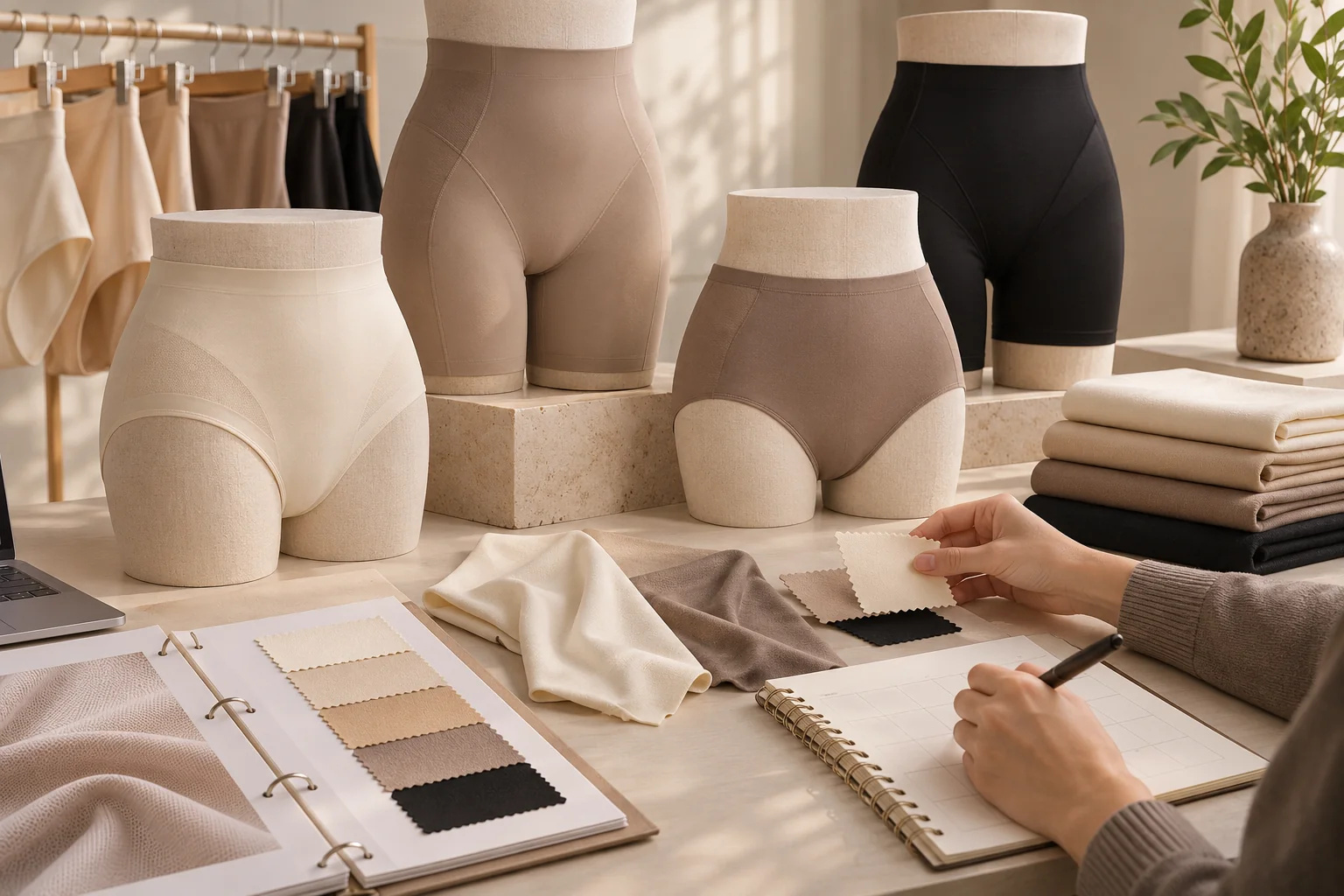
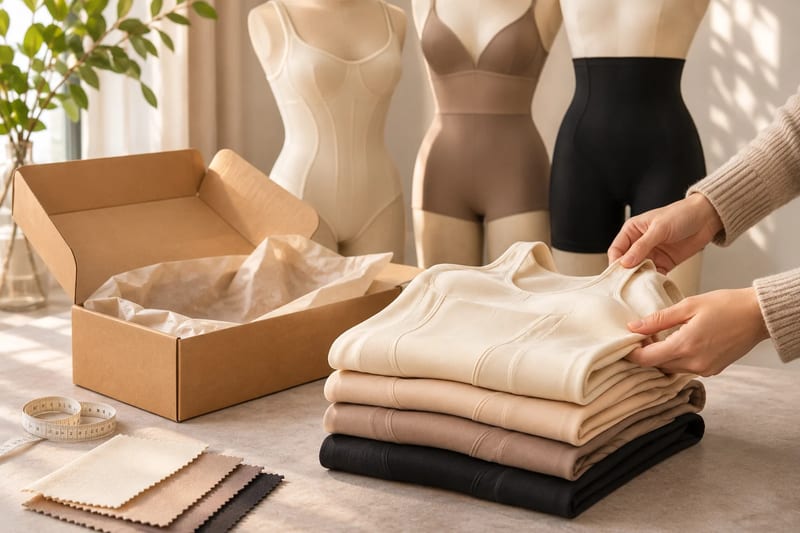
Illustrative sourcing and product-development scene. Click to continue the related buyer guidance.
Low MOQ vs Consumer Pricing: What Does a B2B Range Really Include?
Low MOQ describes a quantity condition within a defined supply route, not a guarantee that a consumer garment can be reproduced at the lowest wholesale listing price. The channel observations below distinguish the retail layer from B2B, while keeping ordinary seamless products and structured fajas apart. Ask which quantity and work actually qualify.
| Channel / buying model | Observed USD per garment | Product and order basis |
|---|---|---|
| Amazon US retail bodies | $12.38–$35.14 | Seamless/lighter bodies $12.38–$19.99; Structured bodies $35.14–$35.14. |
| Value/mid-tier brand DTC bodies | $29.99–$49.00 | Shapermint/Shapellx sale prices; no multi-pack or order code |
| TikTok Shop US bodies | $21.99–$54.99 | Seamless/lighter bodies $21.99–$46.99; Structured bodies $39.99–$54.99. |
| B2B small-order platform bodies | $3.18–$10.00 | Tianchen, Junmao and S-Shaper; listed minimums 5/2/10; not deep-custom eligibility |
| B2B higher-volume platform bodies | $2.50–$12.85 | Listed minimums 100–600; different garments, not a same-SKU volume discount |
US-facing USD single-garment observations reviewed November 10, 2026; variants, retail promotions and shipping/tax differ. Amazon uses May–October 2026 tracker snapshots, not live November checkout. These selected samples are not industry averages or matched constructions. B2B advertisements are not landed costs or final custom quotes. Deeper development needs separate specifications, deliverables and an itemized quotation.
B2B is usually cheaper per piece because a buyer commits inventory and handles more downstream selling, but standard finished bulk goods and deep customization have different preparation needs. Consumer brand premiums and promotions do not determine your MOQ. Request the accepted matrix, available materials, branding conditions and exclusions from S-Shaper. A smaller order can be a useful test even if its final scoped price exceeds a large-volume reference. Approve the product and total commitment the business can manage rather than treating the table’s lowest observed amount as permission to order any custom style in any mix.
This profile concerns everyday platforms. Structured fajas require a separate specification; new patterns, materials and deeper customization are not assumed included in ready-made bulk supply.
How Can a Low Total MOQ Still Create a Difficult Variant Plan?
Count the combinations before allocating inventory. One style in two colors and five sizes creates 10 SKUs. At 100 units total, an equal allocation would average 10 units per SKU. That arithmetic does not recommend an equal split; it shows why a small total can still require several distinct stocking decisions.
Ask the supplier to acknowledge the proposed matrix. If the minimum is per color or if certain sizes have separate conditions, the total can change. Do not rely on a general assurance that mixing is possible without identifying the mix you want. Keep the supplier rule and your allocation rationale in different fields so both can be reviewed.
Preserve the size coverage essential to the audience. A startup targeting a particular fit problem should not remove the relevant sizes merely to fund more optional colors. Consider reducing style or color breadth first, then test whether the remaining platform genuinely serves the customer. A small order should still be a coherent brand offer.
Use customer research and sample results to guide the split, while acknowledging limited evidence. A pilot may reveal that your first allocation was wrong; that is a reason to learn and revise rather than claim a universal size ratio. The most useful minimum is one that permits an informative test without requiring assumptions to masquerade as demand data.
| Illustrative setup | Calculation | What still needs confirmation |
|---|---|---|
| One style, two colors, five sizes | 1 × 2 × 5 = 10 SKUs | Which combinations qualify |
| 100 units across 10 SKUs | Average 10 per SKU | Actual allocation, not an equal-split rule |
| Additional optional color | 1 × 3 × 5 = 15 SKUs | Color minimum and cash exposure |
| Scope | Arithmetic example only | Not a supplier MOQ promise |
Which Shapewear Manufacturers Should You Consider for a Low-MOQ First Order?
Compare shapewear manufacturers in China, the USA, France and Turkey for a manageable minimum order. The recommendations below connect country-level capabilities with specific suppliers and the work your brand needs.
China Shapewear Manufacturer: Match the small-order condition to the garment
China shapewear manufacturers may offer several entry routes, so connect the requested small quantity with an existing platform, permitted changes and component conditions before budgeting the trial.
Recommended China Supplier: S-Shaper
S-SHAPER offers a direct manufacturing discussion supported by design, QA and export specialists and recommendations on materials and functions. Its OEM page mentions batches starting at 50, while the FAQ describes initial 10-piece-per-item testing. That creates useful questions about which existing platform can meet your brief with limited commitment.
It does not establish full custom production at ten pieces. Ask for the accepted size-color matrix, branded-component requirements and a current scope. A current item-specific proposal should identify the complete product and preparation commitment. This route suits founders seeking their own product presentation with support translating a wearer need into manufacturable decisions. See S-SHAPER OEM/ODM and global-brand support, S-SHAPER item-testing MOQ and stock/bulk conditions.
USA Shapewear Manufacturer: Test an assortment through confirmed wholesale stock
A USA shapewear manufacturer search can lead to wholesale stock that suits a resale trial; verify order conditions and origin rather than assuming domestic custom production.
Recommended USA Supply Partner: Vedette
Vedette’s catalogue selection and dedicated B2B support can help a boutique or online reseller investigate available styles and sizes. When the right garments are held within the required delivery route, stock-based replenishment can be more relevant than commissioning a new pattern for the first test.
Confirm actual availability, dispatch and commercial entry conditions; no universal US wholesale minimum is established here. US-facing service does not prove US manufacture or allow relabeling automatically. This alternative fits a resale-led pilot, while a founder needing private label should request explicit permission and a separate proposal before comparing it with factory supply. See Vedette US-facing wholesale program.
France Shapewear Manufacturer: Weigh product relevance against development commitment
For France shapewear manufacturers and own-label developers, an existing occasion-led solution may reduce new design work, while product-dependent minimums still require a scope-specific proposal before ordering.
Recommended France Supplier: Gilsa Paris
Gilsa’s professional assortment and own-label services offer two paths for an occasion-focused brand. Existing invisible-lingerie solutions may address bridal or neckline needs without starting every feature anew; adapted or specific development can be discussed when the available platform falls short.
Its own-label minimum depends on product type, and development or packaging needs a quote. The advantage is design relevance to the wearing context, while the trade-off is a potentially broader preparation commitment than buying finished goods. Ask which route preserves the essential benefit at the smallest feasible scope, rather than assuming a French contact defines the production origin. See Gilsa Paris professional resale and own-label development.
Turkey Shapewear Manufacturer: Ask whether integration supports your actual small scope
Turkey shapewear manufacturers with seamless capability provide another production route to investigate, but a small first order still depends on yarn, color and construction compatibility.
Recommended Turkey Supplier: SML Seamless
SML describes integrated private-label seamless shapewear production, including yarn-to-packed operations. A buyer whose first product fits that platform can investigate coordinated manufacturing and dedicated communication instead of assuming that only one sourcing region offers technical capability.
The minimum and color-batch conditions still require a direct proposal. An integrated plant is not evidence that every custom change is economical at a small quantity. Compare the material, finish and grading in a relevant sample, and simplify optional features only when the revised product still solves the intended customer problem. See SML Seamless integrated private-label manufacturing.
Choose the smallest confirmed arrangement that preserves the product test, including component and development commitments rather than only finished-piece count.
What Should Be Approved Before You Place a Small First Order?
Validate the physical garment against the intended wearer need. A smaller quantity reduces inventory exposure but does not remove fit, care or use questions. Identify the sample’s size, material and construction, and confirm whether it represents the proposed production version. Discuss unresolved changes before approving supply.
Agree the relevant quality checks through the quality-assurance discussion. Keep measurements, seams, labeling and quantity accuracy tied to the approved reference. A pilot order is most informative when you know whether feedback concerns a consistently produced product or a discrepancy from what was agreed.
Confirm payment and delivery responsibilities in a current quotation. Review the logistics scope and ask what packing and receiving information will be available. A small garment count does not make shipping arrangements self-explanatory. The final budget needs the actual destination and handover responsibilities.
Finally, define the pilot’s next decision. Which wear feedback, size questions or purchasing observations will inform a reorder? Set a review point and identify what could justify another quantity or a revised platform. Low MOQ is valuable when it supports a disciplined test and preserves resources for the changes that test may reveal.
How Can S-SHAPER Help Clarify a Low-MOQ Shapewear Proposal?
S-SHAPER’s public FAQ, product listings and OEM/ODM services provide starting points for a small-order discussion. The useful request identifies one garment, the intended wearer and the changes needed. Ask the team which available route matches those requirements and what minimums apply to the actual variants and components.
Share the launch market, preferred style, size direction, colors, branding and approximate total quantity. Ask for an acknowledged matrix, sample route and quotation that separates included work from additional commitments. The factory introduction provides manufacturing context, while the proposal establishes the order you are evaluating.
To begin, request an item-specific low-MOQ proposal from S-SHAPER. Compare the smallest feasible scope with your customer evidence and product promise. A clear answer should help you decide what to test first without implying that every custom garment can be made under one universal minimum.
FAQ: Low MOQ Shapewear Manufacturing: Understand the Order Conditions
What does a low MOQ shapewear manufacturer offer?
It offers a quantity condition for a particular product and service route. Confirm whether the minimum is per order, style, color, size or component and what customization is included. The headline count alone does not describe a complete first-order commitment.
Can a small MOQ include my own branding?
Possibly, depending on the product and branded components. Ask which label, logo and packaging options qualify and whether they have separate minimums or preparation work. Do not assume every available-stock trial automatically permits relabeling.
Does S-SHAPER’s 10-piece testing statement apply to all products?
The public FAQ mentions an initial item-testing option, while product pages show different tiers. Confirm the exact garment, variant basis and customization directly. The statement should not be expanded into a universal promise covering every fully custom design.
Is a higher unit price acceptable for a small first order?
Evaluate the total commitment and the information the pilot can produce. A lower bulk price may require substantially more inventory. Use actual product-specific quotations and demand evidence rather than treating the deepest discount as the right startup decision.
What should I send in a low-MOQ inquiry?
Send the garment reference, essential changes, target wearer and country, approximate quantity, size and color direction and branding needs. Ask for an acknowledged order matrix and a sample route. Identify unknowns so the supplier can explain the feasible scope rather than guess it.