 EN
Quick Answer
Choose the first support level by the customer’s wearing problem, the garment platform and evidence from relevant samples. Light, medium and firm are ordinary product descriptions that need a clear meaning within your own collection; they are not automatically comparable across brands or medical-pressure categories.
For an everyday launch, compare dressing, movement, coverage, positioning and the intended shaping experience before deciding which version to order. Do not assume the firmest sample creates the strongest commercial proposition or that a lighter garment needs less fit development.
A startup can begin with one well-defined support proposition and add another after the product and customer evidence justify it. Approve the actual material, pattern, zones, components and guidance together. The best first choice is the version your audience can understand and use as intended, with a manageable assortment and repeatable supply.
What Should Light, Medium and Firm Support Mean in Your Own Collection?
Write the customer experience in plain language before assigning a label. A product might offer gentle smoothing under daily clothes, a more structured feel for a defined occasion or stable positioning in particular regions. Those descriptions need the garment and use case behind them.
Established brands use their own systems. SKIMS currently presents Light, Mid, Strong and Extra Strong filters and distinguishes collections by construction and intended experience. That is a brand-defined merchandising example, not an industry test scale or proof that your medium equals another brand’s Mid.
Avoid creating false precision. Three support labels do not establish three measured pressure bands. A fabric-force result under defined conditions is also not a clinical garment-pressure rating. Use ordinary shaping language that the actual evidence can support.
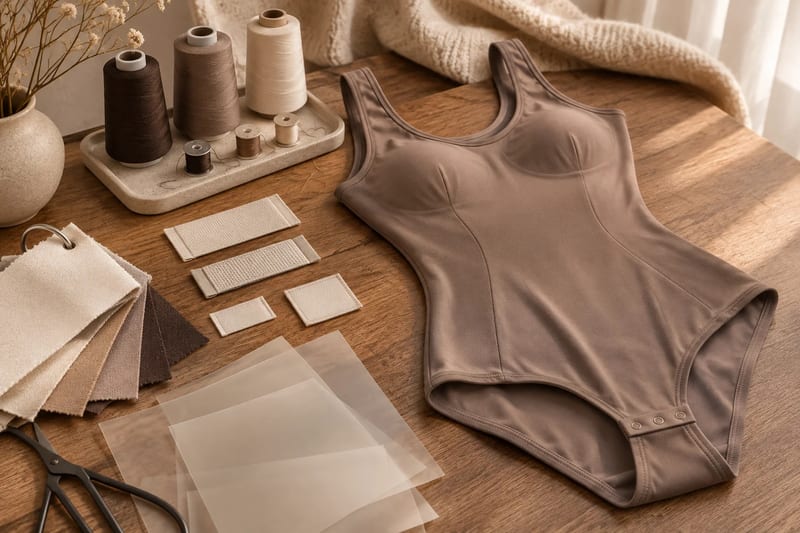
Ask S-Shaper’s material and function customization team what would physically distinguish the proposed options. It might involve material response, panel coverage, knit architecture, pattern or components. The difference should be documented rather than created only by changing the hangtag.
Keep the names consistent across the chart, product page and support replies. If one label means a broad all-over feel and another means a localized region, explain that distinction. Customers should not have to infer the product’s construction from a ladder of increasingly dramatic adjectives.
| Proposed description | Question to define | Evidence needed |
|---|---|---|
| Light support | What smoothing and movement experience? | Platform and relevant wear observations |
| Medium support | What changes from the lighter proposal? | Identified construction comparison |
| Firm support | Where and how is the structure different? | Material, zone and usability evidence |
| Medical-pressure language | Is separate appropriate substantiation available? | Do not infer from ordinary support labels |
Light vs Firm Shapewear: What Does a B2B Buyer Need to Compare?
Compare the complete proposition rather than a winner by intensity. A more structured assembly can address a particular customer goal while requiring another dressing, coverage or component review. A lighter assembly can suit another wearing requirement but still need stable edges and reliable recovery.
Use the same relevant body cases and identify the actual material and pattern. If two samples differ in coverage, closure and fabric, they are different products rather than a clean experiment in support level. That broader comparison can be useful if it is described honestly.
Review entry and removal. A garment’s appearance once positioned does not establish convenient use. Ask whether the intended customers can follow the instructions and access the closure or bathroom arrangement as applicable without an improvised workaround.
Review what remains visible under the intended outfit. Seams, panel boundaries and edges can matter as much as the general shaping sensation. A firm label cannot compensate for an unsuitable construction under the clothing the customer actually plans to wear.
Do not recommend a smaller size merely to simulate a firmer version. That changes openings, coverage and placement as well as tension. Develop the intended support through the accepted product and sizing system, then explain which version suits which use rather than treating tightness alone as proof of value.
| Buyer comparison | Lighter proposal | More structured proposal |
|---|---|---|
| Primary goal | Defined daily smoothing or movement need | Defined shaping or positioning need |
| Usability | Verify entry, movement and edge stability | Verify entry, movement and localized restriction |
| Construction | Identify actual material and zones | Identify panels, closures and components |
| Appearance | Check the intended outfit | Check bulk and boundary visibility |
| Fit | Validate relevant body cases | Validate relevant body cases; no size-down shortcut |
How Should the Product Platform Shape the Support-Level Decision?
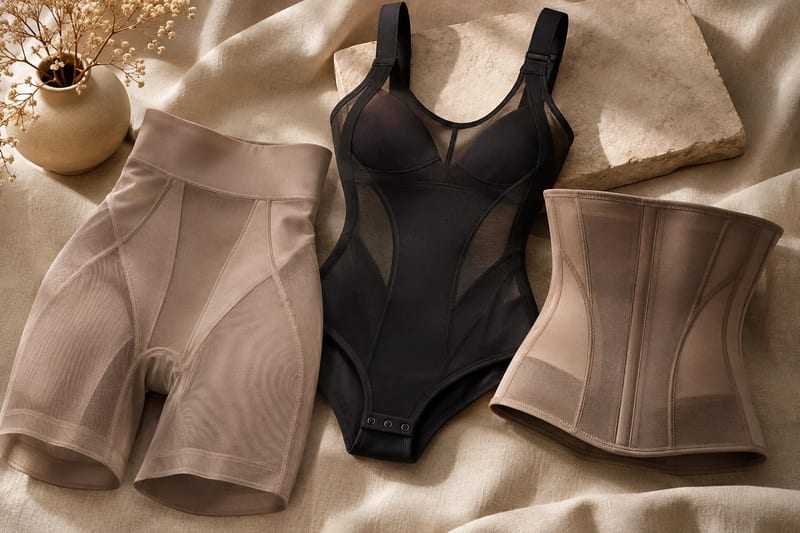
Begin with the coverage and task. A shaping brief, short and body place support and openings differently. A support description that makes sense for one platform can be misleading on another if it hides which body regions the product actually covers.
Use S-Shaper shaping-product references to create a focused shortlist. Identify the customer problem each platform might solve and the construction features that must be retained. Avoid launching several unrelated silhouettes simply to populate every support category.
Ask whether an existing suitable platform already offers the desired experience. A startup may need a scoped material or presentation adjustment rather than new architecture. Conversely, an unsuitable torso or opening should not be accepted simply because its support label matches the marketing brief.
Discuss options through the S-Shaper OEM/ODM route. Request a distinction between available-platform supply, light customization and new product development. Material procurement, pattern changes and components may introduce different samples and quantity conditions.
Keep the target market in context without stereotyping. Customers in the US, UK, Europe or other markets can have different occasions and proportions within the same country. Define the actual audience and fit cases instead of assuming that a national market always prefers one firmness level.
Illustrative sourcing and product-development scene. Click to continue the related buyer guidance.
What Evidence Should You Request Before Choosing the First Version?
Identify the sample construction, body chart and relevant size range. A support-level comparison is difficult to interpret if the sample material or fit recommendation is unknown. Keep body dimensions and garment measurements as separate records connected through fitting.
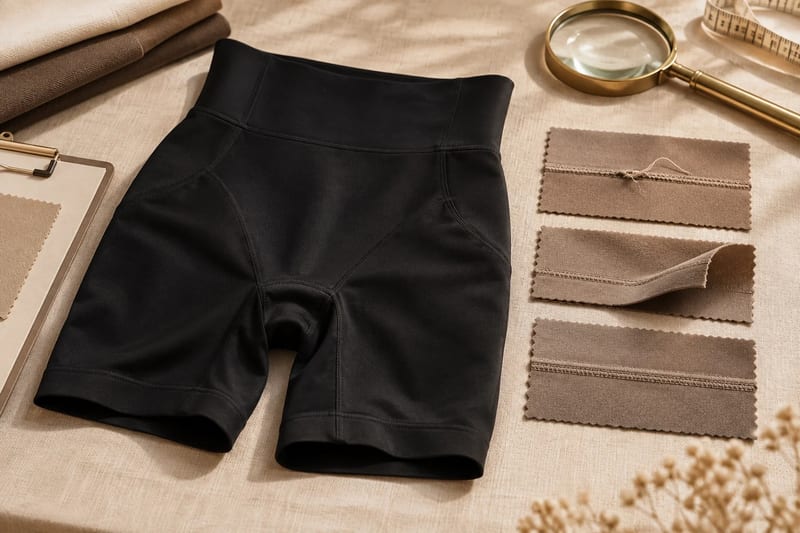
For material questions, ask a qualified laboratory or technical team to select appropriate comparisons. ASTM D4964 concerns elastic-fabric tension and elongation under stated conditions. Comparable setups matter; the public scope is not a complete laboratory procedure or a universal requirement for your product.
Review the actual garment during intended tasks. Record positioning, coverage, dressing, movement and localized discomfort with the sample and body case. Preserve observations instead of reducing everything to one firmness score that conceals a failed closure or edge.
Discuss S-Shaper’s quality-assurance process and the care-state evidence needed for the assembly. The first wearing impression can differ from the product after the relevant treatment. Confirm material recovery, attachment and dimensions as appropriate to the platform.
Define the decision before gathering more samples. Which finding would reject a version, justify a targeted change or support the next size-set stage? A clear decision plan helps a startup avoid buying a succession of attractive samples without learning which version it can responsibly launch.
| Evidence record | What to retain | Buying decision |
|---|---|---|
| Product identity | Material, pattern, components and sample | Know what the label describes |
| Mechanical comparison | Method, conditions, units and specimen | Assess a defined material question |
| Wear record | Body case, task and location | Check the complete proposition |
| Care review | Treatment and sample state | Assess relevant continuity |
| Disposition | Approve, revise or unresolved | Authorize a specific next step |
How Does Launching Several Support Levels Change Inventory Complexity?
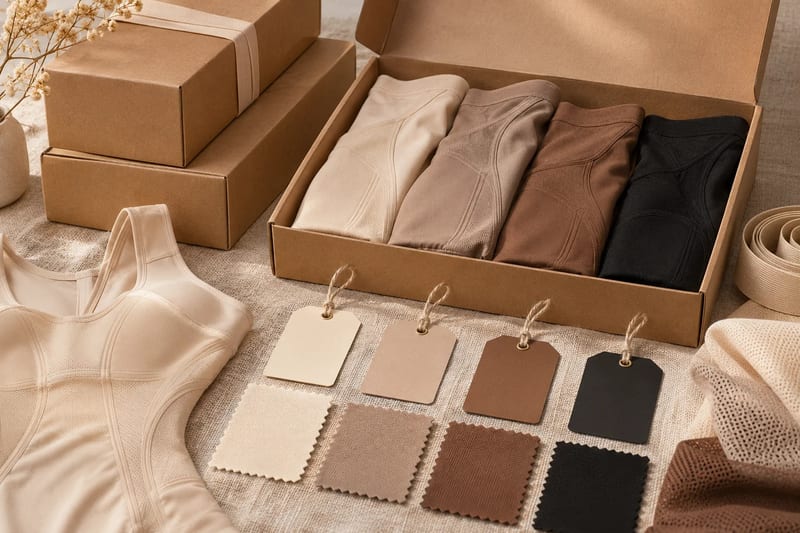
A support variant is an operational product decision, not only a filter on a website. It can require distinct materials, components, samples, labels and picking records. Confirm whether it creates a new physical article and what conditions apply to each version.
For a deliberately hypothetical assortment, one platform in two colors and five sizes creates ten combinations at one support level. Offering three support levels under the same color and size structure creates 30 combinations. These are chosen counts, not a recommended range or proof that a supplier accepts the matrix.
At an invented total commitment of 180 pieces, an equal allocation would average 18 per combination for the single-level range and six for the three-level range. That demonstrates shallower depth under a fixed total, not demand by size, a sales forecast or a universal inventory recommendation.
Actual allocation should follow your evidence and the available commercial program. A second support version may be worthwhile, but it should answer a distinguishable customer need. Ask whether the new option also requires separate material or component purchasing that exceeds its garment quantity.
Keep the initial offer easy to explain. A founder who cannot describe why a customer should choose one level over another may need more product work before funding three versions. A focused first range can provide clearer feedback for a deliberate expansion rather than turning every early preference into another SKU.
| Hypothetical range | Combinations | At chosen 180 total pieces if equal |
|---|---|---|
| 1 level × 2 colors × 5 sizes | 10 | 18 per combination |
| 3 levels × 2 colors × 5 sizes | 30 | 6 per combination |
| Interpretation | Three times combinations | One-third average depth |
| Limitation | Not a size ratio or supplier offer | No demand or sell-through prediction |
Which Shapewear Manufacturers Should You Compare for the First Support Level?
Compare the route behind the support proposition: original development, an adaptable platform or a finished assortment for resale. Country alone does not establish a shared support scale, a customer preference or a manufacturing quality ranking.
China Shapewear Manufacturer: Scope One Clear Support Proposition
China shapewear manufacturers offering product and material development can help connect a first support concept with an actual platform, identified components and the size evidence needed for a focused launch.
Recommended China Supplier: S-Shaper
S-Shaper’s design, production, QA and export specialists provide a route for discussing material and function recommendations informed by work with international brands. Ask the OEM/ODM team what makes the proposed level physically different and which available platform can test it. Applicable low-quantity programs depend on the item and changes; three support variants do not automatically share one minimum. Confirm material readiness, samples and component approvals before dispatch planning. It suits a founder needing practical development and direct manufacturing communication without an unsupported promise that the firmest option will sell best.
USA Shapewear Manufacturer: Evaluate an Existing Assortment’s Support Language
A USA shapewear manufacturer shortlist should separate domestic fabrication from US-facing wholesale distribution when the founder is comparing existing support propositions and local replenishment rather than commissioning original materials or patterns.
Recommended USA Supply Partner: Vedette
Vedette offers wholesale catalogue selection and B2B support. Ask for style-specific construction, chart and current availability before deciding which article serves the target occasion. Confirm where stock is held and what delivery or replenishment arrangement actually applies. US-facing service does not establish US manufacture or private-label rights. This route can suit a curated resale model, while the support names remain those of the actual products. An original brand-level architecture or new fit requires a separately confirmed development service.
France Shapewear Manufacturer: Start with Occasion and Outfit Requirements
France shapewear manufacturer and adaptation proposals can be relevant when the first support choice depends on bridal coverage, difficult necklines or invisible edges under an outfit rather than an all-purpose firmness hierarchy.
Recommended France Supplier: Gilsa Paris
Gilsa describes invisible lingerie, professional resale and own-label adaptation or development. Its occasion context can help define which construction the customer needs and what the sample must demonstrate. It does not establish that every product suits everyday wear or that a support label is transferable to your collection. Product-dependent minimums, components and development require a quote; existing-stock replenishment differs from adaptation. French service does not prove French fabrication for every article. It suits a precise product brief with clear permission and customer-information responsibilities.
Colombia Shapewear Manufacturer: Compare the Actual Shaping Platform
Colombia shapewear manufacturer comparisons can include specialist finished shaping products, provided the buyer evaluates coverage, usability and fit instead of treating national reputation as a uniform definition of firm support.
Recommended Colombia Supplier: Leonisa
Leonisa identifies Colombian manufacturing and an international wholesale program. Ask for the actual style guidance and available variants, then compare the product on relevant body cases. Wholesale access does not establish OEM control or permission to relabel and alter the range. This route suits a resale assortment whose existing proposition meets the audience’s needs. Confirm stock and replenishment conditions, and seek a separately verified development route if the first collection needs original zone placement or a different support construction.
Choose the route that can supply a distinguishable, validated proposition at a manageable first scope, then expand only when the next support version has a clear purpose.
What Should Be Approved Before You Name and Order the Support Level?
Connect the chosen label to one accepted product record. Include material, pattern, zones, components, size guide, sample findings and care information. A support name should remain meaningful when another team prepares the next order.
Write the customer explanation from the actual construction and use case. Describe coverage, adjustment and intended experience without guaranteeing a body change or medical pressure. Avoid instructing customers to choose a smaller size to obtain a different level.
Confirm production and variant identity. If several levels exist, labels, stock codes and packing information must distinguish them. Use the S-Shaper supply and logistics handoff to align quantities and receiving records with the actual accepted scope.
Require changes to be identified. A substituted fabric or component may alter the basis of the support description even if the garment looks similar. Decide what needs renewed sample, care or fit review before preserving the old label.
After launch, review specific questions about use, fit and expectation. A desire for another level can justify investigation, but it is not automatically evidence to broaden the range. Keep the customer problem, technical proposal and inventory decision connected rather than adding variants as a default response.
How Can S-Shaper Help Choose a First Support Proposition?
S-Shaper’s shaping references, OEM/ODM, customization and quality services provide a starting point for comparing a focused set of support options. A startup can ask the team to distinguish an available product from the work needed for another material or construction. The proposal should state actual samples, requirements and approvals.
Send the target wearer, occasion, coverage, intended measurements and the experience you want to improve. Ask what physically distinguishes each option and which comparison is worth funding first. Review the S-Shaper order FAQ for preliminary conditions, then confirm the selected platform’s quantities and material availability.
To proceed, request a first-collection support and sample review. Seek one understandable product proposition with a repeatable specification, rather than a broad intensity ladder unsupported by the actual samples.
FAQ: Choosing Light, Medium or Firm Support for a First Collection
Should an everyday startup always launch light support?
No universal level follows from the word everyday. Define the audience, tasks, coverage and desired experience, then compare relevant samples. A focused suitable proposition is more useful than selecting a label without evaluating its actual construction.
Are light, medium and firm the same across brands?
Do not assume equivalence. Brands can define their own categories and product relationships. Explain what the labels mean in your actual collection and preserve the supporting material, construction and wear evidence.
Can I assign medical pressure ranges to the levels?
Not from ordinary shaping labels or fabric-force results alone. Appropriate separate substantiation would be needed for the intended application. Keep the customer description within the evidence for the actual garment.
Should I launch all three levels at once?
Assess whether they serve distinct needs and whether you can validate and supply each. More physical variants can multiply combinations, sampling and component commitments. The 10-versus-30 example is hypothetical complexity arithmetic, not an inventory prescription.
What matters before adding another level?
Identify the unmet customer need, the actual construction change, relevant fit and care checks, procurement conditions and variant mapping. Do not create a new label solely by changing marketing wording or asking customers to wear a smaller size.